“Nick,” again

I see the last time I dealt with “nick”–BrE slang for the verb “steal”–was in October 2011, when I categorized it as “On the Radar.” I believe the time has come for a upgrade for full NOOB status. My earlier post included examples only from that fount of Britishisms, the New York Times. But last week, reading the more heartlandy Philadelphia Inquirer, I came upon this sentence, referring to a man who in the 1950s built Roadside America, an 8,000-square-foot model of a mythical village: “He built fire escapes from the family’s curtain rods and nicked his daughter’s dollhouse furniture.”

Of course, the Times continues to use “nick,”most recently in a June 28 theater review, describing a character who “begins to appreciate the convent when she notices that a veil she’s nicked acts ‘like a goddamn spotlight for my cheekbones.’”

“Twig”

New York Times theater critic Ben Brantley is a frequent user of Not One-Off Britishisms, presumably having picked  them up during all the time he spends in London going to plays. In the third paragraph of a review last week of a New York production of Gogol’s The Government Inspector, Brantley referred to an actor “called” (instead of “named”) Michael Urie, which led me to turn on my NOOBs-dar. And sure enough one came along just a few paragraphs later:

Any suspense in the plot as to do with anticipating when, or if, the townsfolk will twig onto Ivan’s true identity…

“Twig onto” was unfamiliar to me, but it seemed to have a distinct British feel. Green’s Dictionary of Slang has a long entry for the verb, with definitions and citations dating from the eighteenth century for four different (similar) meanings: “to observe, to watch”; “to understand, to work out”; “to recognize, to expose”; and “to catch sight of, to become aware of.” Interestingly, the dozens of citation almost all use “twig” alone, rather than followed by “onto,” as Brantley has it. For example, from Alan Sillitoe’s 1958 novel, Saturday Night and Sunday Morning: “Brenda had never the agile mind to twig that he was whiling the days between times away with her sister.”

Green’s suggests the word may have been derived from “twick,” meaning “to jerk,” but Stan Carey has (for me) more convincingly argued for a derivation from the Irish “tuig,” meaning “understand.” The argument is bolstered by the fact that the first citation in Green’s (it’s the “observe, watch” meaning) is from the 1754 play The Brave Irishman, by the (Irish) Thomas Sheridan: “Twig his boots.”

Back to the “twig onto” matter, a search for “twigged onto”  on Google News yields a mere sixteen hits, from an intriguing variety of locations: the U.S., U.K., Australia, New Zealand, and India. But “twigged that” pops up 1,030 times, the overwhelming majority from the U.K. The takeway is that Brantley got it wrong, and should give some thought to the proposition that if you’re going to use a Britishism, you should use it correctly.

“In the Street”

A notable difference in British and American usage can be found in references to streets or roads. We would normally say, “I live on Parrish Road,” while the British would say, “I live in Parrish Road.” This sounds very strange to American ears–as if the speaker were saying they pitched a tent in the middle of a street. That oddness explains (to me) why the otherwise very language-sensitive lyricist of My Fair Lady, Alan Jay Lerner, could not bring himself to call the song “In the Street Where You Live.”

I was therefore surprised to come on this sign in Philadelphia yesterday:

street

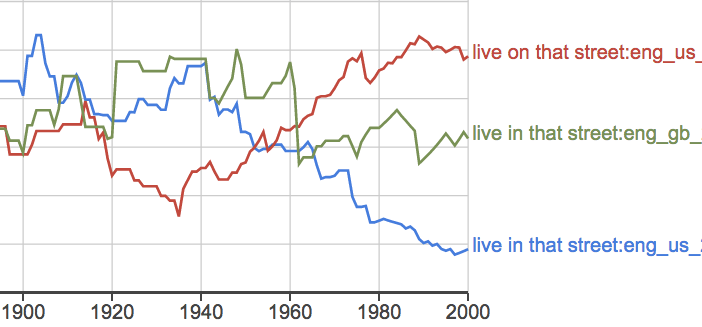
I would have expected it to say “NO PARKING ON THIS STREET.” It prompted me to do some research with the Google Ngram Viewer tool, which produced this graph:

Screen Shot 2017-06-04 at 5.32.06 PM

The three lines represent the relative frequency with which the phrase “live on that street” has appeared in American books (red), and the phrase “live in that street” has appeared in British (green) and American (blue) books. “Live on that street” has apparently never appeared in a British book. (I used “that street” instead of “the street” because “live in the street” has in both countries [I believe] an additional meaning–basically, being homeless.)

The interesting takeaway, for me, is looking back at 1940 or so. Apparently U.S. usage up till that time still followed the British model of “in the street,” after which the “on” phrasing steadily gained popularity, coming out on top in about 1950.

I guess Philadelphia doesn’t change its street signs very often

“Done and done”

I hasten to say this is not a Britishism, at least in the way it’s currently used in the U.S. But it relates to a Britishism, so I reproduce below my post on “done and done” from the Chronicle of Higher Education’s Lingua Franca blog:

I texted my wife the other day asking whether she had walked the dog. She answered, “Done and done.” I was like, “Wait — what and what??”

The truth is, the expression, indicating a task accomplished, did have a bit of a familiar ring to it. Going to Google News, I find these examples just in the last 10 days:

  • “I also believe it’s a particularly good match for the free-weekend treatment. You get in, you hopefully have a good time, and you get out. Done and done.” –Destructoid, on a game called Steep.
  • “First, duh, we just replace the iceberg that the Titanic crashed into with a giant, ocean-based creature. Bang. Done and done.” –article on The Ringer about putting giant animals into classic movies.
  • “Pink suitcases that could fit everything and still be light — done and done. The opportunity to extend the pastel world is so exciting for us.” –Poppy James, of luggage maker Pop+Suki, in Teen Vogue
  • The Princeton University basketball team owns “the spotless 14-0 conference record, and a 17-game winning streak. If this were yesterday, they’d own a bid to the NCAA Tournament, all done and done.”  –NCAA.com

In January, the New York Times television critic James Poniewozik wrote about Donald Trump’s reality-TV-style approach to the issues of the day: “And what does ‘ending conflict of interest’ look like? A lawyer says the word ‘trust’ a bunch of times, and there’s a big pile of documents. Done and done!”

These and other examples comprise two categories: cases where more than one task has been completed (so that the first “done” refers to one thing and the second another), and cases where it’s just one task (in which the second “done” is rhetorically redundant).

The expression doesn’t appear in the Oxford English Dictionary or Green’s Dictionary of Slang. But it was used as early as 1712, when, as Richard Bleiler of the University of Connecticut has discovered, in “Whig and Tory: or, Wit on both Sides”:

Which introduc’d the Strife.
At which, the rough Tarpawling
Huzza’d, and made a Hollowing,
By crying, you’re a Whig, Sir,
Altho’ you talk so big, Sir,
And dare not Wage your Life.
When Done and Done was spoken,
A sure and certain Token,
That they both were agreed, Sir,
To do some mighty Deed, Sir . . .

The website World Wide Words investigated the expression in 2004 and found an appearance in the novel Castle Rackrent by Maria Edgeworth, published in 1800: “‘Done,’ says my master; ‘I’ll lay you a hundred golden guineas to a tester you don’t.’ ‘Done,’ says the gauger; and done and done’s enough between two gentlemen.”

World Wide Words explains that tester is “a slang term for sixpence” and  gauger “an exciseman’s assistant who checked the capacity of casks.” It goes on:

… it seems that the usual convention was that a bet was agreed on the mere word of the two principals if both said “done.” They both being gentlemen, or assumed to be such, their word was their bond and there was no question of going back on the agreement once it had been made. Hence “done and done” meant that a binding agreement had been mutually accepted.

A half century after Edgeworth’s book, the expression seems to have become established, as well as crossed the Atlantic. From James Fenimore Cooper’s The Crater (1848): “Done and done between gentlemen, is enough, sir.”

But the current use of the expression has a different meaning — “Done thoroughly and satisfactorily,” as Wiktionary puts it. Wiktionary’s first citation for it is a short story called “A Natural Notion,” by David Seybold, included in the 1985 book Seasons of the Hunter: An Anthology, edited by Seybold and Robert Elman: “Done and done, he said to himself. And he felt pretty good. The anger and hurt that only a few hours before had been sharp and deep had dulled.”

My sense is that this second meaning of done and done took hold after the turn of the 21st century and has really taken off in the last few years. And my hypothesis is that its popularity sprang from another, similar sounding expression, done and dusted, which I covered in this blog in 2015:

The Oxford English Dictionary defines the phrase as meaning “completely finished or ready.” Its citations are all from British sources, starting with the British Bee Journal, which had this line in 1953: “All to be done and dusted before the National Honey Show. After this the grand clear up.”

Done and dusted, which appears to have originated as a Northwest England regionalism, became in vogue in the 1990s Britain, but still hasn’t achieved much popularity in the United States, as this Google Ngram Viewer graph shows:

Screen Shot 2017-03-14 at 10.09.08 AM

So here’s the hypothesis. Done and dusted is a useful expression, the alliterative double verb giving strong emphasis to the idea of a job completed. But it sounds too, well, British, for Americans to want to use it, at least for the time being. So we Yanks cleverly resurrected a similar-sounding older phrase, and cleverly assigned to it the same meaning as done and dusted.

The done and done question?

Done and done.

The Case of the Missing “Brilliant”

A couple of weeks ago, I noted on this blog an ad that appeared in my local newspaper, the Philadelphia Inquirer, with a suspiciously British “brilliant“:

img_3657

But then, just a couple of days ago, I opened the Inquirer to find this:

img_3708

Which made me wonder: Did Samsung suddenly realize that “brilliant” was a NOOB and replace it with the much more American “beautifully”? Or do they run the ads in rotation? Or is there some other explanation?

If by a remote chance someone from the Samsung advertising department reads this blog, do me a solid and let me know.


“Go to ground” Gets a Bump

A few years back I wrote about the expression “go to ground,” which originated in fox-hunting and came to mean “disappear”–not in the “go missing” sense but as a deliberate act, a sort up souped-up lying low (or, as it’s nearly universally rendered in the U.S., “laying low”).

The expression has been picked up by U.S. sources in the past week in reference to Christoper Steele, the former British intelligence officer who put together a dossier alleging bad behavior by Donald Trump and, when the news came out, flew the coop. So the New York Times had this headline:

img_3661

While checking out recent uses of the expression, I noticed something I didn’t mention in my original post. In As mentioned in the original post, in British football and rugby coverage, “go to ground” is used more literally–meaning a player who for one reason or another has actually ended up on the ground. As in:

screen-shot-2017-01-14-at-10-23-19-am

As Tara McAllister Byum has pointed out on Twitter, a slang expression long favored by doctors  and used in the 1978 novel “The House of God” is “Gomers go to ground.” (“Gomer”–possibly an acronym for Get Out of My Emergency Room.) According to an article in Phramacy Times, “The gomer was often an elderly patient, and one of the ‘laws] of the book was that ‘gomers go to ground,’ referring to their tendency to fall or fall out of bed.”

“Liaise”

NOOBSian Stuart Semmel of Yale University has passed along two new (to me) NOOBs. The first is the verb “liaise,” a back-formation from the French noun “liaison,” which originally meant a sauce-thickening agent (who knew?) but has since referred to a close (sometimes intimate) connection between two people or organizations. The OED describes “liaise” as “originally Services’ slang” and provides a first citation from 1928: ” [Lord Fisher said in 1916] I want a soldier..to keep in touch with the Navy and so ‘liaise’ or exchange inventions which may be suitable.”

It is certainly a Britishism (which achieved massive gains in popularity in the last four decades of the 20th century), as seen in the Google Ngrams Viewer graph:

screen-shot-2017-01-09-at-11-11-30-am

I had heard it over the years, but mostly in the context of critiques of business jargon and “verbing” nouns. Back in 2005, in a column about back-formations, the great William Safire of the New York Times commented, “I don’t like liaise, a self-important, bureaucratic substitute for ‘work with.'” (He added, interestingly, “I like ‘surveil,’ because ‘surveillance’ has more of a pervasive and sinister quality than ‘watch’ or ‘follow.'”)

As the graph shows, “liaise” has gained some popularity in the U.S., but still is used much less than across the pond. Since Safire’s column, it has been used (by apparently American writers and sources) fifteen times in the Times, ten of them since 2010. This came from a February 2016 article about Libya:

Libyan officials and news media outlets have reported the presence of American, French, British and Italian special forces units in the country in recent weeks, ostensibly on reconnaissance missions and to liaise with local militias.

Next up: Semmel’s second NOOB (and therein lies a clue).

“Hooter”

Writing in the New York Times Book Review yesterday, Woody Allen (invoking the sort of stereotypes that would be offensive from the pen of a Gentile and maybe even from a Jew like Allen) referred to the American playwright George S. Kaufman as having a “standard tribal hooter and the natural blessing of wit common to his people.”

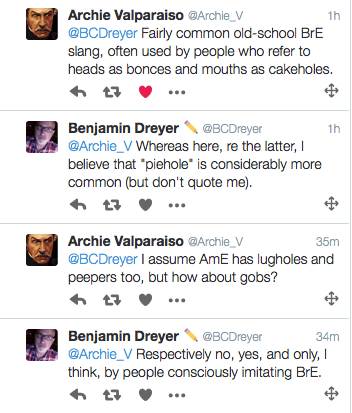
Benjamin Dreyer, an editor at the American publishing firm Random House, remarked on Twitter that he had only recently become aware of “hooter” as a slang term for “nose” and then had this illuminating exchange:

screen-shot-2017-01-02-at-9-21-29-am

Mr. Dreyer’s last assessment is spot-on, in my humble opinion.

“Hooter” for nose isn’t all that old; the Oxford English Dictionary’s first citation is from the 1958 book Bang to rights: an account of prison life, by Frank Norman. It’s clearly derived from another British sense of “hooter”–what Americans would call a car horn. Along the same lines, in Australian Rules Football, the hooter is the horn that sounds at the end of a period or a game. In the U.S., traditionally, the main slang meaning of “hooter” is the female breast, as seen in the chain of fine dining establishments.

Woody Allen (whose review proves–again in my humble opinion–that he’s much better at writing comic essays than movies) was in his high S.J. Perelman mode, which includes a mix not only of Britishisms but of Yiddish, low slang, and polysyllabic archaicisms. Thus his “hooter” doesn’t signal or awkward a widespread U.S. adoption. (We’re good with “honker” and “schnozz.”) The only other recent use in the Times was from book critic Dwight Garner, himself an estimable stylist. Reviewing a collection of Garry Trudeau’s “Doonesebury” cartoons in 2010, Garner referred to “the pencil-shaped hooter that his main character, Mike Doonesbury, has sticking out of his face.”


“Scuppered”

The ever-observant Nancy Friedman has sent along a screenshot of a Wall Street Journal headline: “Tehran officials say accord is now harder to undo, threaten clawbacks if scuppered.”

Never mind about “clawbacks” for the moment–the thing that caught her, and my, interest is “scuppered.” The OED tells us that the verb “scupper” originated in the late nineteenth century as military slang for “to surprise and massacre.” There followed a “colloquial” twentieth-century meaning, “To defeat, ruin, destroy, put an end to.”  By 1957–when a writer for The Economist noted, “The suspicion is still alive that there would have been secret rejoicing in Whitehall if the French Assembly had scuppered the common market”–it had entered (British) journalese, in a sense similar to that seen in the Wall Street Journal headline.

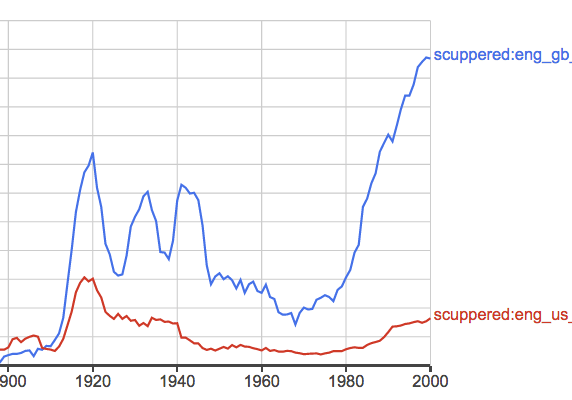
And it definitely is a Britishism, as seen in this Google Ngram Viewer chart:

screen-shot-2016-12-20-at-2-54-47-pm

I reckon that the recent popularity of “scuppered” is in part due to its aural resemblance to “scuttle”–originally a nautical term meaning to bore holes in the boat for the purpose of sinking it, and in figurative use by the 1888, after which it has been equally popular in the U.S. and U.K. according to Google Ngram Viewer. ( “The day..began with bad news. The Rent Subsidy Bill had been scuttled without opportunity to work on it.” Ladybird Johnson, White House Diaries, 1965.) “Scuppered” may (wrongly) make  journos and subeditors feel that they are using a fresher word than the tired old “scuttled.”

In any case, “scuppered” is gaining a foothold among U.S. writers, who may (wrongly) feel that using a Britishism makes them seem cool. It has appeared in the New York Times five times in 2016, first from the pen of columnist Maureen Dowd:

Of course, if [Hillary Clinton] had been a better listener on her health care initiative and the Iraq invasion, those two towering issues might not have scuppered her.

And most recently from the pen of former Harvard president Lawrence Summers, who wrote for the December 5 edition:

A trade deal between the European Union and hardly threatening Canada was almost scuppered by a recalcitrant Belgian province concerned about the effects of globalization on local workers.