

A few years back, my daughter Maria Yagoda, who knows a lot of British and Australian young people, told me to be on the lookout for the arrival of a word she always heard them saying: “fully.” Now, this adverb is common in the U.S., in two particular contexts: a synonym for “completely” or “totally” (“the hotel is fully booked”) and a kind of antonym for “only” (“fully two thirds of registered voters sat this election out”).
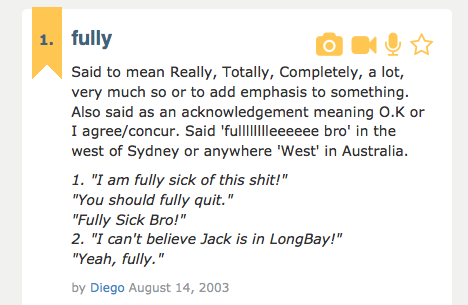
The connotation Maria had picked up on was slightly different and is well-put by “Diego” (evidently an Australian) in this Urban Dictionary entry:
I found a few other examples out on the web, two from British sporting types:
 A rugby coach: “We had so many chances and the game was fully in our hands for 80 minutes. I was worried, but we got there in the end. George North saved the day.”
A government official: “Large unmanned aircraft, when they come, should be as safe as manned aircraft and the British public should be fully consulted before companies fly large, remotely-piloted aircraft over their homes alongside passenger planes.”
There things stood until a couple of weeks ago, when I attended (with Maria) a talk by Lena Dunham at the New Yorker festival. She showed a scene from a film she had made five or six years ago, and when the lights came up, she said, ” I forgot that I fully had acne.”
Maria and I high-fived each other. The rest of the crowd thought we were nutters.

 notoneoffbritishisms.com