“Sorry?”

This is a very British way of saying, “I didn’t hear what you said–please repeat.” The OED dates it to the mid-sixties, and it was still novel enough in 1972 for Tom Stoppard to have sport with it in his play “Jumpers”:

Miss Moore, is there anything you wish to say at this stage?

Dotty (in the sense of “Pardon?”): Sorry?

Bones: My dear, we are all sorry

I’ve felt for a while Sorry? is gaining ground over here. But for a long time I didn’t know any way of finding out. The databases and corpora I usually consult primarily deal with published texts, and Sorry? is, of course, something that’s said far more than it’s written. Moreover, none of my sources pay any heed to punctuation, so any search would bring thousands of leaden I’m sorrys and sorry states for a single piece of gold.

Then Mark Liberman of the University of Pennsylvania advised me that the Corpus of Contemporary American English over at Brigham Young University indeed allows you to include punctuation in searches. Bingo. A search of broadcast transcripts yielded about 150 hits, most recently this from a journalistically hard-hitting ABC Primetime Live segment called DIRTY DINING: WAITER DROPS FOOD, TRIES TO SERVE IT:

GREG-1ACTOR2-# Here you go. And that’s it. (Voiceover) And before they can take that first bite… DINER-1MALE2-# Guys? One of your sandwiches, he just dropped it. ACTRESS-1FEMALE2# I’m sorry? DINER-1MALE2-# He just dropped one of your plates. The sandwich went on the floor, right here.

And this from a 2010 CNN interview:

KING: The mood there must be pretty good, huh? LAVANDERA: I’m sorry? KING: The mood must be pretty good?

The sharp-eyed will notice that in both those cases the speaker said “I’m sorry?” rather than simply “Sorry?” This is the case with a considerable majority of the COLA hits, one exception being this double-sorry from a segment on NPR’s Talk of the Nation. It starts off with the host, Neil Conan, interrupting a long statement by a caller, Eric:

CONAN: Eric – I’m sorry. Eric? ERIC: Sorry? Go ahead. CONAN: I was to ask you if you had any more. ERIC: Oh, no. I’m, you know, the only concern that I have is as far as, you know, I mean, everybody is concerned about their privacy.

Now that I examine the quote, it seems that both Eric and Conan are saying “sorry” to actually apologize. In any case, my hypothesis is that Americans, as is their wont, have subtly altered the British Sorry? into the more literal I’m sorry? Agreement, disagreement, explanation and any other amplification welcome.
“Trousers”

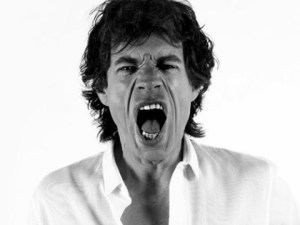
Jagger

A couple of weeks ago, the New Yorker magazine ran an online competition asking readers “to propose a single English word that should be eliminated from the language.” The winner, somewhat puzzlingly, was slacks. This is a rather old-fashioned term for what Americans call “pants” and Brits call “trousers,” which is my subject today.

The term dates from the seventeenth century and virtually all the OED’s citations for it and the many phrases and compounds formed from it (wears the trousers in the family, anything in trousers, not in these trousers) come from Britain, with one of the few exceptions being this 2005 quote from The New York Post: “Lee was game and let his trouser snake loose.”

The word initially forced its way into my consciousness via a moment on the Rolling Stones 1970 live album, “Get Yer Ya-Ya’s Out,” in which Mick Jagger addresses the audience: “Ah think I’ve busted a button [heavy glottal stop on the “buh-un”] on my trousers. I hope they don’t fall down….You don’t want my trousers to fall down, now do ya?”

Pants, dating from the early 1800, is the preferred American term. In the U.K., of course, that word means something completely different.

Trousers has, or have, been making inroads over here for some time, but seemed to have reached a crescendo of late, referring to articles worn by both men and women. In Anne Tyler’s new novel, The Beginner’s Goodbye, a man reflects about his wife: “Her clothes made her figure seem squat — wide, straight trousers and man-tailored shirts, chunky crepe-soled shoes of a type that waitresses favored in diners.”

Writing in the New York Times on May 1 about a new Ferragamo store, Alexandra Jacobs observes, “A fellow wearing cerulean trousers and slicked-back hair sampled driving moccasins while his bored-looking female companion sat on a couch, an amusing inversion of the customary situation.”

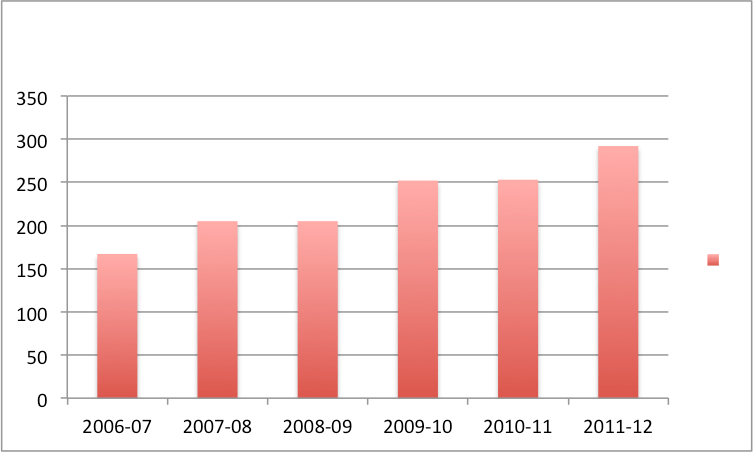
To be sure, the Times is fond of trousers. The chart below shows its frequency in the paper in twelve-month periods (May through April), 2006 to the present.

Gingrich and Sedaris

They have nothing at all else in common, but David Sedaris and Newt Gingrich are alike in their fondness for clever in the British sense (the quality for which Americans would use smart or intelligent). I noted Sedaris’s use of it last week and Gingrich’s some months back. Now Newt has hauled it again, in his comments yesterday in suspending his presidential campaign. He said his wife, Calista, had commented to him, “approximately 219 times, give or take three, that ‘moon colony’ was probably not my most clever comment in this campaign.”


“Bloody”

A reader named Stephanie Cerra writes:

I’m a book reviewer for a paid review site, so I read a lot of indie (self-published) novels. I’ve been seeing a lot of “bloody” in the British sense in American novels with American characters–most recently, a book where 10 widely different characters used “bloody” for emphasis. I get the impression that the writers are probably Monty Python/Dr. Who-type Anglophiles who feel it sounds more intelligent, more original, or more genteel than “goddamn” or whatever.

The OED’s relevant definition of bloody: “As an intensifier, modifying an adjective or adverb: absolutely, completely, utterly. More recently also as a mere filler, with little or no intensifying force (although generally implying some element of dislike, frustration, etc., on the part of the speaker).” The dictionary dates this from the seventeenth century, one of the first citation being this stage direction from John Dryden in 1683: “The Doughty Bullies enter Bloody Drunk.”

The OED has quite a lot of observations about the usage of bloody:

This word has long had taboo status, and for many speakers constituted the strongest expletive available. This is reflected in the regularity with which dashes, asterisks, etc., were formerly used to represent the word in print, and in the large number of euphemistic forms to which it has given rise, including bee n.3, bleeding adj. 5, blerry adj., plurry adj., sanguinary adj. 4, and perhaps blooming adj. 4. In the case of the adverb, the considerable public reaction to the utterance of the word on the London stage in George Bernard Shaw’s play Pygmalion in 1914 (see quot. 1914 at sense C. 2b) gave rise to the further humorous euphemism Pygmalion adv.

The dictionary is referring to Eliza Doolittle’s line “Walk! Not bloody likely,” which created such a sensation that people started using the word Pygmalion as a substitute for bloody, as in this line of dialogue from the 1967 novel “Rendezvous in Rio”:  ” ‘Are you thinking of joining in?’ ‘Not Pygmalion likely,’ Bland returned brusquely.” Anyway, by no later than the mid-1950s, bloody had apparently lost its sting. In writing the book for the musical version of “Pygmalion,” “My Fair Lady,” Alan Jay Lerner didn’t use Shaw’s “Not bloody likely!” As I recently noted, his Liza shocks with another word when she says, “Move yer bloomin’ arse!”

Back to bloody‘s status as an NOOB, the OED says that after originating in the British Isles,  the use of the word as an intensifier “spread to most other parts of the English-speaking world, with the notable exception of the United States, where it has apparently only ever achieved limited currency, e.g. among sailors during the 19th cent.”

Is this now changing, as Stephanie suggests? Well, of the thirty most recent uses of bloody at the New York Times’ website, twenty-nine use the word either in its literal sense, that is, having to do with blood, or in a reference to the cocktail the Bloody Mary. The sole exception appeared in a May 15, 2011, blog post in which the author anthropomorphized a spring flower, then self-consciously noted the unusualness of the word in an American paper: “’Relax,’ the tulips tell us. ‘Soon you’ll be complaining how bloody hot it is.’ (If the tulips sound very European, there’s a good reason for that.)”

So no empirical evidence yet. But I have the feeling Stephanie is on to something, and I will be keeping my ears open.

“Arse”

I was reminded that I’d been meaning to write about this one by a Facebook friend who linked to an ad posted on Craigslist, 4/24/12: “I am in need of someone who will cook (not microwave) and dangle bacon in front of my starving face while running to the YMCA. The objective is to trick my arse into working out. ”

The OED’s first citation for arse, with that spelling, to refer to a person or animal’s posterior is from 1480. There are multitudinous variations over the years, including this exchange from Ben Jonson’s 1602 “Poetaster”: ” Cris. They say, he’s valiant. Tvcc. Valiant? so is mine arse.” Ooh, snap.

The common and traditional U.S. term, of course, is ass. The OED says of this word: “vulgar and dialect sp. and pronunciation of arse. Now chiefly U.S.”
Its citations for ass are nearly all American, one exception being this from William Golding’s 1959 Free Fall:  “You sit on your fat ass in your ‘ouse all the week.”

Arse and ass look different in print. However, in Britain, where non-rhotic (that is, silent r) pronunciation is the standard, they would sound the same. This site offers British and American pronunciations of arse. The former is non-rhotic. The latter is risible in the exaggerated New York accent it affects.

In My Fair Lady (Broadway: 1956, film version: 1964), written by the American Alan Jay Lerner, Eliza Doolittle famously shouts out at the racetrack scene, “Come on, Dover, move yer bloomin’ arse!” That, anyway, is the spelling one finds on the internet; I don’t have access to the libretto or screenplay. I also don’t have access to the Broadway or soundtrack record albums. I would suspect that Julie Andrews, the original Liza, says it non-rhotically; probably Audrey Hepburn in the movie version as well.  Someone please let me know if that’s not the case.

Arse has been around for a long time in the U.S. as a sort of literary novelty item. Donald Barthleme’s first novel, “Snow White,” contained a chapter titled THE FAILURE OF SNOW WHITE’S ARSE. A 1971 letter by the anglophile S.J. Perelman noted that some New Yorker contributors ”tend to have a ramrod up their arse, acting as though they invented the paper.” (I would say that paper, to refer to a magazine, is a Britishism as well.)

Moving up to the present, arse has become a vogue term in the U.S. in recent years, very much analogous to shite. A 2010 comment on a New York Times blog post by someone who signs him- or herself “AmericanYankee” says: “The last thing I want is for bin Laden and his sycophantic arse kissing illiterate supporters to think they are somehow special.”

Just two days ago, blogging his displeasure about the New York Times at Esquire.com just two days, Charles Pierce comments, “This is all my arse.” And bringing it all back home, a commenter on his post writes, “The Times is, for the most part, irrelevant, and this sort of link-trolling crap should be ignored. It only encourages more shite.”

“Nonstarter”

I’m filing this one under the new category “Historical NOOBs.” When a reader suggested it a few months back, I was initially dismissive, so established an expression (meaning a project, idea or proposal that absolutely will not fly) has nonstarter become. But she (I think it was a she) was right.

The OED dates the word back to 1865, when it was used, straightforwardly, to indicate a horse that was unable to start a race. The first metaphorical use was a line from a 1934 P.G. Wodehouse novel, and the first in what I consider the modern meaning from a 1942 book: “That is one reason why non-intervention is such a non-starter.” That and all subsequent citations in the OED are British.

The New York Times used nonstarter first in 1987 and since then on “about” 1489 occasions (the newspaper’s new search system is for some reason partial to approximation). The most recent came on April 1, in a quote by Speaker of the House John Boehner: “The additional revenue that Obama demanded was a ‘nonstarter,’ he says.”

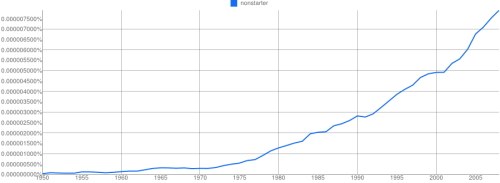
Below are Google Ngram charts showing frequency of use of nonstarter between 1950 and 2008. It’s a bit hard to make out the numbers but they show British use picked up in the ’50s and U.S. use in the ’70s; that Americans caught up with Brits more or less in the late ’80s; and that we now use “nonstarter” more than 50 percent more frequently.

U.S. use of "nonstarter," 1950-2008
British use of "nonstarter," 1950-2008

More on “Clever”

To bring you up to date: my sense is that the British use clever the way Americans use smart or intelligent or bright. The traditional American clever is a more limited honorific; it seems to be implicity preceded by the word merely and suggests a facility with puns or puzzles.

But things are changing. The latest indication that clever is reaching NOOB status is this line from a David Sedaris interview in today’s New York Times:

“I was a judge for this year’s Scholastic Art and Writing Awards, so until very recently I was reading essays written by clever high school students.”

Mark my words, it’s a comer.

“Takeaway”

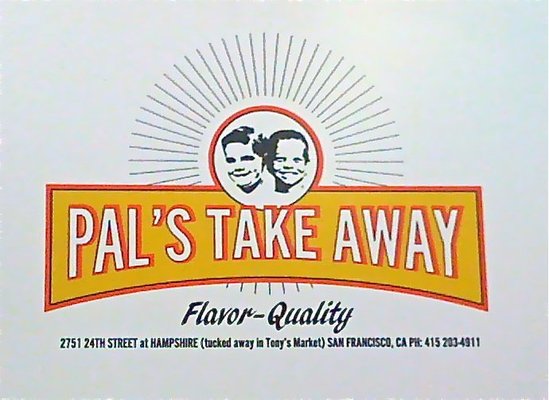
Sign for a San Francisco takeout joint

Takeout and takeaway (hyphenated versions are also commonly found) refer to food purchased in a restaurant or other shop and consumed at home. Both terms can be adjectives or nouns and can refer to the meal itself or the establishment that prepares it. OED describes take-out as “orig. U.S.” and finds it first in a line from James M. Cain’s 1940 Mildred Pierce: “Pies she hoped to sell to the ‘take-out’ trade.” Again according to the OED, take-out arrived in the U.K. no later than 1970, when The Times reported, “One of New York’s finest restaurants will provide gourmet ‘take-out’ lunches for the hard-pressed executive.”

By contrast, all of the OED’s citations for takeaway are from the U.K. or British Empire outposts, commencing with a 1964 quote from Punch: “Posh Nosh‥was serving take-away venisonburgers.”

Takeaway (in the food, rather than the golf-swing, football-interception-or-fumble, or business-jargon, sense) felt strange in the U.S. as recently as 1977, when the New York Times noted about Terence Conran’s new New York furniture store, “delivery is discouraged, and everything stocked carries a tag that says, ‘takeaway price.'” But it has made itself comfortable over here in recent years–for example, in this headline two days ago from the blog Culturemap Austin (Texas): “Fresa’s Chicken al Carbon brings a giant chicken mascot and fresh take-away food to Austin at a decent price.”

Or this from a New York Times review last year of a Brazilian restaurant in Queens: “For takeaway, banana and cassava cakes ($2.75 each) travel well.”

Thus, for my money, takeaway is a clear-cut NOOB. However, I have a nagging sense that I encountered it long ago (I’m talking a half-century) in the Washington, D.C., area, and at the time did a mental double-take to find it instead of the more familiar takeout.

Normally, when I want to look up a word in the Dictionary of American Regional English (DARE), I’m frustrated, because I only possess Vol. V., which covers Sl-Z. I got excited because both takeout and takeaway fall within its purview. However, DARE doesn’t have an entry for either one. Help?

Update, 4/21: The comment from Laura Payne, below, made me realize I was mistaken about remembering takeaway being used in Washington. The term I actually encountered was carry-out.

“Weds.”

“[Charles] Manson is scheduled to have a parole hearing at Corcoran State Prison in Central Calif., on Weds., April 11, 2012.” St. Louis Post-Dispatch

“Romney Coming to Delco on Weds.” Headline, PoliticsPA.com

“Smokers asked to ‘Kick Butt’ on Weds.” Headline, Wwlp.com (Chicopee, Mass.)

For some years, I have been noting an increasing tendency to abbreviate Wednesday as Weds. rather than the (U.S.) traditional Wed. This annoys me. Wed. is shorter (always a good thing in an abbreviation), and Weds. elides two letters (ne), never a good thing in an abbreviation. There is, in short, no reason for it.

I had a hunch that Weds. is of British origin, and a Google News search for “on Weds” (you can’t just search wed or weds for obvious reasons) returns more U.K. hits than U.S. ones, but that’s hardly scientific. I consulted my go-to expert, Lynne Murphy, who kindly conducted a survey of British informants. The results: 67 percent favored Weds. That sounds scientific. Unfortunately, the sample size was three.

Wherever it came from, I wish it would stop.