“Sticky wicket”

Two readers have independently alerted me to this recent quote in the New York Times:

“It’s a sticky wicket for Obama,” said Bruce Buchanan, a political science professor at the University of Texas at Austin, saying any aggressive move on such a high-profile question would be seen as “a slap in the face to his base right after they’ve just handed him a chance to realize his presidential dreams.”

I initially resisted investigating sticky wicket, relegating it to the telly-lift-old chap sort of term that in the U.S. is a stereotype of a Britishism, and thus can’t be a proper NOOB. I was wrong. It turns out that the Times has used the phrase six additional times in the past two years, all either by its own reporter or a quote by an American source. For example, Milwaukee Journal-Sentinal sportswriter Tom Haudricourt commented in 2010 about the Hall of Fame prospects of baseball’s Mark McGwire, who had just admitted to using steroids: “Should we be voting guys in who admit to doing it? The sticky wicket just got stickier.”

The original British expression dates from the 1880s, according to the OED, and is (sorry for stating the obvious, to some) is a cricket metaphor. Thus it’s traditionally phrased as (batting) on a sticky wicket. The batting on is always lost in the U.S.

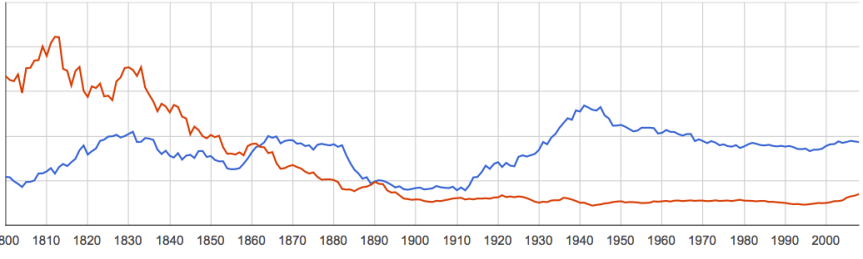
Looking at Google Ngram data (below) makes me think I need a new category for this bad boy. It’s a quintessentially British expression that’s so quintessential, it’s hardly used there anymore. Meanwhile, it has gradually grown in the U.S. from being an exotic novelty item to a solid NOOB–to the point that, in 2004, it was as popular here as it was there! Google’s data only goes up to 2008; I bet that at this point, there are more U.S. sticky wickets than British ones.

Google Ngram showing popularity of the phrase "sticky wicket" in Britain (blue line) and the U.S. (red line), 1915-2008
Google Ngram showing popularity of the phrase “sticky wicket” in Britain (blue line) and the U.S. (red line), 1915-2008

“Turn up”

Screen Shot 2012-12-05 at 10.23.37 AM
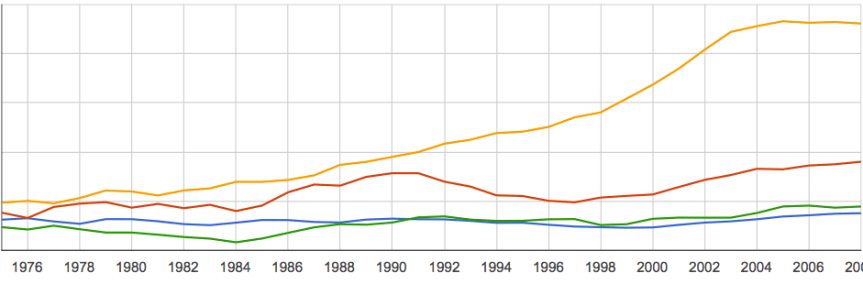
Google Ngram showing use of “turned up early” and “showed up early” between 1975 and 2008. Yellow line: U.S. “showed up.” Red line: British “turned up.” Green line: British “showed up.” Blue line: U.S. “turned up.”

I refer to the intransitive verb that basically means “to appear,” possibly unexpectedly, and that can refer to a person, thing or concept (and not to the transitive form, e.g, “The search turned up a few artifacts” or “She turned up her nose and the cuffs of her jeans.”) I think of it as a Britishism mainly, I suppose, because there’s such a common and reliable U.S. equivalent: show up.

The Google Ngram above, which shows the relative popularity of showed up early and turned up early  in the U.S. and Britain between 1975 and 2008 (the last year for which data is available), pretty much supports my sense. ( I stuck the early in there to avoid false positives in the transitive and other forms.) So does the OED, which reports turn up as having turned up very early in the eighteenth century. The dictionary cites an 1863 British newspaper report: “The Police have been astonished lately at the number of criminals who have turned up of whose previous career they knew nothing…” And the phrase was used memorably by  Dickens in David Copperfield:   “‘And then,’ said Mr. Micawber,..‘I shall, please Heaven, begin to be beforehand with the world,..if—in short, if anything turns up.’”

As for show up, the first citation is from the Lisbon (Dakota) Star, 1888: “Will Worden is expected to show up next week.”

The verb without up can mean the same thing, most often used as a negative or interrogatory. (“Did he show?” “Nope, he didn’t show.”) That’s certainly a popular slangy alternative in the U.S., but it didn’t originate here, according to the OED, which quotes Theodore Hook, The Parson’s Daughter (1833): “The breakfast party did not assemble till noon, and then Lady Katherine did not ‘shew.’” I reckon that was the source for the eventual U.S. show up.

Anyway, if and when Ngram offers data beyond 2008, I predict it will show a sharp uptick in U.S. turned up. My ears feel it has become the preferred alternative among the chattering classes. I was writing this on November 30 and found four separate uses in the N.Y Times that day:

  • “…John McGraw’s futile attempt to trump the Yankees by finding a Jewish version of ‘the Babe.’ An exhaustive search turned up a prospect named Mose Solomon, likened in the press to an exotic animal. (‘McGraw Pays 50K for Only Jewish Ballplayer in Captivity.’)”
  • “Two months later, though, Barnum turned up in Tennessee and, in June 1865, he signed an oath of allegiance to the federal government.”
  • Books that writer Joe Queenan keeps as gags “mostly turned up over the transom at jobs I used to work at. ‘Hoosier Home Remedies’ is my favorite.”

And finally, this immortal sentence: “If Kristen Holly Smith turned up to your costume party in Dusty Springfield drag and started singing, there would be no mistaking the woman she was channeling.”

“Trainers”

Mike Jensen, writing in today’s Philadelphia about a legendary high school runner: “Her left foot hurt her sometimes in the front ‘near the toes,’ but only when she walked, not running. (Could it have been her Adidas LA trainers?)”

In these parts, we would still normally say “running shoes,” or maybe “sneakers,” but I have the feeling we have not heard the last of trainers.

“Knock-on” (effects)

Over on Twitter, Neal Whitman notes that the adjectival phrase knock-on appears twice in the current issue of New Scientist (British) and wonders if it’s “a recent BrE innovation? Just BrE? Just recent? Neither?”

My answer: fairly recent and, until quite recently, almost exclusively British English. The “quite recently” means that for this blog’s purposes, it’s an on-the-radar NOOB. The OED calls the phrase “chiefly” British and defines it as “Being a secondary or indirect consequence of another action, occurrence, or event;  knock-on effect n. a secondary, indirect, or cumulative effect.” First citation is from The Times in 1972: “They would be more than willing to move towards a minimum wage of about £20 a week..if they could be assured..that there would be no ‘knock-on effect’ in the differentials demanded by the rest of the labour force.”

As to derivation, although the term (apparently) has a meaning in rugby football, it’s more likely that the adjectival phrase comes out of physics, where it means “Ejected, produced, or caused as a result of the collision of an atomic or sub-atomic particle with an atom.” (“Knock-on protons produced by 3MeV neutrons would not..produce visible flashes.” Nature, 1971.)

Joining in the Twitter conversation, Lynne Murphy reports finding twenty-nine instances of knock-on in the Corpus of Contemporary American English, which boasts of containing 450 million words used by Americans in writing and on the air since 1990. My own search of COCA yielded twenty-seven hits, but that’s close enough for jazz.

At least half of the uses, I would judge, were written in American publications or uttered on American broadcasts by British people. However, fifteen of the twenty-seven have occurred since 2008, and Americans are responsible for a increasing number of these. For example, in 2011, Steve Coll wrote in a New Yorker blog, “The probable knock-on effect of a second Taliban revolution in Afghanistan would be to increase the likelihood of irregular Islamist attacks from Pakistan against Indian targets.” Georgetown professor Charles Kupchan wrote in Foreign Policy this past January, “[Citizens of industrialized countries] also expect their representatives to deal with surging immigration, global warming, and other knock-on effects of a globalized world.” And Annie Lowrey wrote in the New York Times in August: “Mr. Obama’s address coincided with the release of a White House report quantifying education job losses and detailing the knock-on effects, like bigger classrooms and shorter school years.”

The slowness with which the phrase has been adopted here relates, I would say, to the longstanding presence of perfectly adequate alternatives, side effects and unintended consequences, or, more simply, results. But never underestimate the appeal of a NOOB. I predict that knock-on effects will continue and indeed accelerate its ascent.

“Small beer” and “hard cheese”

A line in David Carr’s column in the New York Times a couple of days ago caught my eye: “Fumbling an editorial change may seem like small beer when viewed against the backdrop of an industry in which bankruptcies are legion and rich business interests are buying newspapers as playthings.”

I wasn’t familiar with small beer, but it had the ring of a NOOB, so I investigated. The first OED definition is “Beer of a weak, poor, or inferior quality” (what Americans might call near beer). The second, by extension, relates to Carr’s meaning: “Trivial occupations, affairs, etc.; matters or persons of little or no consequence or importance; trifles.” Or, what Americans would typically term small potatoes.

Although Shakespeare does use the term in “Othello,” the OED quotes Joseph Addison rather purposely and self-consciously crafting the metaphor in 1710:  “As rational Writings have been represented by Wine; I shall represent those Kinds of Writings we are now speaking of, by Small Beer.” The next quotation is from John Adams, who wrote in 1777, “The torment of hearing eternally reflections upon my constituents, that they are..smallbeer [sic],..is what I will not endure.”
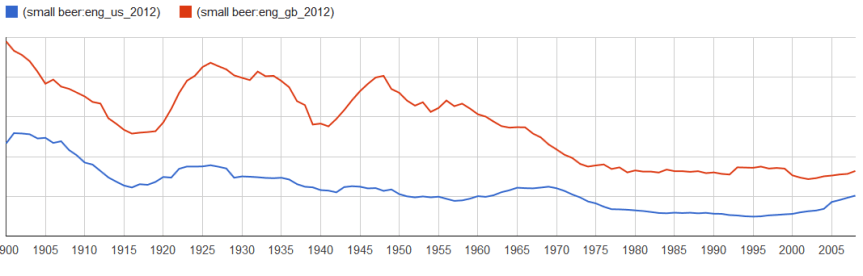
Adams, of course, was an American, and therefore small beer isn’t a NOOB along the lines of gobsmacked or toff. But I do classify it as a “Historical NOOB.” Back in 1777, there wasn’t any, or much, difference between the way Englishmen and Americas used the language. Over the years, however, this particular expression, like many others, acquired a British patina; all post-1777 OED citations are British. The Google Ngram chart below shows use of the phrase in Britain (red line) and the U.S. (blue line) between 1900 (by which time it was mostly used metaphorically) and 2008. Up until the mid-2000s, it was used between two and three times more frequently in Britain.
Google’s data goes up only to 2008, but I would imagine that by now blue and red lines have met, or are about to. That is, small beer is getting some U.S. traction.  Stanford Professor David M. Kennedy, writing for CNN after the recent election, regretted that “as committed a change agent as Obama is doomed to four more years of nothing more than Lilliputian, small-beer tinkering.” In September, a Los Angeles Times writer observed, “Of course, in San Diego a dispute that has lasted only a decade is but small beer.”
Another colorful British food metaphor has had less success over here. I refer to hard cheese, i.e, “tough luck.” (That brings to mind another Britishism, the one-word sentence that’s a favorites of sports commentators, “Unlucky!” No spottings here as yet and I don’t expect there ever to be.) A fair amount of hard cheese searching yielded only a couple of hits, both of them facetious. In 1990, New York Times columnist Tom Wicker channeled the notoriously preppy then-President George H.W. Bush: ”Gee, fellows, we can talk about anything but maybe the graduated income-tax thing; but, golly, if there’s going to be an increase, sorry, hard cheese, but you Democrats have to propose it. Then I’ll just have to tell the taxpayers I’m going along only because you big tax-and-spenders left me no choice.” And a St. Louis Post-Dispatch columnist wrote in 2007: “It’s a cold, cruel, capitalist world out there, Bunky. You put in your 20 years in the gunk at the chemical plant and one day . . . whack! It’s all over. It’s hard cheese for you and your family.”
All the rest of the American uses I encountered referred either to dairy products or to baseball, where the expression is an accepted elegant variation for fastball. From a New York Times recap of a 2010 game: “So, at 3-0, Robertson threw Young some hard cheese at the knees for a strike.”

“Jack the Lad”

Among the several unfamiliar (to me) British expressions used in Justin Peters’ Slate piece (discussed below) was one used by Janet Maslin yesterday in her New York Times review of the memoirs of Rod Stewart, CBE:

“Mr. Stewart’s antics have earned him a richly deserved Jack the Lad reputation.”

In considering the expression, the OED suggests that the reader should “perhaps compare the expression Jack’s the Lad, found in a nautical song,” which it dates from the 1840s and from which it quotes this line: “For if ever fellow took delight in swigging, gigging, kissing, drinking, fighting, Damme I’ll be bold to say that Jack’s the lad.” The definition: “a conspicuously self-assured, carefree, and often brash young man; a ‘chancer’.”

Sounds about right for our Rodney Roderick (except for the “young” bit).

Funny

Peters (left) in man-bun

Great piece in Slate by Justin Peters, who decided to try out as many as he could of the bizarre trends sanctified by the New York Times Style section. He managed to do seven of them, including wearing his hair in a man bun, shaving his pubic hair, and, yes, filling his vocabulary with Britishisms. Peters writes:

“What’s up?” “You the man.” “Take it easy.” I use these slang phrases all the time, which is one of the top five reasons I’ve never been invited back to the Yale Club. According to the Times, British slang is the only slang that a trendy American ought to use: “Snippets of British vernacular—‘cheers’ as a thank you, ‘brilliant’ as an affirmative, ‘loo’ as a bathroom—that were until recently as rare as steak and kidney pie on these shores are cropping up in the daily speech of Americans (particularly, New Yorkers) of the taste-making set who often have no more direct tie to Britain than an affinity for Downton Abbey,” the NYT’s Alex Williams writes.

I was in England earlier this year, and though I spent most of my time being jetlagged and avoiding their hideous breakfasts, I did pick up some slang—words like lorry, as in “I would rather be hit by a lorry than eat another English breakfast.” So I figured this would be easy. I boned up on my Britishisms by rereading Brideshead Revisited and consulting the Wikipedia entry on British slang. When Hurricane Sandy knocked out the electricity, I couldn’t hold it in any longer. “Well, this is all to cock!” I cried.

“Your cock?” my wife said

“No, no, it’s all to cock!”

“Alter cock?”

“It’s. All. To. Cock!” I said again, gesturing emphatically.

“I don’t get it,” she said….

To read more, follow this link.

“Gallimaufry”

@PeterSokolowsi of Merriam-Webster reports on Twitter that gallimaufry is, at this moment, the most looked-up word at the company’s website. Why? Because the New York Times’ Maureen Dowd used it in her column yesterday: “Just like the Bushes before him, Romney tried to portray himself as more American than his Democratic opponent. But America’s gallimaufry wasn’t knuckling under to the gentry this time.”

(Dowd NOOBed in her opening line: “It makes sense that Mitt Romney and his advisers are still gobsmacked by the fact that they’re not commandeering the West Wing.”)

The OED’s first meaning for gallimaufry (which is spelled various ways) is culinary, referring to a stew or ragout with various ingredients, but as early as 1551 it took on the meaning “A heterogeneous mixture, a confused jumble, a ridiculous medley,” which is how Dowd uses it, though with a more positive spin than the definition suggests.

A Google Ngram reveals that, except for a puzzling period between about 1875 and 1885, the word has historically been used more in Britain (red line) than the U.S. (blue line):


But I wouldn’t exactly call it a Britishism, Not One-Off or otherwise. It’s just that columnists need to say things in colorful ways, and Dowd is about as colorful as they come.

“Spanner in the works” (though not “spanner”)

Faithful reader Cameron directed me to a quotation from an article on MLB.com by Anthony Castrovince (the MLB standing for Major League Baseball):

“Wakefield was a dependable eater of innings who annoyed opponents — not just on the days he pitched, but the day after, for a knuckleballer serves as quite the spanner in the works.”

(Translation, for non-American readers: Tim Wakefield is a pitcher who specializes in a rather unusual, fluttering pitch called the knuckleball. Wakefield himself, while he doesn’t produce spectacular results, has the ability to get his team fairly deep in the game without giving up too many runs: that is, “eat innings.” It is a general truth that, if a team faces a knuckleballer one day, its batters don’t do very well against a conventional pitcher the next day.)

I categorize spanner, meaning wrench (the tool) as a Doobious NOOB–that is, it is never found here–and spanner in the works as an outlier. The OED finds the first use of the latter in P.G. Wodehouse’s 1934 Right Ho, Jeeves: “He should have had sense enough to see that he was throwing a spanner into the works.”

I believe the expression will never achieve wide circulation here–will be used only, as Mr. Castrovince does, as a self-conscious exoticism–because we have a synonymous and, arguably, more adaptable and expressive counterpart: throw a monkey wrench in or into, which can be followed by works, plansoperation, or anything else. The OED reports a use of this by the Chicago Tribune back in 1907: “It should look to them as if he were throwing a monkeywrench into the only market by visiting that Cincinnati circus upon the devoted heads of Kentucky’s best customers.”

When Cameron brought up spanner in the works, it rang a vague bell, originating, I realized, in the title of a 1995 Rod Stewart album. I’d never known what this meant, and so categorized it with similarly mystifying British record names, like “Tea for the Tillerman,” “John Barleycorn Is Dead,” and “Thick as a Brick.” When I mentioned the expression to my wife, she reminded me that John Lennon’s 1965 book was titled A Spaniard in the Works. I had never before gotten the play on words. Good one, John.