Faux Brits, or faux Britishisms?

I’ve been at this too long. That, anyway, was my reaction when I read the following in yesterday’s New York Times Magazine profile of Jimmy Wales, the founder of Wikipedia, an American who now lives in London:

He uses Britishisms that make him sound a little like the famous faux-Brits Gwyneth Paltrow or Madonna. He told me he had “a good ol’ time” at the Olympics, where he attended beach volleyball and an equestrian event as Boris Johnson’s guest. Living in Marylebone is nice, he says, because “we have loads of friends and people pop by.” Unlike in the United States, where politicians are remote Wikipedia subjects, in Britain he “literally” (pronounced LIT-ruh-lee) knows them.

The passage left me dazed and confused. Is “good ol’ time” a Britishism? Is “pop by”? (Or is the author referring to “loads”?) And what about that pronunciation of “literally”? I associate it with Rob Lowe’s character on “Parks and Recreation,” who is certainly not a Brit, even a faux one.

I wish I could look all that up on Wikipedia, but even that remarkable resource is no help here. So I’ll crowd-source it to you lot. Help?

“Argle bargle” gets love from Scalia

After I published a post about various U.S. uses of argle bargle (“Disputatious argument, bandying of words, wrangling”–OED), a veritable flood of U.K. commenters observed they heard this term rarely if at all, while a variant, argy-bargy, was quite familiar to them.

Justice Antonin Scalia, in his dissent to last week’s Supreme Court decision overturning of the Defense of Marriage Act, continued the tradition of Americans using the archaic version, noting:

As I have said, the real rationale of today’s opinion, whatever disappearing trail of its legalistic argle-bargle one chooses to follow, is that DOMA is motivated by “bare … desire to harm.”

Elsewhere in his dissent, Scalia doubled down on his NOOB-itude, writing, “It takes real cheek for today’s majority to assure us, as it is going out the door, that a constitutional requirement to give formal recognition to same-sex marriage is not at issue here.”

Cheeky monkey!

“Go to Ground”

The New York Times’ redoubtable media columnist, David Carr, has provided material for this blog before, and he does so again in today’s paper. Referring to a supposed video of the showing the mayor of Toronto smoking crack, Carr writes, “By then the people who had claimed to have the video had gone to ground.”

My NOOB-dar whirred into action at that phrase gone to ground, with which I was not familiar but which had an unmistakable British sound to it. A look at the OED confirmed the suspicion; but even better, it’s a fox-hunting reference. I had hit some kind of jackpot.

The dictionary dates the phrase to 1797 and defines it as when the fox runs

into a burrow or hole in the ground, ‘to earth’… Also to lie at ground  . to go to ground  : also said of a dog. Also in other phrases, and fig. (of a person), to withdraw from public notice and live quietly or ‘lie low’

All citations are from Commonwealth countries and all  refer foxes or other animals until a 1964 quote (with telltale quotation marks, indicating newness): “The four men ‘went to ground’, probably in Johannesburg.” The expression appears currently to be popular in a sporting context, as in this quote from a 2009 Times rugby article originating in New Zealand: “But on defense, he is less assured and at times puts his team under pressure by offloading when it would be better to go to ground and set up the next phase of play.”

Note that this is different from the American expression “to run [something] into the ground,” meaning to destroy or ruin it by over- or misuse. Someone quoted in 2009 by the N. Y. Times’ Dealbook blog (unclear if he is British or American) seems to have confused the two: “Reuters’s Robert MacMillan argued that by letting the story of The [Boston] Globe’s possible demise leak, The [New York] Times may be betting that a white knight will emerge — ‘someone who fulminates long and hard about civic responsibility and not letting a hallowed journalistic institution go to ground.’”

I’m going to classify the David Carr/fox-hunting go to ground as “on the radar” rather than “outlier” because I found a couple of other uses in the Times in the past several months. Interestingly, they both came from members of the intelligence community, and it makes sense that it would have become popular in a world where people are, frequently, compelled to go to ground. In April, Philip Mudd, “a former senior C.I.A. and F.B.I. official,” referring to a Boston Marathon bombing suspect, said, “He’d get nervous and turn himself in, or he could go to ground.” And in February, Michael R. Shurkin, “a former Central Intelligence Agency analyst,” said, “Are they going to dig in and be guerrillas or go to ground and wait?”

How About “Deft Plank”?

When I pick up the (paper) New York Times, I always turn to page 2 to read the corrections. Since the Times is so obsessive about beating its chest over every error it has made, the record-set-straighting can be amusing. A couple of weeks ago, this classic appeared:

Because of editing errors, an article on Thursday about a duo that has its first Top 10 single and its first No. 1 album on the Billboard album chart misstated its name at two points. As the article correctly noted elsewhere, it is Daft Punk — not Daft Puck or Daft Pink.

The mistakes came about because daft is still on the radar as a NOOB. Presumably, the success of the French musical duo will speed the word’s ascent to full-fledged status.

Hasn’t happened yet, however. On Sunday, I opened up my home-town Philadelphia Inquirer to find this:

IMG_0763

Glo’al sto’ no’ heard in Bri’ish poli’ socie’y?

The dirty if not very surprising little secret of this blog is that the majority of its readers are U.K. residents, who are surprised or possibly amused that Americans have been picking up their lingo. And it’s to these Britons that I address a question.

I was reading an article in the New York Times by critic Alastair Macaulay about the quality of dance in Broadway musicals. At the end, he wrote:

As a Briton going to shows on Broadway, may I add what a fun surprise it is to hear, in two different productions, the British glottal stop? Lauren in “Kinky Boots” speaks of going to “I’aly”; and Mrs. Wormwood in “Matilda” says “Bu’ I’ve go’ a baby.”In Britain the glottal stop is never heard in polite society. In America, however, it’s an exotic thrill.

That rather gobsmacked me. I have written about the current popularity of the glottal stop in the U.S., and I thought it was widespread in Britain. I certainly hear it all the time from Jamie Oliver and Ricky Gervais. But perhaps they don’t belong, in Mr. Macaulay’s view, to “polite society.” In any case, I await the reactions of NOOB readers.

“Cross”

I was perusing Twitter the other day when this turned up in my news feed (written by an American):

Luxembourg must be cross that the UK gets to provide the social services and they collect the taxes from amazon: shelf-awareness.com/theshelf/2013-…

The OED  defines cross in this sense as “Ill-tempered, peevish, petulant.” All the citations are British, including Austen’s Pride and Prejudice (1813): “I have never had a cross word from him in my life.”

This is certainly not an unknown word in the U.S. But it is an old-fashioned one, with a rather twee feel to it. Dawn Powell used it (along with a similarly antique verb form) in her 1944 novel My Home Is Far Away: “In the morning he was cross if they waked him.” I associate the word with bordering-on-precious children’s books, as in anthropomorphic bears and ducks who are cross if they don’t get their porridge on time.

As the tweet suggests, the word appears to be getting some broader currency, in part because of the current appeal of NOOBs and in part because it occupies a useful spot on the ever-wider spectrum of annoyance, along with irked, frustrated, and pissed off.

In June 2012, a writer for minnpost.com observed, “Trying to understand all this made me cross.” And health policy expert Uwe E, Reinhardt wrote in the New York Times in March 2013: “I wouldn’t be surprised if the New Jersey hospital industry was cross at me and the commission for our role in the passage of Assembly Bill.”

My favorite recent American use comes from blogger Everett J. Smith, who titled a recent post post, simply, “The Pope Makes Me Cross.”

More on Footballisms

Interesting article on the BBC website about differences between U.S. and British vocabulary for sports, especially football/soccer. NOOBs has covered the issue, especially in a guest post by Jack Bell, but the BBC piece provides some nuance. The author, Tom Geoghegan, quotes American soccer blogger Chris Harris on a contentious split

between US soccer fans insisting on using American terms to describe the game compared to Americans who insist on using British language to talk about the game, so they’re more accepted by hardcore soccer fans and ex-pats. So when Americans use terms like ‘match’, ‘nil-nil’, ‘kit’ and other terms, many US fans will tag those Americans with the ‘Euro snob’ label.

The BBC piece is datelined Washington, but either Geoghegan or his subeditor is British. I know that because the chart in the piece, depicting U.S. and British terms, shows a striking ignorance of the way Americans speak American lingo.

Screen Shot 2013-05-30 at 8.40.02 AM

Where to begin? Well, shutout and matchup are one word in these United States, on frame rings no bell, and our actual cliche is “in his wheelhouse,” not “in the wheelhouse.” And offence instead of offense? Really, BBC?

“Fit”

There are two relevant senses of the adjective. The first, a commonplace in British sport commentary, is more frequently expressed in the U.S. in the phrase physically fit. But the shorter form is creeping through, thanks in some measure to tennis players, announcers, and reporters, who are partial to it. Thus the New York Times last year quoted Dominika Cibulkova of Slovakia, who had commented that Samantha Stosur “played like a man.” Asked to clarify, Cibulkova said, “As a player, she’s very fit. I’m not saying anything bad.”

A British reader of that quote may have had the impression that Cibulkova fancied Stosur, as the second British meaning of fit is “sexually attractive. The OED cites this 1985 exchange from The Observer: “Better ‘en that bird you blagged last night.’ ‘F—— off! She was fit.’”

I had never encountered a U.S. use of the second fit till this morning, when New York Times media correspondent David Carr sent this out over Twitter:

Screen Shot 2013-05-22 at 9.24.09 AM

Now, it’s possible that Carr was merely imagining a United Parcel Service employee who regularly went to the gym. But where’s the fun in that?

Boden

As noted in such past entries as stockists and opening hours, a number of U.S. retailers have lately affected British terminology, presumably in an attempt to seem hip or classy. Sara Wilson alerted me to a wrinkle on the trend that can be seen in the the clothing purveyor Boden. The company originated in the U.K. but has a robust U.S. website on which, if anything, it seems to use more Britishisms than on its British one. Sara pointed out this banner ad:

Screen Shot 2013-05-20 at 9.18.08 AM

She didn’t know what snaffle means, nor, in fact, if the expression being used was snaffle, snaffle up, or snaffle up to. Neither did I till I looked it up in the OED, whose definition for snaffle is: “To appropriate, seize, catch, snatch.” “I soon snaffled a double role in a big spectacle.”–Sunday Express, 1928. (The OED notes that the verb is sometimes rendered as snaffle up, but I believe that is not the case in the Boden ad, as it would render the word “to” meaningless. Rather, the phrase “up to” signifies some discounts are less than 40 percent.)

The Boden site is studded with flamboyant Britishisms. They call sweaters jumpers, a word that hasn’t been uttered on these shores since the film About a Boy. There are references to honour, sackings (for firings), offers (for sales), a call centre (in Pittston PA), and a range (what Americans would call a line). Logical punctuation is employed, and anyone with a question is instructed to call (why not ring?) a customer care representative on 1-866-206-9508 (needless to say, an American phone number).

Boden, could you be any more precious?

“Pudding”

First off, I never expect to see pudding widely used in U.S. to mean “dessert,” both because dessert is too entrenched and because pudding has a such a specific meaning here (“a thick, soft dessert, typically containing flour or some other thickener, milk, eggs, a flavoring, and sweetener”–dictionary.com).

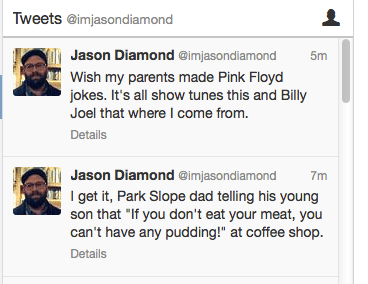
That said, there is room (as is always the case) for ironic, self-conscious use, as Jason Diamond (@imjasondiamond) just observed on Twitter:

Screen Shot 2013-05-10 at 10.51.36 AM

I confess I didn’t get the reference (never fancied Pink Floyd) so had to consult Wikipedia, where I found this under the entry for the song “Another Brick in the Wall”:

The song also features a group of school children for lead vocals in the second verse: as the song ends, the sounds of a school yard are heard, along with the teacher (portrayed as a Scotsman) who continues to lord it over the children’s lives by shouting such things as “Wrong! Do it again!”, and “If you don’t eat yer meat, you can’t have any pudding! How can you have any pudding if you don’t eat yer meat?!”, and “You! Yes! You behind the bikesheds! Stand still, laddie!”, all of it dissolving into the dull drone of a phone ringing and ending with a deep sigh