“Keep Calm and…”: A slideshow of a meme

This slideshow requires JavaScript.

(Note: To start the slideshow, click the image at left or the words “Continue reading,” below. If it moves too fast, you can click the “pause” button at the bottom and advance it one slide at a time with the right-facing arrow.)

If by some chance all this excites you, you can create your own “Keep Calm and” online poster at keepcalmandposters.com or keepcalm-o-matic.co.uk. Both sites let you order actual paper versions of your work; at keep-calm-o-matic, you can also get a t-shirt, a mug, a keychain, or an iPhone 5 case.

At this point, “Keep Calm and” is everywhere. It cannot be escaped. That is all. Carry on.

“Rump”

Joshua Keating’s recent Slate article had a brilliant conceit: how would the U.S. media report on the current U.S. political crisis if it were happening in another country? The piece started:

WASHINGTON, United States—The typical signs of state failure aren’t evident on the streets of this sleepy capital city. Beret-wearing colonels have not yet taken to the airwaves to declare martial law. Money-changers are not yet buying stacks of useless greenbacks on the street.

I recommend you read the whole thing, but the line that’s relevant to this blog is: “…the president’s efforts to govern domestically have been stymied in the legislature by an extremist rump faction of the main opposition party.”

The Oxford English Dictionary’s defines rump (in this context) as “A small, unimportant, or contemptible remnant or remainder of an (official) body of people, esp. a parliament,” and explains that it’s derived from rump Parliament, that is, “the remaining part of the Long Parliament, esp. in its second formation of 1659–60.” As befitting its origin, every citation for rump in the political sense is of British origin.

But it has occasionally been hauled out by Americans. One of the first to use it to refer to the Republican Tea Partyers who have been holding things up in the current mess was Senate Majority Leader Harry Reid (a Democrat). He was quoted as saying on Sept. 27, “The middle class, working men and women in this country, are the ones we were elected to serve. That’s who we should be thinking about. They’re the ones who are going to pay the price if these rump Republicans force a government shutdown.”

A few days later, Mother Jones magazine wrote, “Once again, a rump group of Republican radicals in the House are throwing the US government into chaos.” The day after that, a Baltimore Sun columnist opined, “fault for the current government shutdown lies with the rump, radicalized, tea party-beholden congressional Republicans who have no regard for the legislative process, the country’s credit rating, political traditions, or the U.S. Constitution they supposedly revere.”

Haven’t seen any beret-wearing colonels on the streets of Washington yet, but give it time.

TGIF

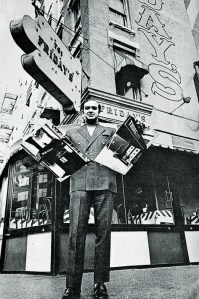
Founder Alan Stillman in front of the original TGI Friday's in New York City.
Founder Alan Stillman in front of the original TGI Friday’s in New York City.

Reader Rosalind Mitchell commented on the recent ta-ta post that the 1940s radio serial “ITMA” (or, “It’s that Man Again”) “also gave us TGIF (‘Thank Goodness It’s Friday’), and since this is now a US-based global restaurant chain this is surely also a NOOB.”

That intrigued me, as how could it not?

The initialism is best known, at least to me, from the restaurant chain mentioned by Ms. Mitchell, which is officially known as “TGI Friday’s” and sometimes called merely as “Friday’s.” Wikipedia reports that in 1965, a young New Yorker named Alan Stillman “purchased a bar he often visited, The Good Tavern at the corner of 63rd Street and First Avenue, and renamed it T.G.I. Friday’s after the expression “Thank God! It’s Friday!” from his years at Bucknell University.” (There are now about 920 restaurants in the chain, around the world.)

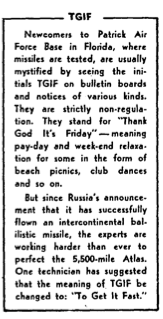
The first time TGIF appeared in the New York Times was in a 1959 article about the U.S. Air Force missile- and rocket-testing site in Cocoa Beach, Florida, which had this sidebar:

Screen Shot 2013-09-26 at 10.31.51 AM

Then came Stillman’s popular joint–one of the first of the “singles bars” on Manhattan’s Upper East Side. The next time the initials appeared in the Times was in a 1969 cartoon (and I’m still not sure how this happened, given that the newspaper is famous for not publishing cartoons). The spot, by Henry Martin, shows Robinson Crusoe spotting a native through some bushes. The inevitable caption: “TGIF!”

A Times reader wrote in to say he wasn’t familiar with the expression, and an editors’ note defined it and explained it was a favorite of–get this–the “Now Generation.” That occasioned a slew of other letters purporting to explain that “TGIF” was much older. One asserted that TGIF went back “at least 30 years–when I first started working in an office, and every stenographer and file clerk intoned those magic initials on Friday afternoons, while combing her hair in the ladies’ room.” Another claimed the initialism was invented by one Richard Amper during a “beer bout” near the University of Missouri in 1934.

It’s hard to verify those claims. But Jonathon Green’s authoritative Encyclopedia of Slang provides an authoritative 1941 quote, from the [Marion, Ohio] Star:

I thought I’d heard of everything in the way of booster clubs, alumni organization and the like, but this city, home of the Ohio State university Buckeyes […] has come up with one that tops them all. It’s the “Thank God It’s Friday” Club, composed entirely of undergraduates here at State. […] A typical meeting of the TGIF club foes something like this….

Now, “ITMA” ran from 1939 to 1949, and it’s possible that someone on the show uttered TGIF before the Ohio State club adopted it, but I’m dubious. For now, I’m going to label TGIF not only not a Not One-Off Britishism, but not a Britishism at all.

“Ta-Ta”

saveTeeBlackThe New York Times’ Sarah Lyall recently ended eighteen years as a London correspondent. The title of her farewell article, “Ta-Ta London. Hello, Awesome,” made me curious about ta-ta, which I hadn’t  thought of as a Britishism. In fact, my main association with the term is a memory of my mother jokingly saying, “Ta-ta, tatele“–the latter word being a Yiddish diminutive for “father.” A Google search also reminded me of a 1993 “Seinfeld” episode where George quits by saying to his boss, Mr. Tuttle, “Ta ta, Tuttle!”

But ta-ta is indeed of British origin. The OED defines it as ” nursery expression for ‘Good-bye’; now also in gen. colloq. use.” The earliest citation is from 1823, and a notable one can be found in T.S. Eliot’s 1923 “The Wasteland Waste Land”: “Goonight Bill. Goonight Lou. Goonight May. Goonight. Ta ta. Goonight.”

None of the dictionary’s examples come from U.S. sources, but it caught on here fairly early, as is illustrated by this 1889 article from the New York Times:

Screen Shot 2013-09-15 at 9.32.59 AM

During the 1940s, an initialized version of the expression merged via a character on the BBC radio program “Itma.” According to the OED, a “famous saying” of the Cockney Charlady, Mrs. Mopp (played by Dorothy Summers), “were the letters ‘T.T.F.N.’—a contraction of ‘Ta-ta for now’ with which she made her exit.” TTFN emerged decades later as an example of teenage online lingo, presumably on both sides of the Atlantic, peaking sometime in the middle of the decade of the 2000s. I gather that from a comment to a 2012 New York Times review of a play called “Peter and the Starcatcher”: “it tries so hard to be contemporary that it manages to date itself to about five years ago by overusing pop culture references and slang (‘TTFN,’ ‘guuuuuuuurl,’ ‘as if,’ and ‘Oh. My. God.’ to list just a few) from that time.”

A similar sounding word, also with nursery origins, but apparently with no connection to ta-ta, is ta, meaning “thank you.” I believe this is still current in the U.K. (in fact, it just showed up in an English friend’s Facebook feed), but hasn’t made any inroads in the U.S. I had a brief moment of hope when a Google search found it in a line of dialogue in a 2003 William Gibson novel, All Tomorrow’s Parties: “’Cheers,’ Tessa said, ‘ta for the lager.'” But when I looked into it, it turned out that Tessa is Australian, a fact Gibson tried to emphasize by having her use three separate British-Australianisms in one sentence.

I have the sense that a single “ta” is sometimes used in Britain as a shortened version of “ta-ta,” the way one might shorten “goodbye” to “bye.” Any guidance on this point would be appreciated. [Update. Several comments have convinced me that I was mistaken on this point.]

Meanwhile, a more recent term, seemingly American in origin, is ta-tas, or tatas, meaning breasts. It’s been especially prominent since 2004, when an anti-breast-cancer foundation was founded with the name “Save the Ta-tas,” prompting many t-shirts such as the admitted click-bait at the top of this post. I hesitate to speculate on the etymology of the term, but the earliest use I’ve been able to find is from the 1997 book Sexplorations: Journeys to the Erogenous Frontier, by Anka Radakovich: “My own lingerie jones is bras. I like plunging my tatas into lace, satin, and vinyl, and I love shopping at Frederick’s of Hollywood.”

“Run to ground”

The fox-hunting-derived expression go to ground, covered here not long ago, came to mind this morning when I read something President Obama said in an interview with Fox News yesterday:

And, you know, we’ve seen some indications from the Russians as well as the Syrians today, uh, that they may be willing to look at the prospect of getting those weapons under control, perhaps even, uh, international control, and getting them out of there, where they could be vulnerable to use by anybody. And that’s something that we’re going to run to ground over the next couple of days.

(By the way, I assume the Fox intern who transcribed the interview got extra brownie points for ever “uh” he or she could stick in.)According to the OED, “run to ground” is a variant of “go to ground,” both meaning (literally) to burrow into a hole in the earth, or, figuratively, to withdraw from public view or lie low. Something or someone can also be run to the ground, meaning worn out through overuse. Obama seems to have meant something different, more like “explore in every possible way.”

As I noted last week in a post on the Chronicle of Higher Education blog Lingua Franca, one of the distressing aspects the current debate over intervention in Syria is the way it’s led metaphors to run amok, including “red line,” “boots on the ground,” and “shot across the bow.” Now we seem to have come to the stage where metaphors are given new meaning, just because they, uh, sound good.

Lost in translation

Wes Davis sends along this from today’s New York Times real estate section. I believe the bathroom in question would not actually be considered a W.C., owing to its non-closet-like largeness and the presence of a shower, but some journos will do anything to avoid using the same word twice:

wes