

Some time ago, I was reading an American friend’s Facebook post. He was remembering when, decades back,
“I was at my folks’ apartment and put on [the album] Blonde on Blonde. My father said, ‘Take off that garbage.’ I stared at him, utterly stonkered.”
For such a productive group of words, “stonkered” and its variants are quite new. The OED‘s first citation is for the verb “stonker,” meaning to kill or destroy a person or thing. The quote is from the Anzac Bulletin in 1917: “Without a gun in their hands the Diggers just went for them and stonkered the lot, except one whom they brought in prisoner.” Anzac refers to the Australian and New Zealand forces in World War I, and for three decades or so, the word was the exclusive province of Down Under, even as it developed new meanings:
- Exhausted: “It’s this rotten pack. By heaven, I’m feeling stonkered! Where the Hell’s Our Camp?” Aussie: Australian Soldiers Magazine, 1918
- Intoxicated: “”There is a difference between a man who is either full, shickered, stonkered … or boozed, and he who is … paralytic drunk.” Perth Daily News, 1922
- Rendered useless or ineffectual; defeated.
- Surprised, gobsmacked: “Why don’t they shut off the confounded thing?” “Too stonkered with surprise, I’ll bet.” A Upfield, Royal Abduction, 1932.
British soliders picked up the verb in World War II and streamlined it. The Daily Telegraph wrote in 1944, “Here was one more message before we left–that British troops on a captured ridge were being ‘stonked.'” (Note inverted commas indicating novelty.) And a reader wrote to The Times in 1993, “To many of my generation who served in the Army in the second world war stonking meant the putting-down of an artillery or mortar concentration on a given target.”
The word caught the fancy of a young RAF officer and Punch contributor names Basil Boothroyd, and he wrote a rather remarkable sketch for the September 6, 1944, number called “Stonking Times.” It begins:
“I should not like to think that the Punch volumes for World War II contained no mention of the stonking types who helped to win it (hoping for a world fit for Stonkers to stonk in) and of they stonking times they had. So I am going to place on record a few facts about Stonkers.”
The word caught on among the British public at large, who, by the late 1980s, were using it as a noun meaning “Something which is very large or impressive as its kind, a ‘whopper.'” A 1994 record review (not of Blonde on Blonde) calls the disk “an absolute stonker.” The next and at this point final development was “stonking” as an adjective, meaning marvelous or great, and adverb, meaning extremely. A 1993 audio review notes, “The Kenwood receiver is … stonking value for anyone wanting to talk their first steps into home cinema.” Some will remember Boris Johnson’s quote from 2019, when he called the Conservative Party’s election victory “a huge, great, stonking mandate.”
By this point, “stonking” is much more commonly used than “stonker” or “stonkered.” As for American use, here’s the Ngram Viewer graph:
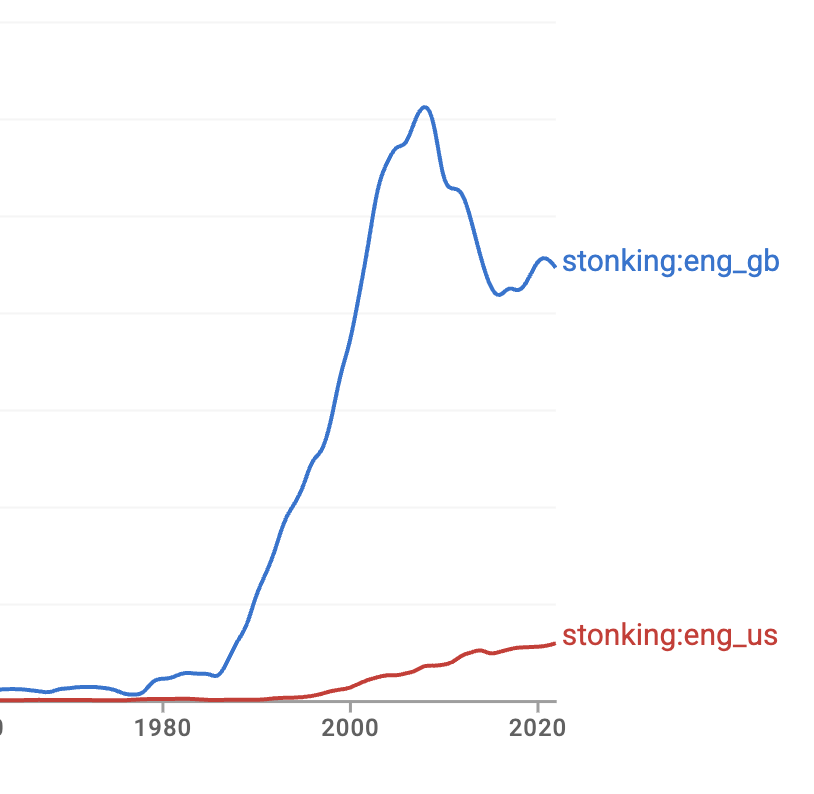
As you can see, the word is still pretty rare in these parts. An early American use was from occasionally Anglophilic Spy magazine in 1998: ” Your drug-use pattern was to make do with ‘ludes and bookze for most of the month and then let rip with a stonking crack and scag binge.”
Earlier this year, in a review of a movie called Nuisance Bear, the Hollywood Reporter wrote: “There’s also beautiful footage of foxes, of stonking big crows right out of Poe and caribou with sprawling antlers that are like contemporary art sculptures.”
And NOOBs Hall-of Famer Dwight Garner of the New York Times referred to a “stonking sentence” by Robert Macfarlane. As usual, Garner was right, and let’s go out with Macfarlane’s words, from Underland: A Deep Time Journey:
“This is the way the world ends, this is the way the world ends, this is the way the world ends — not with a bang but a visitors’ center.”


The Boris Johnson quotation (above) seems somewhat at odds with what the British electorate will recall: “Some will remember Boris Johnson’s quote from 2019, when he called his election victory “a great, big, stonking rejection of Brexit.”
In fact, Johnson declared himself to be pro-Brexit in 2016.
When he was elected as Prime Minister in 2019 he said,
“The people of this country have given us tonight a huge great stonking mandate. They’ve given us this mandate of course because they want us to do one thing, which you all know, they want us to get Brexit done.”
Nick, I have fixed my embarrassing mistake.
— “who served in the Army in the second workd wat stonking meant“
..?? Perhaps ‘second world war’ was meant.
Or perhaps your stonking keyboard is stonkered.
I’m not stonkered but a bit sleep-deprived, and red-faced about the typos and mistakes. Will fix now.
And who can forget the far from classic number one hit from Comic Relief in 1991, “Do the Stonk”. (9) HALE AND PACE – COMIC RELIEF – THE STONK – 1991 – YouTube
there’s also an artillery stonk: an intense and concentrated bombardment of a specific spot or map grid – which kind of points to stonkered as relating to this?
The Stokes mortar arrived on the Western Front in quantity in 1916, the year before the first citation (1917) of ‘stonker’.
The verb stonker could be imitative of the sound of the mortar firing (or its bomb landing and exploding, etc).
If so, the ‘sss’ would be the bomb sliding down the tube, ‘tonk’ would be the mortar firing. The ‘er’ of ‘stonker’? – perhaps a short reverberation, or ringing of the tube; combined with compression of the ear drum.
https://en.wikipedia.org/wiki/Stokes_mortar