

I’m (usually) not one to turn down a challenge, so a post the other day by Lynne Murphy, the OG of British-American language differences, caught my attention.
On her blog Separated by a Common Language, Lynne (a native American who has long taught linguistics at the University of Sussex), brought up a particular preposition, remarking: “A few months ago, an American friend of my spouse asked him to ask me: ‘Why is everyone suddenly saying alongside?’ I hadn’t noticed it at that point, but once he’d mentioned it, I felt surrounded by alongside.”
She included an Ngram Viewer graph showing not only a recent increase in use of “alongside” but also that it’s a NOOB: it has been more common in Britain for more than a century, but American use has ticked up since the 1990s.
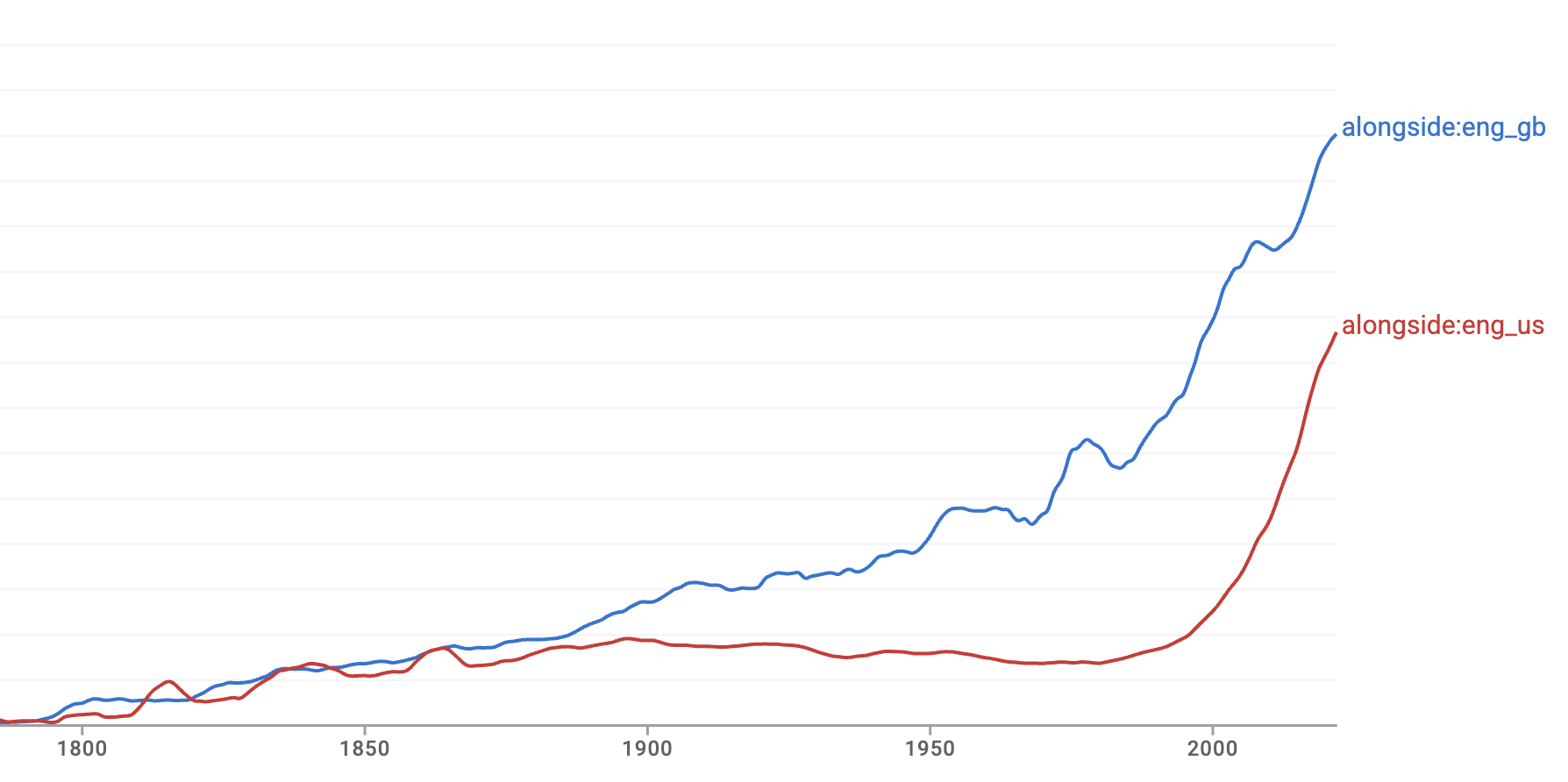
The OED notes “alongside” was “originally nautical” and gives this definition: “In a position parallel to; side by side with; close to the side of; next to, beside.” The first citation is from 1704; the following century, it started to be used in non-nautical contexts.
Lynne wondered why Americans have taken to this long word, when there are such briefer alternatives as “next to,” “beside,” “next to,” and “with.” And here is where the challenge comes in. She recalled that in 2013, I wrote an article for Slate about Americans’ (especially young Americans’) recent fondness for saying or writing “amongst” instead of the completely synonymous and one-letter-shorter “among.” And she produced data from the News on the Web corpus showing that American use of “amongst” actually peaked the following year.
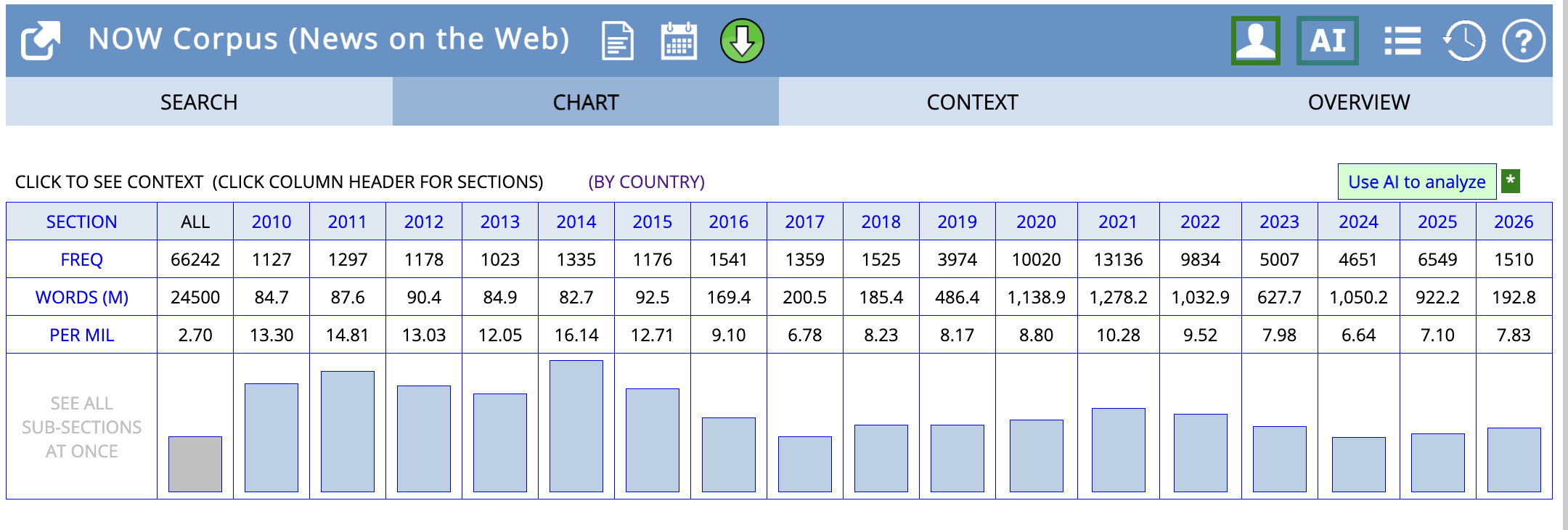
“Perhaps,” she mused, “once people were talking about the ‘British invasion’ of amongst, Americans became more self-conscious about it. If Ben published an article about alongside, could that change its fortunes?”
Well, challenge accepted.
I actually have a very specific association with the word” alongside.” In the late ’90s there was an Aaron Sorkin sitcom called Sports Night, which centered on a double-anchored, smart sports news show very much on the model of ESPN’s Sports Center. Anyway, when one of the anchors intro’d the show, he always said “alongside”—i.e., “This is Dan Rydell alongside Casey McCall.” The intro was so much a feature of the show that it’s repeated in this AV club piece:
As Dan said it, it had a slightly ironic, Lettermanesque feel.

As to the word’s popularity, I place it alongside other lengthened or lengthy words, not only preposition like “amongst,” “towards,” “amidst” or (the admittedly still rare in U.S.) “whilst,” but also “oftentimes” (with “t” pronounced), communications or admissions departments (used to be communication and admission) and something I’ve started to see a lot lately, an “advanced” (i.e., pre-publication, or “advance”) copy of a book. Contrary to what you might expect, people seem to want to talk longer, not shorter.
Will this post have any affect on the popularity of “alongside”? I am highly dubious, but crazier things have happened.
 notoneoffbritishisms.com
Alongside ?
A nautical term ?
What do you expect from the country with a great Royal Navy ?
I don’t recollect hearing this word much– or more than usual– so I’ll start listening. I would argue, however, that there is a difference between alongside and beside or next to. I think alongside is cozier, implying a relationship or an intentional pairing; beside or next to are like dice that have been rolled and land adjacent to each other, or like buildings built decades apart which happen to be on the same street.
As for the other words you cite, I attribute use of amongst and whilst to the silly notion that British words are more correct or classier. Similarly, communications and admissions are brought to us by the same luminaries who bring us housing or commercial developments spelled centre or harbour.
Oh, and congratulations, Ben, for mitigating the muck of amongst. I was unaware of that good deed.
Towards vs toward, however, is a different story. I believe it is just whatever the person says that day or under those circumstances; I don’t think most Americans, anyway, stick to one or the other. (I do, but it’s ideological for me.)
Alongside also may be a CANOE word, which is a bit of a tangent from the usage discussion but worth considering.
I have been searching for the meaning of ‘CANOE word’ but can’t find anything. Can you explain the meaning of this phrase please David? Thanks.
I think you have a typo – among is two letters, not one, shorter than amongst.
I think the present day, non-nautical usage of ‘alongside’ has specific nuances to distinguish it from “…such briefer alternatives as “next to,” “beside,” and “with.”” that Lynne cited.
‘Alongside’ can suggest co-operation, simultaneity and complementation in a way that those alternatives would not always do as effectively.
Consider:
Political will WITH a cash injection really makes a difference. (Both elements are present.)
Political will ALONGSIDE a cash injection really makes a difference. (Implies elements working together.)
Put the cards NEXT TO each other. (Any orientation.)
Put the cards BESIDE each other. (Suggestive of long sides adjacent.)
Put the cards ALONGSIDE each other. (Unambiguously long sides adjacent.)
If I want to give a sentence impact, I might say ‘amongst’ to benefit from the harder sound at the end of the word. ‘Among’ has a limp, flabby finish and I might write or say that if I want to seem sympathetic. (“You’re among friends here.”) Also, in the middle of a sentence, ‘among’ would provide a smoother flow from word to word. (“Love among the ruins”/“Love amongst the ruins”. Which sounds better?) ‘Amongst’ works well where the word is being used emphatically, in a comparative sense. (“Not surrounding the demonstrators but amongst them.”) What if some of the Americans using ‘amongst’, ’towards’, ‘amidst’ and ‘whilst’ are doing it not out of vacuous copycat posturing but to add punch to a word because of it’s context?