

I’ve just finished a book called The Disappearing Spoon: And Other True Tales of Madness, Love, and the History of the World from the Periodic Table of Elements, by Sam Kean. It’s highly recommended, as Kean makes this ostensibly abstruse subject come alive, even for a complete non-scientist like me. But I bring it up here for another reason, the way Kean (an American) spells one of the elements: “aluminium.”
The metal’s history is fascinating. It was discovered in the early 1800s and for decades was more precious than silver or gold, because of the difficulty of extracting it. At first there was no consensus on what it should be called . Then, in 1811, following the model of potassium, magnesium, sodium, and many other elements, a scientist proposed “aluminium,” and it stuck. But not for long, or, rather, not for long in the United States. First, Noah Webster, in his 1828 An American Dictionary of the English Language, endorsed “aluminum.”
But the “-num” spelling really took off in the U.S. in the 1890s, as this Google Ngram Viewer graph of American usage shows. (The blip in the 1830s is presumable due to Webster.)
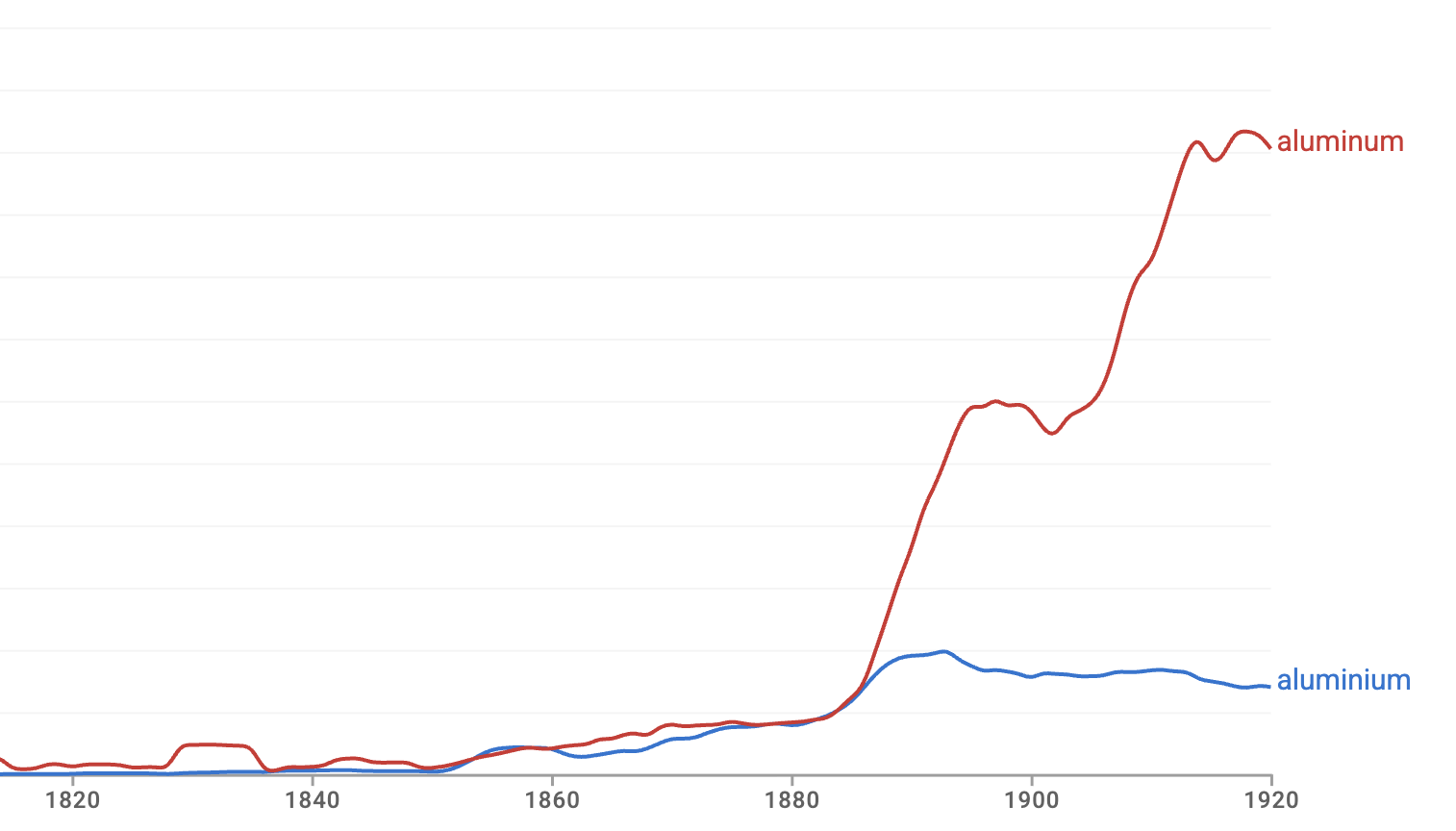
The rise and subsequent dominance is probably due to the influence of Charles Hall. In 1886, as a young freelance scientist, Hall discovered a cheap and easy way to extract the element. He went on to found the Aluminum Company of America, aka Alcoa, and become fabulously rich. Sam Kean reports that when Hall applied for patents on the process he’d discovered, he used the “aluminium” spelling.
“However, when advertising his shiny metal, Hall was looser with his language. There’s debate about whether cutting the i was intentional or a fortuitous mistake on advertising fliers, but when Hall saw ‘aluminum,’ he thought it a brilliant coinage. He dropped the vowel permanently, and with it a syllable, which aligned his product with classy platinum. His new metal caught on so quickly and grew so economically important that ‘aluminum’ became indelibly stamped on the American psyche. As always in the United States, money talks.”
Meanwhile “aluminium” held fast in the rest of the world, and in the scientific community. (In Britain, interestingly, “aluminum” has shown some growth in the past several decades.)
Admittedly, other than its use by Kean, “aluminium” is a marginal Not One-off Britishism. A search for that spelling in the New York Times archives yields 2901 hits, but the majority are from before 1910 or so, which seems to be roughly when the newspaper’s own style changed. Recent uses tend to be from articles about British football on the Athletic website or quotes from non-Americans, such as the British anti-vaxer Christopher Exley:
“In an email to the New York Times last week, Dr. Exley wrote, ‘Secretary Kennedy asks my advice on aluminium in adjuvants as I am the leading authority on human exposure to aluminium.'”
The British spelling did slip in in April 2025, in a graphic accompanying an article on tariffs.
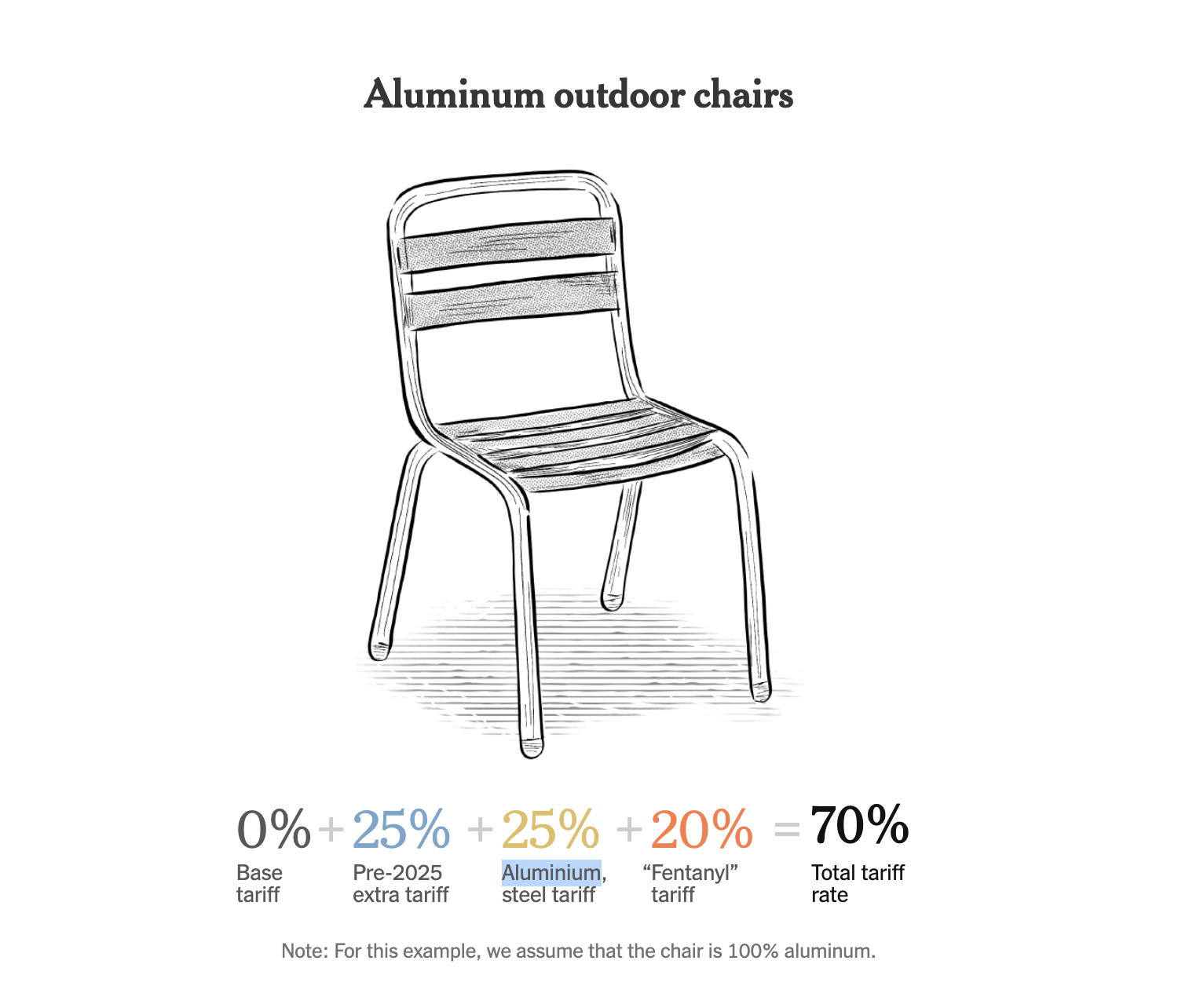
But given that the graphic’s heading and the note on the bottom use “-num,” I’m pretty sure that was a one-off.
 notoneoffbritishisms.com
Just to be provocative, I’ll note that, once again, the American usage simplifies and thus improves the language. 🙂
That there are two different spellings of this word was news to me till I saw and read this item. I had thought that the pronunciation with the extra ‘ee’ sound was peculiar to British speech, but now of course I see that it’s actually spelled differently, with an extra letter, and the second ‘i’ accounts for the more stretched-out pronunciation. Then there’s also the first syllable, which sounds like the name “Al” in the British and Canadian versions, while in the US we say a-luminum, with no accent on the first syllable.
We don’t pronounce platinum as platinium in the UK, so I don’t follow the logic in thinking that we simply mispronounce aluminium as aluminium 🤔
…aluminum as aluminium…
I have worked in telecoms and electrical engineering for my whole career and frequently, in gathering and selling non-ferrous scrap metal, I search for prices on line and visit scrapyards. I have never encountered the ‘–num’ spelling or pronunciation in the UK. The only time I see or hear it is in U.S.-originated material in print or on line. I am puzzled, therefore to see the uptick from the 1980s when I select ‘British English’ on your Ngram. I can only presume that British Generations X, Y and Gen-Z (yes, we pronounce that instance as ‘zee’) have adopted ‘–num’ but I have so little to do with them that I have been unaware of it. I will be looking for it in a hyperaware way from now on.
I’ve asked Lynne Murphy to look in to the apparent British trend toward “aluminum,” and whether it might qualify as her choice for U.S.-to-U.K Word of the Year (last year it was “zee”!). Let’s see what she has to say.
That last comment from cheerful10fa6f68d4 was actually from Nick L. Tipper but I was not asked my name this time.
Yes, in “official” scientific usage (the International Union of Pure and Applied Chemistry’s nomenclature), it’s “aluminium” even for American chemists, and “sulfur” even for the British.
I’m so used to the British spelling and pronunciation that when I read US texts, I hear the British word in my head.
Lynne Murphy recently posted about how Gen Z was making the US “zee” pronunciation popular in the UK. I had been reading it as Gen zed. (Similarly, there’s a Philip K Dick book I read back when I was a teen in the sixties where there is a drug called Chew-Z. It was only much later a friend pointed it was pronounced “choosey”.)
Your fascinating post reminded me of research I did into the switch from beer bottles to cans, after finding these in our attic! https://radnorhistory.org/your-radnor-story/radnor-story-3-the-beer-cans-in-the-attic/ These were made of steel (circa 1937-1938) before the switch to aluminum 20 years later!