

The OG of British-American language comparison is Lynne Murphy, a U.S. native, professor of linguistics at the University of Sussex, author of the book The Prodigal Tongue and the blog Separated by a Common Language. On the blog she annually chooses two Words of the Year: a U.S.-to-U.K. export (this year it’s pronouncing the last letter of the alphabet “zee” instead of “zed”) and, what’s interesting for my purposes, a word or phrase that’s traveled from the U.K. to the U.S. The winner for 2025 is, drum roll please, the adjective “fiddly.”
The OED defines it as “Requiring time or dexterity; pernickety” and has citations going back to 1926. Early uses were strictly British but it traveled to America by the 2000s and, as Lynne notes, I wrote about it on this blog in 2016., when a common phrase was “fiddly bits.” She observes that the News on the Web (NOW) corpus gives the impression that U.S. use had a bump in 2014, dropped off for a couple of years, and has been steadily increasing since then.
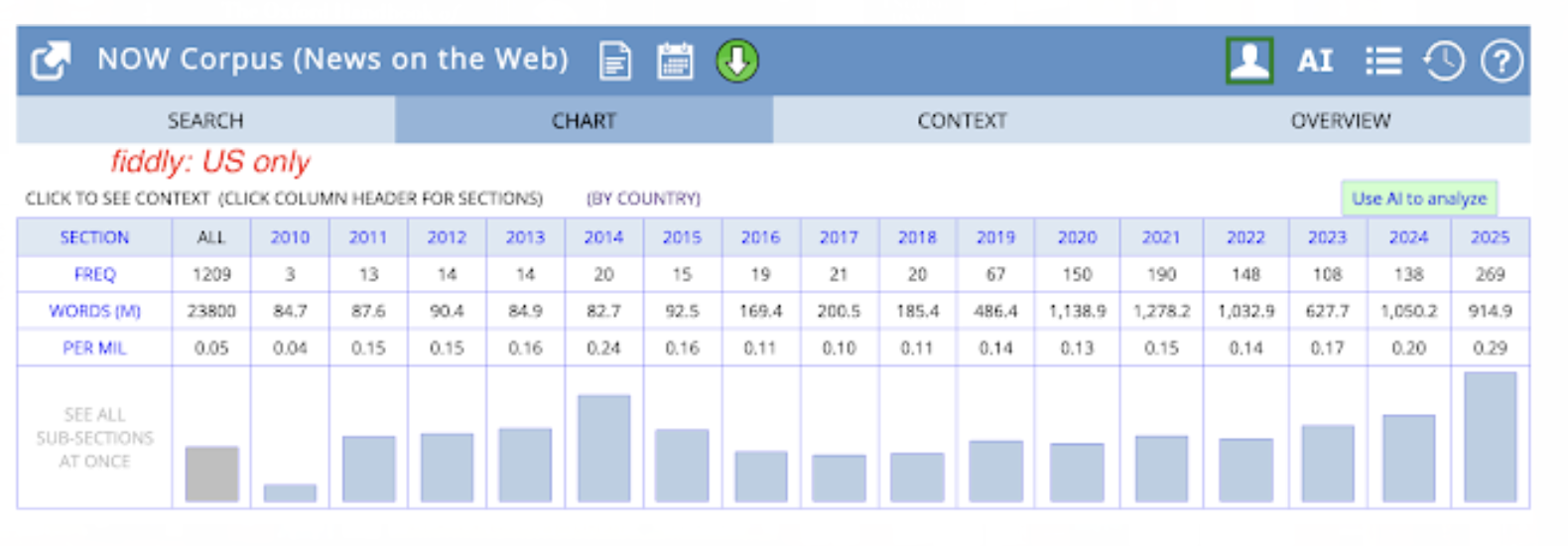
She looked at the ten most recent uses in the corpus and found that “Many things and activities … are fiddly: some kind of electronic device, rolling and stuffing a baked good, cleaning ear buds, a fictional mystery story, installing something on a bike, actions in video games, frostings and icings on Christmas cookies, using an infant car seat, paperwork.”
One commenter on Lynne’s post suggest a possible entry point for U.S. use of the word: board-game aficionados. He gives a link to a 2010 thread on the BGG (Board Game Geek) kicked off by someone commenting:
“I’ve seen people talk about how a game is ‘fiddly’, which usually means that they don’t like it as much…. So, what makes a game fiddly, and why should that detract from the game? Is chess fiddly because of all those pieces you have to move? Is Alea Iacta Est fiddly because you have to deal with all those dice? Is Dungeon Lords fiddly because of all those imps, adventurers, monsters, damage cubes, etc.? Dominion must be fiddly, because you have to shuffle so much. So what are your thoughts? Help me to understand.”
There are twenty-three responses, including this clear and non-fiddly one:
“I use the term and think it a nice summation to what most have voiced here: at discreet points in the game, players are required to perform the tasks listed in the rules. Those tasks, for one reason or another, are usually difficult to remember and sometime cause errors in play or recurring rules consultations. The number of bits isn’t necessarily the cause though. It just as easily can be caused by a litany of housekeeping at the ends of rounds (player A gets a free X cause he’s in last, player B moves up two because they lost dominance, player B also gets to choose a consolation prize from the items in board area 3.”
Thanks for clearing that up!
 notoneoffbritishisms.com
Good afternoon, Ben!
Perhaps the effect of using sans-serif type, but I was puzzled when I read, in your posting above, “Alea Iacta Est.” I don’t know if that is how an uppercase “J” might be rendered in that font, but, of course, the verb form used by Caesar was “jacta” for “throw.” It looks like an “L” in the text you cite.
Not sure how to interpret that. My Latin is at least 60 years old. Maybe “Milk the die?” or “The die is (made of) cassia”?
Made me grin to think about it. And to reflect on why I love serif-type so much!
Best regards!
Tim Orr
Of course in Caesar’s day, j didn’t exist as a letter distinct from i (maybe your Latin classes 60 years ago mentioned that). That’s why Suetonius, writing about Caesar, wrote the phrase with “iacta”, and why the board game is named Alea Iacta Est with a capital I.
I had forgotten the “i”/”j” identity! Thanks for pointing it out. Of course, it is still true that with a serif font, the difference between “i” and “j” would be clear.
1
I wonder… about that last paragraph.
at discreet points, or at discrete points?
I assume fiddly comes from fiddle: small finger movements and hence a violin used for playing fast paced jigs and reels.
I also wonder if these were possibly originally derived from the bow drill fire starter… Something that required dexterity, patience and concentration.
In the UK there is also the phrase ‘fiddling small change’ meaning small coins too low in value to be bothered with….
I know it as piddling small change, piddling meaning to urinate.
“…since a Ningi is a rubber coin six thousand eight hundred miles along each side, no one has ever collected enough to own one Pu. Ningis are not negotiable currency, because the Galactibanks refuse to deal in fiddling small change…”, The Hitchhiker’s Guide to the Galaxy 🙂
However, Chambers dictionary define both fiddling and piddling to mean trifling.
Fiddly? Unnecessarily complicated, while it (whatever) could be simpler. Often a term of frustration.
‘Fiddly Bits’ however has a completely different connotation, UK side…….. usually a euphemism for adjusting genitalia, it you get my thrust!
An inspired choice. Yes, I think it’s become a valid NOOB, though I don’t know whether it’s via games or something else. It’s particularly valid, in my case, because I am not only officially, if light-heartedly, against the infection of American by British words and usage, but I especially can’t stand “fiddly.” My British wife has, of course, used the word for the decades I’ve known her, and that was no problem, but I’ve developed an animus about its more widespread use. It’s not fair and/or irrational, but I can’t help it. It just seems like a childish term for describing a complex operation. I also know exactly when and why I turned against it. In about 2012, I started watching the British TV show “Wheeler Dealers,” which is about two guys who fix up cars and sell them. The first mechanic of the three the show has employed, Edd, used the word often to describe steps or elements or components of repairs he was undertaking. It caught my ear because the word didn’t seem substantial enough for that. But, fine, I could live with Edd saying fiddly on one show. Then I started hearing Americans use it more and more, and that just rubbed me the wrong way. Uncharitable, to be sure, but that’s the way I often am when it comes to NOOBs.
My perception of ‘fiddly’ is purely in regard to things that are physically awkward to achieve. In the established British usage of ‘fiddly’, I can’t see how the quoted examples ‘a fictional mystery story’ and ‘paperwork’ (unless it’s origami) could have the attribute ‘fiddly’ applied to them.
Perhaps this is an example of a word which, in crossing the pond, has undergone a broadening of its meaning.
So Lynne Murphy is ‘the Own Goal of British-American language comparison’…hmm.
As for fiddling vs piddling, let’s not forget ‘fiddly-piddly’. Which reminds me of when I’d tell my daughter not to ‘dilly-dally, shilly-shally, or finny-fanny’. For those who don’t recognise it, the last is from ‘fannying about’.
I too thought ‘own goal’ and was puzzled as to why Ben would write that about the revered Lynne. A little digging has revealed ‘original gangster’. I wonder if this will catch on in the UK. Maybe it already has and I am old and out of touch.
I too had to look it up, Nick; spelt ‘gangsta’ perhaps. I echo your other comments. I used to be a few years behind the times, now it’s more often 10-20 years.