

Anthimeria (also known as “functional shifting”) is a linguistics term that refers to a word being used as an unaccustomed part of speech. It happens a lot, as when people started to say, “I’m going for a run,” or the first advert(isement) that proclaimed something like “Welcome to extraordinary!”
Two NOOB-y examples recently popped up. My friend Hillard Pouncy sent me this quote from Josh Marshall at the Talking Points Memo blog: “We start with a piece in this morning’s Punchbowl which is simultaneously encouraging and gobsmack disheartening.” That is, he is using “gobsmack” as an adverb. I’ve searched around a bit and, having found no other examples, conclude that this is a one-off. Hopefully it will stay that way.
Next is a quote that NOOBs-friend Mike Pope posted on Facebook (he didn’t name the source, but “straight away” suggests the writer is British):
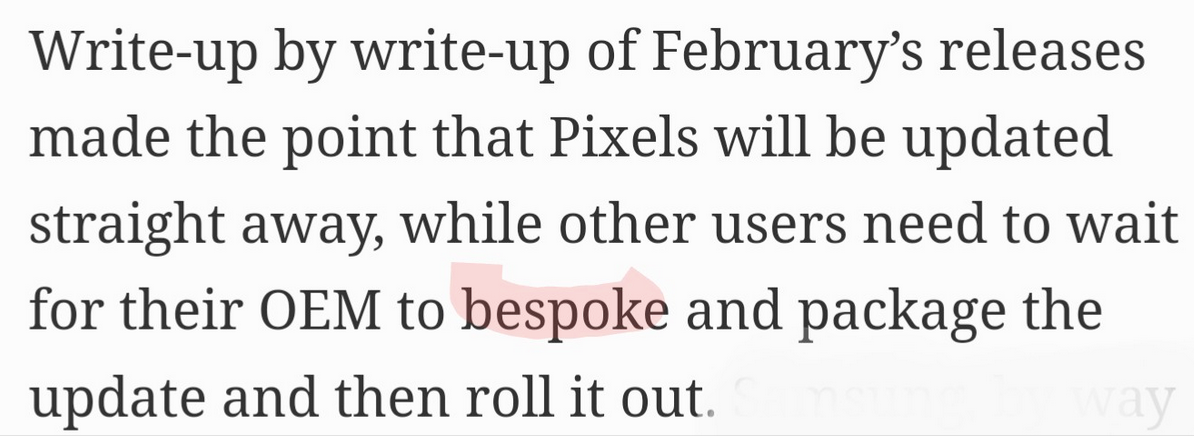
That is. “bespoke” as a verb meaning, as one commenter on Mike’s post pointed out, “tailor.” (That of course is itself an anthimeria, albeit a venerable one; the OED reports that “tailor” was used as a noun by 1297, and a verb by 1662,)
The OED doesn’t recognize “bespoke” as a verb but it’s out there. To separate it out from the noun I searched for “bespoked” in Google Books and got a non-negligible number of hits, including:

and

Meaning that this one, alas, appears to be no one-off.
 notoneoffbritishisms.com
I do sometimes wonder whether these examples are non-native speakers or perhaps even AI’d (can I claim that or has it already gone?).
“gobsmack” as a verb is quite old and comes from Irish and Scottish gaelic, probably from around the 13th Century.
Alan
Ugh. “Can be bespoked”
I don’t like doubling words in conventional usage “He had had enough of…,” much less doubling up syllables when such verbs as ‘customized,’ ‘tailored,’ ‘adapted,’ ‘altered,’ ‘conformed,’ ‘adjusted,’ ‘fitted,’ etc.
And I suspect that the use of ‘morphologically’ in the second example is a bit of window dressing too. Someone, I would guess, thought that a sentence like this: “The pod can be tailored to the required size and specification…” was just not fancy enough.
Oy. Sorry about the incomplete sentence in the first paragraph of my reply. Sadly, editing is not an option.
“Had had” is the pluperfect form (or past perfect form) of the verb “have.” It’s a way to refer to something that happened before something that happened in the more recent past.
Indeed, I remember coming across “had had” at primary school and I asked the teacher if this was a misprint. I can’t recall the explanation but I think the book it was in was adventures of Muffin the Mule, which dates it.
Here’s a Wikipedia article that contains a spectacular demonstration of the importance of punctuation, using a long string of hads.
https://en.wikipedia.org/wiki/James_while_John_had_had_had_had_had_had_had_had_had_had_had_a_better_effect_on_the_teacher
Sorry it’s neither a NOOB nor even an OOB, but one I am seeing more and more is “setup” used as a verb. I am frequently being told to “setup” something, when what they actually meant was “set up.”
(Reminds me of Rudolf Flesch’s remark that people who cannot express themselves clearly are usually unable to think clearly.)
I’ve always thought that “bespoke,” even as an adjective, was nothing more than an American attempt to do what Edwin Newman called “putting on the dog,” an affectation rather like saying that something “begs” the question instead of the correct and less pretentious “raises” the question.
I guess we need to look at a Google Ngram to see whether even the English use “bespoke” all that frequently.
Your “setup” example reminds of one that regularly bugs the hell out of me: “login” as a verb, as in “Click here to login”.
‘bespoke’ as an adjective saw an increase in UK English (I suspect this is in the software context) in the early 21st century, it seems to have been catching on in the US more recently.
I think it’s always been an adjective. That’s the only definition the OED has, with examples starting in 1755. (“At length a bespoke play was to be enacted.”) A big upswing in use started in the 1980s, according to Ngram Viewer
I am offended by Josh Marshall’s use of ‘gobsmack’ as an adverb. Gobsmackingly would have been more acceptable, to me. I hope it doesn’t catch on.
I’m not mad about (i.e. keen on) ‘bespoke’ as a verb but I think its use is already widespread and gaining popularity among the kind of people who overuse ‘going forward’ when they mean ‘in the future’.
Totally agree. Could you see Blackadder describing something as ‘gobsmack awful’ ?
Ngram Viewer says “bepoke” significantly more common in Britain than US except 1840-1855, when it was roughly equal.
76 year old native British speaker here.
Bespoke was never a verb in the way it is used here; it’s the past and past participle of bespeak, a virtually obsolete word meaning to order or commission. It was the practice for gentlemen to buy a length of cloth and then instruct – or bespeak – a tailor to make a suit for it: hence the term ‘bespoke tailor’. You will probably find the word used properly in a book by Jane Austen or one of Georgette Heyer’s Regency romances.
Language evolves and this seems to be a neoligistic usage. But it grates on my ear (and eyes). Will we also get bespoken in time?
Whilst writing, can I also complain about underway as a single word?
I’m not going to look it up, but I recall editing “underway” in someone’s writing about 30 years ago only to have that person argue that it was correct as used. She was right. I stood corrected.
There is a correct use for underway, as opposed to under way, but the distinction has all but disappeared. The one that makes the most sense is a passage under something, but I don’t know that I’ve ever actually heard anyone say that, as in “I took the overpass and the underway to get there.”
George Orwell in Politics and the English Language quotes a letter to Tribune which includes the sentence: ‘Timidity here will bespeak canker and atrophy of the soul’. Obviously the author of the letter didn’t know (in 1945 or so) what ‘bespeak’ means (meant) and guessed that it must mean something like ‘indicate’.
Lawrence Vosper and Siginthistorian, this usage of “bespeak” was old before you were born, whether you noticed it or not. Why don’t you try looking it up in a dictionary (an old one)? Among the definitions in the OED for “bespeak” is II.7.a. “To speak of, tell of, be the outward expression of; to indicate, give evidence of,” with examples from 1629, 1673, 1778, 1814, and 1863. No usage guide has ever objected to this use, because it isn’t new; it has remained in continuous standard use since Shakespeare’s day. You can easily find examples from the late 19th and early 20th century in high-prestige sources, if you’ll bother.
(Orwell had his problems, but he didn’t claim “bespeak” was misused in that quotation; he simply says the passage as a whole has “staleness of imagery” and “lack of precision”, which is true enough without any misused words.)
those aren’t Britishisms at all. those usages would be just as alien and weird in British English as they are in North America
The current example of anthimeria which I find grating is ‘compute’ as a mass noun (meaning computing resources). There is an example here in the third paragraph of this article on The Register.
The world of information technology has brought us many neologisms over the last half century, some good, some bad. This is definitely in the bad category.
Sorry! Not understanding. Isn’t “compute” in that article being used as an adjective? Not that that is a good thing, by any means. Adding a single “r” would have smoothed things out.
Apologies. the link to The Register article referred to in my earlier comment has disappeared. It should be: https://www.theregister.com/2025/02/01/deepseek_kettle_ai/
I don’t want to hijack the topic onto my personal peeve, but if you listen the podcast which is embedded in the link to the The Register, at 4:33 you can hear Tim Prickett-Morgan say “it was a fraction of the compute …” I have also heard the word being used as a noun on several other occasions elsewhere.
My latest dislike is ‘move’ instead ‘movement’ as used in the otherwise excellent podcast Ukraine: The Latest (from the Telegraph): ‘there’s not a lot of move on the ground’.
18/2/2025 – Today’s NYTimes Connections Puzzle has Britishisms as one of its categories, the words being butty, chippy, footy, telly. I don’t think you’ve listed all of those, Ben; this job will work you into the grave.