

Back to H.L. Mencken and his The American Language. In a supplemental volume published in 1945, he writes:
The English opposite number, signifying a person in corresponding office or position, e.g., the American Secretary of State with respect to the English Foreign Secretary, has made some progress in the United States in recent years, but only on relatively lofty levels: the common people know nothing of it.
Mencken also says, “It has come in England since World War I, and probably had a military origin.” The first part of that sentence is wrong, and for the second, I would replace “military” with “naval or nautical.” The first citation in the OED is from 1874: “The next time the fish rose it was close to one of our boats, in which was Jemmy Gray, a sure and successful harpooneer, who, unlike his opposite number in the other boats, quickly fired and got fast.” (A.H. Markham, Whaling Cruise to Baffin’s Bay.)
Using Google Books, I was able to antedate that by two years, with a quote from The Medical Press and Circular, from October 2, 1872:

Google Ngram Viewer shows a sharp increase in British use of the phrase in the 1910s and ’20s, followed by an American uptick just about the time Mencken was writing.
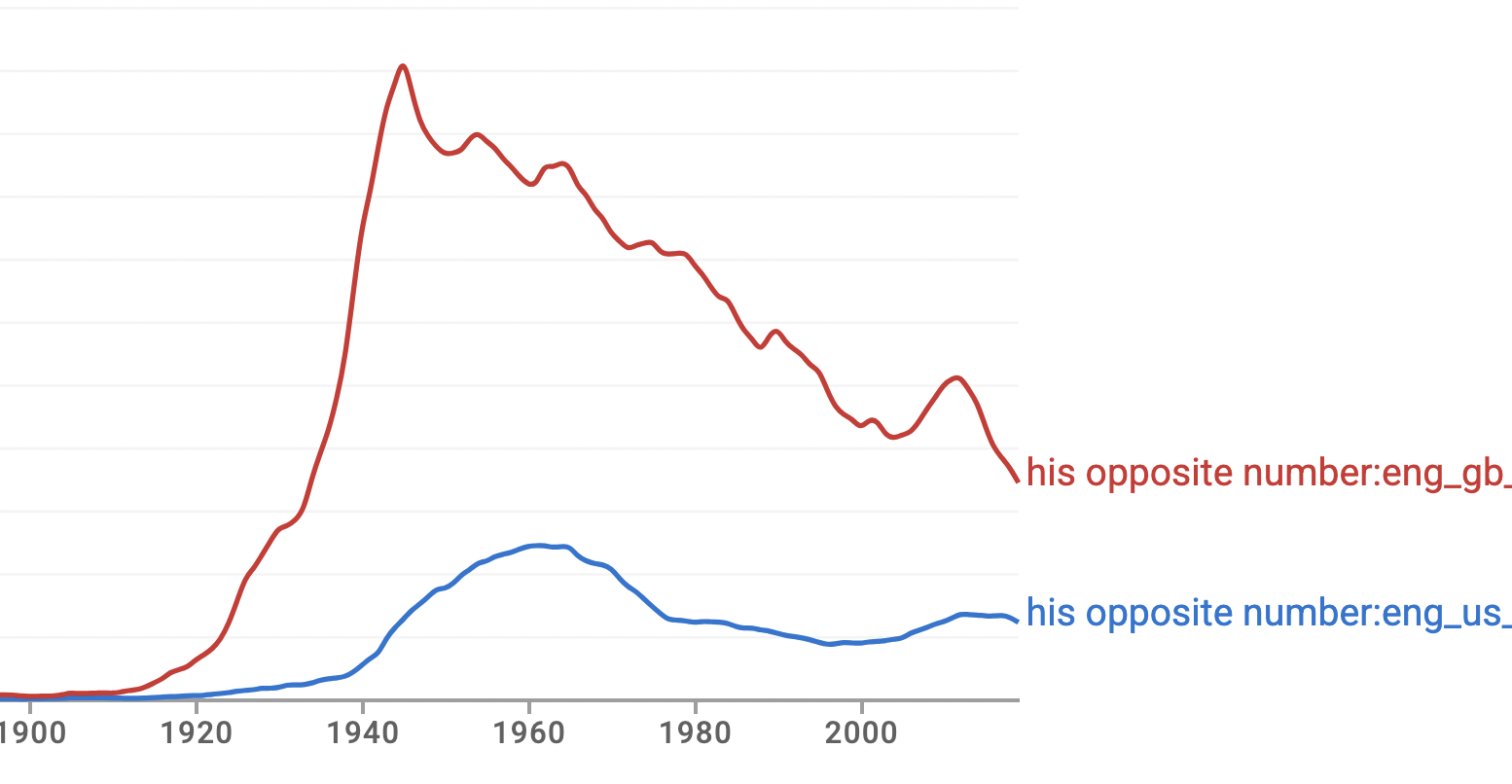
“Opposite number” is quite familiar to my American ears, albeit a little old-fashioned; I was surprised to learn of its British origin and, especially, that it currently seems to be more than twice as common in the U.K. as in the U.S.
The New York Times first used the phrase in a 1940 movie review, and it’s been in the paper about 700 times since then. But the figure is misleading. The most recent forty-six uses, dating back to the summer of 2024, have all been in coverage of football/soccer, mostly concerning English or European teams, in the Times’ sports site, The Athletic. For example, “Over 30 minutes had passed after [Manchester City manager Pep] Guardiola left the room and, still, his opposite number was nowhere to be seen.”
Which suggests to me that “opposite number” currently lives most robustly as a British sportswriting cliché. Or at the very least as elegant variation for “counterpart.”
 notoneoffbritishisms.com
There is a related military slang term, oppo, which seems to have started as particulalry meaning your opposite number (doing the equivalent job) in a different watch or team, but now seems to mean something more like colleague, or perhaps buddy.
I remember my late father – a 22 year Royal Navy veteran – used the term in both ways from as far back as I can remember, until his death in 1999.
I still hear it regularly in my local pub, which is next door to RMB Stonehouse in Plymouth!
Me and the trouble and strife say oppo; we’re aware it means opposite number, which we virtually never say. She has just the one colleague, who performs the same role; her oppo.
And “oppo research” is something else.
I’d never heard of “oppo research”, Ben.
And I was mistaken – the missus said “opposite number” in full a day or two ago.
“to the English Foreign Secretary”
British Foreign Secretary.
The British Foreign Secretary may be English, but England has no government, is not an independent country, and so has no foreign secretary of its own.
Interestingly, I got this from Wikipedia on the subject of English vs British, so perhaps Mencken reflected what was then common usage:
In 1965, the historian A. J. P. Taylor wrote,
One to direct to HL Mencken. I think back then people were even less aware of the differences.
And thank goodness that no English person has ever conflated England and Britain, or English and British. 🙂
Given the date of your whaling citation, I have a suspicion the term may originate in football. The Football Association was founded in 1863, with the laws of the game also published that year, and the Rugby Football Union and its code following in 1871. Unlike the American game, both soccer and rugby players wear numbers 1 – 11 and 1 – 15 respectively, their opponents in the same position wearing the same number. For example, both scrum halves wear No 9. Indeed, in rugby, some positions are actually called by their number, notably the Number Eight. (Just to be different, for many years some clubs insisted on wearing letters rather than numbers.)
Sounds highly plausible to me.
The first recorded use of nuumbered shirts for soccer players is in 1911 in Australia. They were not adopted in England until the 1930s.
American football players do wear numbers. What’s more, a number associated with a particularly admired player is sometimes retired, meaning that number is never used again on the team. I don’t know if this is the reason you now see players with number 0.
I appreciate that American Football players wear numbers but, unlike soccer and rugby players, those starting in the same position as their opponents do not necessarily wear identical numbers, nor are the numbers restricted to 1 – 11 and nor are players in the same position on the field simultaneously. For example, do opposing quarterbacks both wear the number 8 and do they ever face each other on the field? Their equivalent position in rugby, the fly-half, always wears the number 10 (unless replaced during the match) and takes to the field with his or her opposing fly-half.
And a quick check on Sky Sports I saw highlights of a game between Crystal Palace and West Ham. There were shirt numbers in the 20s.
Is that still the case? I don’t usually watch football, but sometimes I’m going through the channels on TV and there’s a game going on. Substitution during matches are now allowed and it looks like the manager (or one of his assistants) holds up a sign saying which number is coming off and the number of their replacement. (And did goalkeepers ever wear number 1. Not that I remember.)
Traditionally, soccer players wore numbers 1 to 11 according to position. I am less familiar with soccer than rugby and, apparently, many professional soccer teams now wear squad numbers across the season, similar to gridiron. Rugby remains unchanged, with starting players wearing numbers 1 to 15 according to position. Replacements wear numbers 16 to 23, forwards having the lower numbers.
When I was a lad, the players didn’t hold onto their numbers like they do now, so that whoever was playing in goal would be 1, etc. That’s no longer true but the positions are still commonly referred to by numbers (like this)
Nowadays, numbers are assigned to professional footballer players at the beginning of the season, and the 1-11 numbers indicate what the manager sees as his starting 11, based on position. The rest of the squad are assigned numbers >11. Of course, during the course of the season, who the starting 11 will change frequently. The position-based numbers are not re-assigned game-by-game. Modern managers rotate their teams a great deal more than was common in the 19th and early 20th century.
In basketball, they also speak of positions by numbers 1-5. That is, players and coaches do – the journalists and fans who’ve never played organized basketball don’t generally use the numbers. But those numbers are not the numbers worn by the players.
As a Canadian, I know “opposite” number in a political sense as when one refers to a Cabinet Minister, eg Minister of Health, and their “opposite number” across the floor, being the Shadow Minister of Health. In a cooperative parliament, a Minister being absent from the floor will often seek to “pair” with their opposite number so as not to upset the balance of members.
I was wondering that myself. Not claiming that the phrase *originated* in politics, but that the existence of an oppositional Parliament keeps the general concept more in the public mind.
It’s occurred to me that the modern slang ‘opp’ (short for ‘opposition’ and meaning ‘rival gang member’ or ‘enemy’) is very different in meaning to the morphologically similar ‘oppo’ (opposite number). Imagine the confusion if, as is their wont, Aussies start referring to ‘opps’ as ‘oppos’!