

Judging what I’ve been reading in the sports pages and hearing in broadcasts, sports (“sport” if you’re British) has become a fount of Not One-Off Britishisms. Here is a recent headline from the New York Times’ sports division, The Athletic:
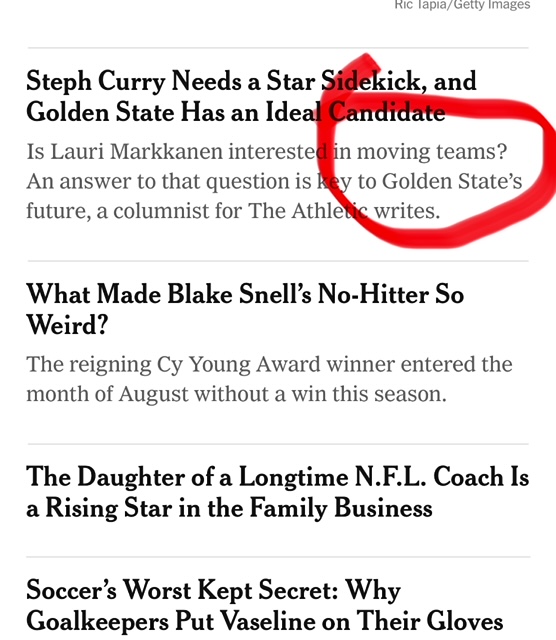
I’m not positive but imagine the circled phrase is a Britishism, as Americans would normally say “changing” or “switching” teams; the British say they are “moving house” or “moving offices.” (I still recall the first time I heard the latter expression from none other than legendary editor Tina Brown.)
And here’s the beginning of an Olympics-related article from an American writer for The Athletic:

As I explained in this post, “athletics” is the British (and international) term for what Americans call track [running] and field [throwing things like discuss and shot put].
But The Athletic is nothing compared to the Tennis Channel, where (American) commentators Jim Courier and, especially, Brett Haber have recently gotten completely jiggy with Britishisms, many of them unfamiliar to most American ears. A sampling:
- Courier said a match between Janik Sinner and Alexander Rublev was “a ginger matchup.”
- Haber referred to Jacob De Minaur’s “kit,” that is, outfit.
- Getting more obscure, Courier said a certain shot “works a treat.”
- Haber said player Jack Draper was “well thrashed” online after he didn’t call an infraction on himself.
- After a certain shot failed, Haber said “No joy.”
And in the deepest cut of all, Haber, said that it was “early doors” in a match. The bloke could commentate for the BBC!
 notoneoffbritishisms.com
Good morning, Ben!
I was intrigued by your use of “fount” in the first line. I think I would have chosen “font.”
Anyway, I Googled, but still don’t think I know what a “ginger matchup” is. On “early doors,” however, I found a fascinating Wikipedia article (https://en.wikipedia.org/wiki/Early_Doors#:~:text=The%20title%20is%20a%20British,England%20closed%20in%20the%20afternoon), that amongst other things, says it “originates in the practice of British theatres from around 1870 of allowing customers who paid a little extra to enter the theatre early and choose their own seats to beat the rush just before the performance started.” Now it is commonplace in sports and is also the name of a BBC sitcom.
I do wonder sometimes if the use of Britishisms by non-Brits is a sort of non-U affectation. Like talking about “football” instead of “soccer.” I suspect “football” as used in the US is non-U. Or the way some people are complaining that when their kids watch Peppa Pig or Bluey, they end up with Brit or Aussie accents.
Best regards!
Tim Orr
I presume the tennis players have red hair.
I think you are exactly right. Most sports reporters (on air and in print) are prone to copy-catting, and this is another way to do that. (As we have seen, American journalists who write or talk about football/soccer insist on using British vocab like “pitch” and “side” and “boots” and the like even though we have perfectly serviceable words in American for them.
Sports journalists incorrectly think they are speaking in some kind of cool language. A few years ago, I wrote to the production department of the broadcaster of my local NBA team to complain that the announcers were driving me crazy by repeating cliches and catch phrases over and over EVERY SINGLE game. They gave me free tickets to a game. 🙂
Athletics includes running on roads (e.g. marathons), cross-country running (which is not an Olympic event) and race-walking as well as track and field.
Is it an Americanism to refer to a marathon as part of “track and field”, because that would seem really weird to this Brit?
Except at Olympics time, most Americans probably associate the term “track and field” with high school competitions of which the marathon is not a part. They also might not give much thought to whether event marathons such as the Boston Marathon count as track and field. But if we had to assign the marathon to a category, we would pick track and field. The U.S. Track and Field website lists marathons, half marathons, and other lengthy races on their list of upcoming events.
Commentators often work around the world and for broadcasters in different nations, so I think they probably pick up words and phrases used outside their own country.
And of course commentators are always having to find new ways of saying the same old things, sporting activities seem terribly, terribly *repetitive* to me, if only to stop themselves going batty with boredom and a simple way to do that is to borrow words & phrases from elsewhere.
The word “bloke” seems old fashioned.
Just heard you, Mr Yagoda, on CBC this morning talking about these Britishisms. Lovely stuff.
The first such expressions I heard when I came to upstate New York thirty years ago from Nairobi and London, having been ( pronounced bin) brought up in the colony and the mother country, were ‘sticky wicket’ and ‘back foot’, and this in a hospital ( generally not encouraging words to hear in a hospital..), was surprised, delighted, as these are terms from cricket, not a common sport in Syracuse.
One of my favorite ( would’ve spelt (not spelled, of course) it other wise if writing in Brit English) cricket writers, Matthew Engel, also wrote about this a decade or so ago I think. Now I need to browse further your book on the New Yorker that I have on my shelf.
Gobsmacked is a word I don’t like, I’m afraid, or referring to university as ‘uni’, grates me….
Look forward to your new book. Cheerio…