

From last week’s New York Times:
“Weather apps are two a penny, but I’ve used one more than any other this year: Yahoo Weather.”
The Oxford English Dictionary’s definition for “two a penny” (“ten a penny” is a variant): “plentiful and consequently of little value, commonplace; easily obtainable or available; occurring frequently.” The OED quotes a 1948 novel by Neville Shute: “In Hollywood beauties were two a penny, and it was years before she got an inkling what it was that differentiated her from all the stand-ins and walkers-on.”
Before reading the quote in the Times, I was unfamiliar with “two a penny.” Searching the the newspaper’s archives, I see the last time it was used was in a 2005 review of a play by Alan Ayckbourn, which was kind of appropriate, in view of Ayckbourn’s nationality. Given that there is an apparently completely synonymous American cliche–“a dime a dozen”–I don’t expect to encounter “two a penny” here again. But as Fats Waller immortally said, one never knows, do one?
News flash: Mere minutes after this was posted, the following came over Twitter, from Kit Eaton, who wrote the line about Yahoo Weather:
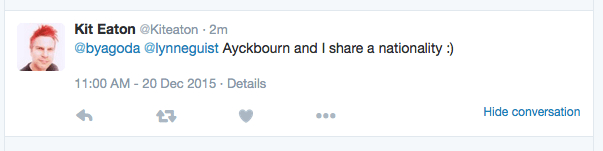
 notoneoffbritishisms.com
When I read the phrase in question here, my mind went immediately to the opening line of my favorite song from the 1968 musical, /Oliver/, “Who Will Buy”: “Who will buy my sweet red roses? Two blooms for a penny,” sung by the rose seller in an ensemble chorus. I suspect composer Lionel Bart strung out the phrase to get it to scan musically. https://youtu.be/OntYSs5DsJ0
‘In for a penny, in for a pound’.
‘Penny for the guy’.
‘Penny wise – pound foolish.’
‘Penny for them’.
‘Spend a penny’.
In pre-Decimal (1971) and early Decimal UK there were halfpenny (pronounced hape’ny) coins. The amount, two a penny, was relatively common and had a recognized, if small, cash value. To stress a valueless amount, the expression therefore would have to be “ten a penny”.
Despite the British credentials of Messrs. Shute and Eaton, “two a penny” sounds like an Australian / American corruption.
The American “dime a dozen” alliterates well but “ten a penny” has better consonance.
I also remember it as “ten a penny”. Maybe “two a penny” is inflation?
I (English) am familiar with ‘two a penny’, but no other numbers.
I suspect the familiarity of that form may be related to the (18th-century) nursery rhyme with the refrain “one a penny, two a penny, hot cross buns!” (See https://en.wikipedia.org/wiki/Hot_Cross_Buns )
That’s exactly what I thought of when I saw the phrase.
http://news.bbc.co.uk/1/hi/magazine/8598312.stm
Where I’m from “ten a penny” is quite a common saying, I’m in Lancashire.
I’m with Bendy. Up North: ‘ten a penny’!
I’m in Southampton and use it regularly,
It is all down to the relative value of the currency when they were popular.Before the UK switched to decimal numbers for the pound there used to be 20 shillings to the pound. Each shilling was worth 12 pennies.When decimalisation took place it was probably to disguise the falling purchasing power of the smaller coins.The value of coin was 1/2,1,3d,6d,1shilling,2shilling,2shilling and 6 pence other coin values were generally for collectors and not in general circulation.Pre 1960`s 1 penny was worth a lot of money therefore in Victorian times it would have been a fortune and that is probably where the 10 a penny came from.
Not sure when you were born, but I’m 1954 vintage (so, just missed farthings), and 1d was not, I assure you, a lot of money. A call from a public phone box was 4d. A portion of chips was 3d from the chippy, and I remember the price going up to 4d. Some sweets (notably, midget gems and sports mixtures) were four for 1d.
My stepdad was born in Cardiff in 1932. He told me he could go to the pictures, have a chip supper afterwards, and still have enough change for the bus home.
I was born in 1969, and was very aware of inflation as I grew up. I still recall being rather shocked when sherbet fountains went up from 5p to 7p – without stopping at 6p!
I should probably try to translate this into American and Australian ….
“Hot cross buns, hot cross buns, one a penny, two a penny, hot cross buns. If you have no daughters, give them to your sons. One a penny, two a penny, hot cross buns.”
I surely cannot be the only person who remembers this rhyme – okay, no-one sings it any more, but it’s an old street-cry which survived until at least the 1970s as a chant. These days, hot cross buns are sold [cold!] year-round, but they were once only sold around Easter. The two-a-penny buns will have been smaller buns, sold to those for whom one penny was a bit expensive.
This reminds me (Canadian, but grew up in the U.S.) of when I was doing a short-term consultancy at the World Health Organization in Geneva in 1987. In my first week there, the associate director invited me to have dinner with her – she’d been invited by a guy from the British Mission who she thought was sweet on her. She wasn’t interested so she asked me along so she wouldn’t have to be alone with him. Well, we hit it off. The guy and I spent most of dinner swapping idioms. I remember making a note of “two a penny,” and telling him that the North American (or maybe just U.S.) equivalent was “dime a dozen.” Ah, the flood of memories unleashed by “two a penny”…
Terry Murray