“Greengrocer”

From today’s New York Times:

Greengrocer is a really useful word. American English doesn’t have a good equivalent, possibly because up until recently we haven’t had that many greengrocers. The only alternative that comes to mind is “produce store,” which clearly isn’t very good.
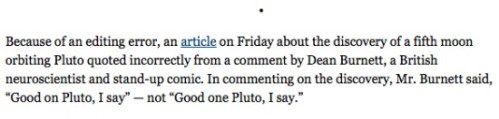
However, it sounds inescapably pretentious–much like fishmonger. Perhaps that’s why the Times changed the word, in its online edition, to just plain “grocer.”

“Jumble Sale”

I was talking last night to Steven Rea, film critic of the Philadelphia Inquirer and proprietor of Rides a Bike, a Tumbler page devoted to vintage photographs of Hollywood personages riding bicycles. (Check it out–very cool.) Naturally, the subject of not one-off Britishisms came up, and he mentioned that the Brooklyn Bike Jumble, which, he said, invoked the Britishism “jumble sale.”

I confess that the only time I had ever come across the expression was in the town I live in, Swarthmore, Pennsylvania, in which the local Friends Meeting holds an annual jumble sale–that is, rummage or tag sale. I confess I thought that the Friends had made the term up. But it turns out that it is indeed a Britishism, first spotted by the OED in 1898 and still in heavy rotation in the U.K., according to Google News.

Steven was also right about the Brooklyn Bike Jumble, in which used bikes and accessories are on offer, the latest edition of which is to be held September 8:

The phrase shows up here and there in U.S. print sources, as in this quote from an April 15, 2011, New York Times article about Los Angeles’s Chinatown:

“Cutting-edge performance artists staged happenings and smart collectors trolled to find future art stars at jumble sale prices.”

“Argle bargle”

In his always illuminating Baltimore Sun blog, “You don’t Say,” John McIntyre offers a word of the week. Today, he presents a British phrase, argle-bargle, and notes:

Originally meaning a squabble, argument, or bandying of words–it rises from a Scottish variant of argue–its meaning has broadened to include meaningless talk or writing, nonsense. There’s a variant, argy-bargy.

Naturally, this led me to look into the investigate the popularity of argle-bargle and argy-bargy in these parts. They pop up here and there. One veritable fount of spottings is the right-wing National Review, especially its writer Jonah Goldberg, who prefers the argy-bargy form and uses it incessantly. One time he criticized Attorney General Eric Holder because “he thinks this isn’t nearly enough racial argy-bargy”; another, he ripped an Obama energy ad for “endless stream of intellectual jibber-jabber and nonsensical argy-bargy.”

Elsewhere, the terms appear only intermittently. A couple of years ago, Alex Beam wrote in a New York Times op-ed about conflicts in the Episcopal church, “The schismatics invoke endless biblical argle-bargle to defend their un-Christian bigotry.” And just last week, a commenter on the Portland (Oregon) Mercury website humorously responded to a silly season article about how breakfast is overrated: “Shame on you and all those who truck with such joy-murdering argle-bargle.”

Bottom line, there is life in argle-bargle (I like that version better), so I say have some fun with it. Except for you, Goldberg. You are grounded.

“Knickers in a twist (or knot)”

A cartoon by Ming

Faithful reader Hall Hall sends a link to a Cnet.com article that begins “Verizon Wireless’s new family share plan has gotten lots of knickers in knots. But is the new plan really as bad as some people fear it is for consumers?”

Hal asks: “A Britishism (or an Americanism)?”

My answer … wait for it … an Americanism!

Here’s the deal. Knickers in a twist is indeed a Britishism, derived from the British sense of knickers as (in the Oxford English Dictionary’s definition) “A short-legged (orig. knee-length), freq. loose-fitting, pair of pants worn by women and children as an undergarment. In extended use, the shorts worn by boxers, footballers, etc.” The twisty figure of speech first appeared in the U.K. in 1967, according to Google’s Ngram viewer, quickly gained popularity through the mid-1980s, and has leveled off since then. In the U.S., by contrast, the phrase’s popularity grew quite gradually through the early ’90s, when it took off; it’s now used more here than here. A proper NOOB indeed. Here are the charts.

U.S. use of “knickers in a twist,” 1964-2008
British use of “knickers in a twist.” 1964-2008

Here is the thing. The red line in both charts represents relative use of knickers in a twist. But you’ll notice that the American chart has a blue line. That represents use of knickers in a knot–it first shows up in 1968 and has slowly risen ever since. In the British chart, knickers in a knot is a pure flat line, suggesting it has never been used.

Why did Americans make up knickers in a knot? Is it because we are partial to alliteration? Is it because we are unaware of the original meaning of knickers and hence don’t realize the physical impossibility of them getting knotted up on their own?

I have no idea and hence I’m not going to get my bowels in an uproar over it.

Do they say that in the U.K.?

“Athletics”

A few days ago, the (London) Daily Mail published an article that began:

Olympic legend Michael Johnson says a ‘superior athletic gene’ in the descendants of West African slaves means black American and Caribbean sprinters will command the sport at the London Games.

The Olympic gold medallist and BBC commentator said: ‘Over the last few years, athletes of Afro- Caribbean and Afro-American descent have dominated athletics finals.

‘It’s a fact that hasn’t been discussed openly before. It’s a taboo subject in the States but it is what it is. Why shouldn’t we discuss it?’

If you’re American, you will probably be puzzled by (the American) Johnson’s comment that certain people “have dominated athletics finals.” In the U.S., athletics is an all-purpose term, pretty much a fancier and more formal version of sports (sport to you). In the U.K., however, athletics is used as Johnson was quoted as using it: to refer to track, that is, running, events.

I said that Johnson was “quoted as” saying athletics. I bet that he did not actually say it, but rather that the Daily Mail–not known for its journalistic scruples–doctored the quote to make it understandable to readers. Anyone think otherwise?

“Silly Season”

On my first extended visit to London fifteen or so years ago, I noticed a front-page headline on a (legitimate) newspaper that read something along the lines of: RANDY ANDY’S BAWDY JAPE. The article that followed reported (using anonymous sources) that Prince Andrew had apparently made an off-color joke at a party.

Classic silly-season article, from a Cambridge (England) newspaper.

Thus was I introduced to the concept of silly season, which the Oxford English Dictionary dates to 1861 and defines as “the months of August and September, when newspapers supply the lack of real news by articles or discussions on trivial topics.” (The Randy Andy article was actually printed in a sort of subsidiary silly season, the period between Christmas and New Year’s Day.)

The phrase has been picked up and as far as I can tell broadened in the U.S. in recent years. That is, it doesn’t primarily refer to silly newspaper articles–in that regard, every season is silly season–but to idle or unsubstantiated speculation in politics and sports. For example:

  • “The silly season has officially begun. The start is defined by a sudden desire among political reporters to speculate about who might be chosen by a presidential candidate — in this case, Mitt Romney — to be the vice presidential nominee.” (New York Times, June 21, 2012)
  • “What [Matt] Kenseth and [Denny] Hamlin did last week is show that NASCAR’s traditional “silly season” — that time of year when drivers jump from team to team — isn’t so silly anymore, and may never be that way again.” (Washington Post, July 2, 2012)
  • “The silly season, aka free agency, begins today at 9:01 p.m., Pacific time, and Lakers general manager Mitch Kupchak figures to be busy.” (Los Angeles Daily News, June 29, 2012)

“Scrum”

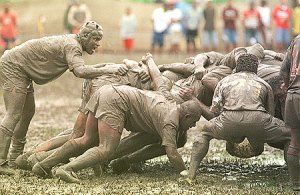
We’ve talked a good deal about soccer of late. Now for some ruggers.

Scrum refers to the deal in rugby where all or most of the players join in a kind of aggressive group hug. (I await scornful corrections and clarifications.) The OED’s first citation for a metaphorical use–denoting “a confused, noisy throng (at a social function or the like)”–is  Murder Included,  by J. Cannan (1950): “I kept wondering where you were..in that awful scrum.” That and all subsequent cites in the dictionary are British except for a 1979 quote from the Globe & Mail of Toronto.

Scrum appeared to arrive in the U.S. in the 1970s as well. Early uses tended to be make the metaphor explicit, as in an article by the NY Times’ R.W. “Johnny” Apple about a Watergate trial: Judge Sirica, he wrote, had jurors “approach the bench individually to talk to him and to a kind of rugby scrum of lawyers straining to hear the process.”

As Wes Davis pointed out to me, scrum is now everywhere in the U.S. media. Google News reports that fourteen hours ago (as I write), the Omaha World-Herald posted, “An arbitrator’s report details why an Omaha officer was reinstated after her role in an arrest scrum last year outside Creighton University.”

But Johnny Apple’s erstwhile employer, the Times, has given the word more love, by far, than any other publication. Wes noted a front-page story in the paper yesterday about low pay in Apple stores (great article by the way): “If a solution took longer to find, which it frequently did, a pileup ensued and a scrum of customers would hover.” But that’s one example out of thousands. The Times  has used scrum an astonishing 98 times in 2012, all but a handful of them in a non-rugby context. Time to give it a rest, methinks.

“Sacked”

“Veep” is a very caustic, very foul-mouthed, and pretty funny HBO series about a U.S. vice president played by the brilliant Julia Louis Dreyfus. It is also written and put together by a group of British blokes. They must have some good minders at the network, because up until the June 3 episode, I hadn’t noticed a single Britishism that had crept in.

A plot point on that show had to do with the veep’s getting rid of a secret service agent on her detail. At one point, a headline on a TV screen said: “Guard Sacked.”

My glee was short-lived, however, because it turned out that sacked–that is, fired from a job–has been a legitimate NOOB for some time, as witness:

“The surprising return would come more than a month after Mr. Woodford was sacked by the board as president and chief executive after questioning a series of outsize transactions at Olympus.”–New York Times, November 22, 2011

“The mysterious death of Neil Heywood in the Chinese city of Chongqing last year is emerging as a key element in the drama surrounding Bo Xilai, who was sacked as Chongqing’s Communist Party chief in April.”–Wall Street Journal online, June 20, 2012

“In Stages 5, 6, and 7, the star editor gets sacked, a pushover is hired as replacement, the moguls strip the publication down to its chassis and wheels, and they look for a new sucker to buy the publication.”–Jack Shafer, Slate.com, November 12, 2010, referring to “the seven stages through which all vanity press moguls pass after buying a faltering magazine or newspaper.”

It makes perfect sense that sacked would gain popularity over here, as it sounds more brutal than fired and thus suits the act it denotes. I don’t expect, however, that the British term for what Americans call laid off will follow suit. Made redundant is too much of a mouthful, and too odd.