What was that all about? The classic snail joke has often come to mind since a couple of weeks ago, when Cordelia Hebblethwaite’s BBC article featured NOOBs and drive something over 100,000 visitors to this site. The Guardian, The Daily Mail and The Sun all weighed in. Then yesterday, the New York Times published Alex Williams’s very funny article “Americans Are Barmy Over Britishisms.” (Best line: “Have we all become Madonna?”) As I write, the piece is the number-one most e-mailed article over at the Times’ website; it has spurred coverage in the Atlantic Wire and, bringing things full circle, an upcoming interview with your truly by the BBC’s World Service.
As Wolcott Gibbs wrote in a very different context, “Where it all will end, knows God!”
Let me get this straight. This U.S. company is called Proper Suit, it sells bespoke suits, but its website doesn’t mention the word “bespoke.” (Thanks, Nancy Friedman.)
Journalist Nico Hines of the Times of London recently informed me that snarky is a NOOB. This surprised me, as I had always assumed–without really thinking about it–that the term for a certain kind of glib sarcastic negativity, endemic to the the internet, was a recent American coinage, possible derived in a roundabout way from Lewis Carroll’s 1876 poem “Hunting of the Snark.” But Nico was correct.
The term was apparently first used in the New York Times in 1995, in a reference to “snarky put-downs and the fever for electronic communiques” (quaint phrase, that, dating from the dawn of e-mail). That quote does not appear in the Times’ online archive (presumably due to copyright issues) but the redoubtable William Safire referred to it the following year while noting the “growing use” of snarky. He said he was “reluctant” to attribute this to Carroll, noting that ten years before the poem, the British publication Notes and Queries referred to “a certain kind of snarking or gnashing.” He went on:
In his 1976 diaries, Richard Crossman, a [British] Cabinet minister, used the word to describe a journalistic tone in the sense that snarky is currently used in the White House to deal with some of us who observe the passing political scene: ‘The stream of anti-government propaganda, smearing, snarky, derisive, which comes out of Fleet Street.”
The OED contends the word derives from snork, meaning snore or snort. The dictionary cites Jessie Vaizey’s 1913 (British) novel College Girl: “‘Why should you think I am “snarky”?’ ‘Because—you are! You’re not a bit sociable and friendly.’” Wonderful quote: the title of the novel suggests the “crowd” that used the word, the end of the line of dialogue suggests a definition (not sociable, not friendly), and the quotation marks suggest that in 1913 it was slang of fairly recent vintage.
American use came a bit earlier than that 1995 Times quote. In 1970, Billboard called Roberta Flack’s song “Reverend Lee” “an amusing, slightly snarky slam at Southern Baptist morals.” And Marilyn French (a Harvard PhD who wrote her dissertation on James Joyce) wrote in The Women’s Room (1977):
Bliss turned with a snarky smile. “Thanks. Paul thinks so too, I guess. He asked me to go to the Bahamas with him. Some lawyers’ conference. Think I should go?” Mira had learned enough sophistication to be able to play the snarky game.
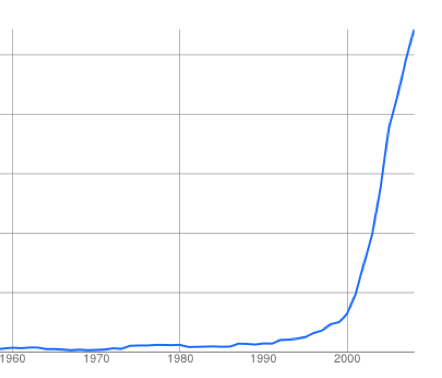
Google Ngrams show interesting patterns in British and American use of snarky. In the U.K., it was an available but rarely used term through the twentieth century, and rapidly rose in popularity from 1998 to the present. In the U.S., it was hardly ever used (most references are to a mid-century puppet character called Snarky Parker) until 1990, when it went through the roof.
U.S. use of “snarky”
So snarky is number one with a bullet among both peoples, but note this: the Ngrams show that as of 2008 (the most recent year for which figures were available), it was about ten times more commonly used in the U.S. than the U.K. What does that prove? If your answer is that a country gets the words it deserves, you will get no argument from me.
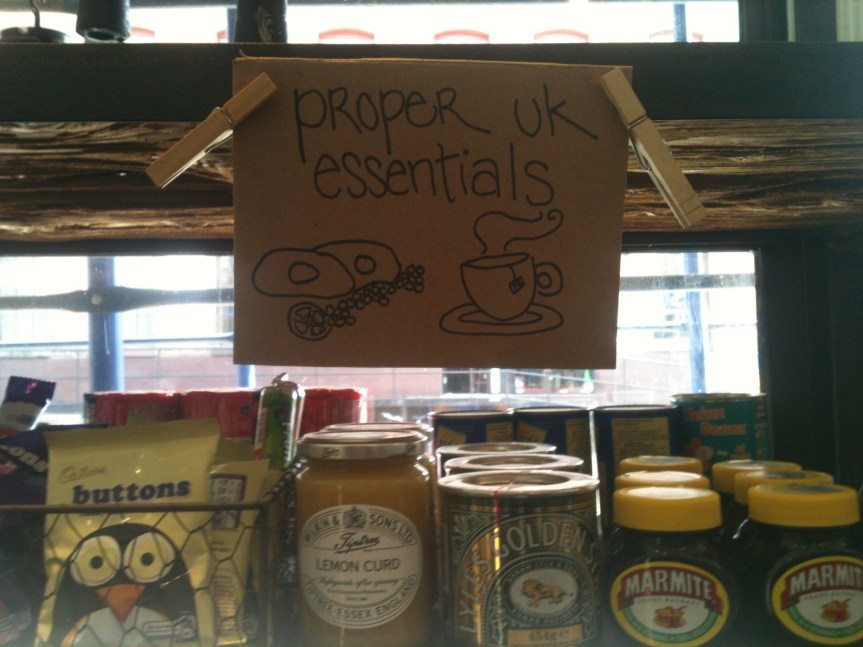
A display at Depanneur, which, by the by, serves up the best sandwiches in New York’s foodiest borough
[Added October 9. I see from comments along the lines of “What’s so twee about Marmite and posh lemon curd?” that an explanation is in order. First of all, there is an American novel from the 1940s called “A Tree Grows in Brooklyn.” Since its publication, roughly 50 percent of all newspaper and magazine articles having to do with the borough of Brooklyn have had headlines that are variations of or puns on that title. (This predilection among what the Brits call subeditors and Americans call copyeditors has only recently abated.) So I was, first, partaking of that tradition and, second, suggesting that it may indeed by slightly twee for residents of Brooklyn–the archetypal dese, dem and dose borough–to be partaking of such quintessentially British products as Marmite and posh lemon curd.]
There are many different categories, of NOOBs, I have found. Some are the province of commerce (opening hours, bespoke, stockists), and some of journos (bits,cheeky). Others have flourished in the U.S. in a Darwinian process of adaptation: they filled a need, and survived (go missing, run-up). One of the more subtle groupings consists words or expressions that have historically been used by both Yanks and Brits but alternate as to which side of the Atlantic favors them. Two examples are trousers and amongst, and another is an expression I read today in a Philadelphia Inquirer review of an album by Kurt Elling: his “reworking of [Jerry] Leiber’s ‘On Broadway’ makes a pretentious hash of it.”
To make a hash (that is, mess) of something is, indeed, in moderately wide circulation among the American chattering classes, as in this from a Commentary magazine blog post: “When the Germans take full account of how rapidly they are sinking into the same debt morass that afflicts their profligate neighbors in and out of the euro, they too may well decide that their elites (and their Constitutional Court) have made a hash of it.”
And this, from the Texas Tribune, on the state’s former Governor Rick Perry’s presidential run: “He took the family name out into the world and made a hash of it.”
The expression was coined in the British Isles, probably not long before 1833, when Cardinal Newman wrote in a letter: “Froude writes up to me we have made a hash of it.” But it was picked up in the U.S. soon after that and reached a plateau of popularity here from the 1890s through the 1920s. I know that from this Google Ngram chart showing the frequency of the expression made a hash of it from 1850-2008. Use then sharply dropped, bottomed out roughly 1950-1990, and has increased ever since–predictable, since 1990-present is the golden age of NOOBs.
British use, meanwhile, plateaued roughly 1920-1990. At that point, just as Americans were warming to the phrase, it lost its luster for the British. Their use of it has dropped by about 50 percent, to the point where … wait for it … they currently use it with just about the same frequency as the Americans do.
This is a pattern that has come up many times in these posts and suggests intriguing patterns of linguistic identity among the two peoples. If anyone out there is looking for a topic for a dissertation, this might be a keeper.
According, to Wikipedia, the athletic clothing company Under Armour was started in 1996 by “Kevin Plank, a 23-year old former University of Maryland special teams captain for the university American football team. Plank began the business from his grandmother’s basement in Washington, D.C.”
Reader Richard Raiswell, of Prince Edward Island, Canada, writes:
You don’t seem to have done “on the back foot”. This (I think) comes from cricket and refers to a defensive shot which also has some attacking merit. I have heard it creeping into use in US English recently.
Well, yes. You need only look at today’s Chicago Tribune to find it in a baseball article: “In Oakland, starter Travis Blackley tossed six solid innings while his offense scratched out enough runs to seize their fifth straight win and put the Rangers (93-68) on the back foot.”
Then there’s this, from an early September post on NewsBusters, a blog dedicated to “exposing & combating liberal media bias”: “New York Times campaign reporter Ashley Parker tried to put Mitt Romney on the back foot from the opening sentence of her article on his speech to the National Guard convention in Reno.”
But in the Times itself, you have to go back to March 2011 to find a non-sporting, non-direct-quote back foot: “Activist investors generally prefer to be on the attack. So it’s odd to see them on the back foot, fighting to preserve an important arrow in their quiver.”
Interesting that these uses don’t appear to conform with Richard’s notion that the phrase suggests a ploy that “has some attacking merit.” I am sure that readers will weigh in with their thoughts on this matter. As for NOOB status, it appears that on the back foot is only on the radar at this point. Time will tell if it has (sorry) legs.
This noun phrase meaning “expert” (usually followed by at, as in “a dab hand at cookery“) derived from the now-archaic dab, meaning the same thing, which is “frequently referred to as school slang,” according to the OED. The first citation is from The Athenian Mercury in 1691: “[Love is] such a Dab at his Bow and Arrows.”
Dab hand apparently originated as Yorkshire dialect pre-1800, but didn’t become widely used in Britain until the 1950s, according to a Google Ngram. Following a familiar pattern, it peaked in Britain in about 1990, while U.S. use continues to rapidly increase (though it’s still used less than half as often here as there).
There are many dab American hands nowadays. The distinguished Stanford Berkeley linguist Geoffrey Nunberg was quoted in the New York Times in 2011 as follows: “I fancy myself a dab hand at Google, but it drives me crazy,” but the term shows up in less elevated company as well:
“Hughes graduated in May with a degree in entrepreneurship management from Boise State University. Now he’s putting what he learned to work as he functions as a driver, a furniture mover, and at times a dab hand with the little wrenches IKEA encloses in its packaging (his business offers assembly).”–Idaho Business Review, August 22, 2012
“[‘Abraham Lincoln: Vampire Hunter’ director Timur] Bekmambetov, who proved himself a dab hand at vampire thrillers (‘Night Watch,’ ‘Day Watch’) before he directed the 2008 graphic-novel adaptation ‘Wanted,’ handles the violence in an arresting if flashily impersonal style.”–Variety, June 22, 2012
“At Virginia Polytechnic, [architect Kimberly Peck] started playing around with industrial design, and became a dab hand at using the lathe, the milling machine and other mechanical equipment.”–New York Times, April 15, 2012
Reader Bruce Stoneback sends along the quote below, and suggests looking into toff (i.e., upper-class twit). I have done so, and strangely found that every recent American reference is to the same person:
“And if you are Mitt Romney, with Mitt Romney’s biography, résumé and bankroll, there are certain things you don’t want to be filmed saying in a dining room full of toffs in a Boca Raton, Fla., mansion that looks like a location from Eyes Wide Shut (and whose owner reportedly threw a tabloid-notorious sex party at an estate in the Hamptons).”–James Poniewozik, Time, October 1, 2012
“Romney isn’t the bumbling toff he’s made out to be.”–The Daily Beast, September 17, 2012
“We may wince when the blithering toff, or want-wit, as Shakespeare would say, arrives at the Brits’ home and throws his Cherry Coke Zero can in the prize rose bushes. But what drives his gaffes is his desire to preen over accomplishments.”–Maureen Dowd, New York Times, July 28, 2012, referring to Mitt Romney.


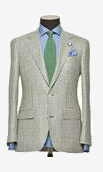 Let me get this straight. This U.S.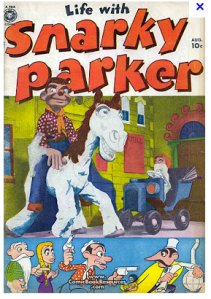


 notoneoffbritishisms.com