What It All Means

Slate, the online magazine, asked me to write a piece about my experience doing Not One-Off Britishisms. I had been thinking I should really weigh in on What It All Means, so this gave me the opportunity to cogitate on the matter. It was a bit challenging, since in this and most cases, I’m a lot more interested in observing that and how than in speculating about why or (even worse) weighing in on whether the phenomenon is good, bad or somewhere in between.

But I wrote the piece and you can read it here.

Just a couple of things to add. First, while the headline (“The Britishism Invasion”) is spot-on, I did not write an am not pleased with the subtitle, “Language corruption is a two-way street.” “Corruption” is such a harsh word.

Second, the comments–342 at last count–are a trip. A few are dopey, but most are right in the spirit of this enterprise, adding interesting comments and suggestions for future entries. (Shag seemed to keep coming up.) Also, not a few pointed out that I made an embarrassing mistake–I had the plural of corpus as corpi, which apparently is not a word, rather than corpora. Hey, I don’t know Latin and I’m not a linguist. I don’t even play one on TV.

I heard directly from quite a few people with interesting things to say. One of them was Helen Kennedy, the first journo, according to my unscientific investigation, to use go missing to refer to Chandra Levy’s disappearance. Her e-mail had the subject line “You made my day!” and began:

I always knew I would amount to something, and having some small part in the downfall of American English – well, could one be more subversive? No, one could not.

I’m half-American and half Irish, raised in England and Italy. I am CONSTANTLY having to turn to my colleagues to ask if “advertizing” has a Z here, etc… I genuinely had no idea that “gone missing” was not regular Ammurican.

So “go missing” was (arguably) blown to these shores, like some exotic seed, by someone who learned it in the U.K. As has been observed before, the Internet sure is something.

“A proper …”

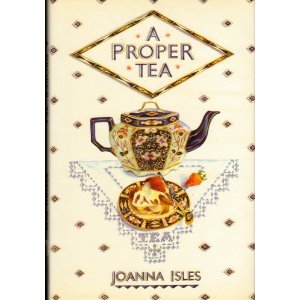
Adjectival phrase. It does not indicate “characterized by propriety” (as in proper behavior) but rather fits this subsidiary OED definition of proper: “Strictly or accurately so called; in the strict use of the word; genuine, real.” The OED has surprisingly few citations, the first notable one coming from Ann Thwaite’s 1984 biography of Edmund Gosse:  “He had worked with magnifying slides but he had never had a proper microscope.” Three years later, more to the point of Britishisms, came a book called A Proper Tea: An English Collection of Recipes.

Help me out here. I can’t put my finger on it, but there is something very British about thinking about or referring to this quality. Americans don’t generally care about whether a particular thing satisfies all the attributes of its category, only whether or not it works or is a good buy. They didn’t used to, that is. Now they are all over “a proper.”

Our distant ancestors probably did not have a proper breakfast when they woke up in their caves, so they gorged whenever they made a kill. (Marian Burros, New York Times, December 18, 2002)/Now that Anderson Cooper has come out of the closet about his admiration for Nicole “Snooki” Polizzi, it’s only fitting that they go out on a proper date. (TVGuide.com, September 15, 2011)

” … years on”

Preceded by a number and indicating, roughly,  “… years later.” More so than “later,” “on” provides a retrospective feel, and thus is useful in titles, as in Alan Bennett’s first produced play, the 1968 “Forty Years On.” The two-letter word makes the expression especially tempting for headline writers, and as the tenth anniversary of 9/11/01 approaches, it is ubiquitous. A Google News search for the phrase in headlines yields 424 hits for just the two days Sept. 3 and 4, 2011, from “Bin Laden Wanted a Second Hit, Ten Years On” (Sydney Herald) to “10 Years On: Finally, Smarter Airport Security Screening?” (Wall Street Journal).

A Consummate Teacher: Coach Robinson 50 Years On. (New York Times headline, August 4, 1991)/Though we’ve felt the impact of 9/11, more will yet unfold. Ten years on, it still might be “too soon to tell.” (Sacramento Bee, September 4, 2011)

“Dodgy”

(Thanks to Nancy Friedman.) Evasive, tricky, artful; dubious, unreliable. OED’s first citation is 1861. Google Ngrams show British use taking off in about 1940 and American, characteristically for NOOBs, circa 1990.

To heighten the fun of the chase, she gives Grace a road buddy in Darcy Kohler, a dodgy market analyst who stands to lose her condo if her missing boyfriend can’t be found to make good on the bond she co-signed. (Marilyn Stasio, New York Times, September 18, 1988)/ I see that the administration is pressing New York’s attorney general to drop its investigation into dodgy foreclosure practices and settle with the banks. (Megan McArdle, TheAtlantic.com, August 25, 2011)

“Shambolic”

Adjective indicating the state of being in shambles. The OED’s first cite is from 1970 (The Times) but curiously notes in small print: “Reported to be ‘in common use’ in 1958.”
To which I say, Hah! A Google Books search reveals a few dozen pre-1958 uses, the earliest being this from a 1939 issue of The Journal of Land & Public Utility Economics (and the telltale quotation marks indicate it’s a very early use indeed):

If judges are hesitant to adopt the findings made by a commission, and instead substitute their own inclinations, the administrative agency becomes not symbolic of legal progress but “shambolic.”

That is an American journal (don’t know the nationality of the author), but shambolic is nonetheless definitely a Britishism. Google Ngram data suggests it is currently used about five times more frequently in British than American English. But it is also a Not One-Off-Britishism: that same Ngram chart indicates frequency of use in American English has increased some 400 percent since the early ’90s.

Despite its shambolic start, the euro is not going to vanish. (Paul Krugman, New York Times, September 20, 2000.)/Taken together these albums hopefully represent the first unified volley in a new Philly sound — shambolic, shamanistic and completely cool. (Associated Press, August 15, 2011)

“Cheeky”

Mike Myers as Simon

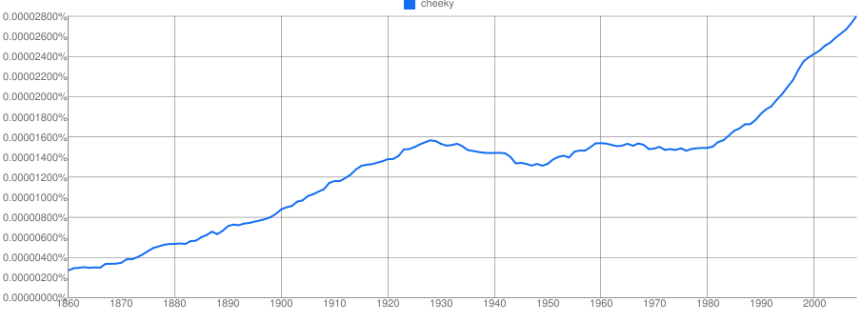
OED defines cheeky as “insolent or audacious in address; coolly impudent or presuming” and cites a first appearance in 1859. It was not unknown in the U.S. in subsequent years; a New York Times headline from 1885 read, HOW HILL HELPED PATRICK.; A CHEEKY CIRCULAR SENT THROUGH CHEMUNG COUNTY BY PONY EXPRESS. In 1943, the American writer Max Shulman published a comic novel with the amusing title “Barefoot Boy with Cheek.”

But the Google Ngram below shows that, as with  many Britishisms, American only increased significantly in the 1980s.

American use of "cheeky," 1860-2008

Presumably, its popularity was helped along by Mike Myers’ late-80s Saturday Night Live character Simon, one of whose catchphrases was “Cheeky monkey!”

Years after retiring, she became friendly with a 37-year-old cheeky chap who had the habit of forging her name on big checks. (New York Times, March 4, 1990). My man Mark Thompson puts up a cheeky post yesterday that I most heartily approved of. (Thomas P.M Barnett, Time.com, August 9, 2011)

On the radar: “daft”

When I recently wrote a post about mad and nutter I considered including one additional Britishism indicating insanity. I ultimately decided not to because the chance of any American using seemed closer to slim than none.

I did not count on the New Yorker. Reading the August 1 issue of that publication this morning, I came upon this sentence from Sasha Frere-Jones: “My Morning Jacket, on the recently released album ‘Circuital,’ its sixth, makes it clear that the real hippie is neither biddable nor daft.”

That’s right, daft. Wikipedia informs me that Frere-Jones is an American, Manhattan-born, though it also notes “he is a grandson of Alexander Stuart Frere, the former chairman of the board of William Heinemann Ltd, the British publishing house, and a great-grandson of the novelist Edgar Wallace, who wrote many popular pulp novels, though he is best known for writing the story for the film King Kong.”
Turning to the New Yorker’s merciless online database, I find that Frere-Jones has used daft eleven times since 2005. This gives him a narrow lead over the magazine’s (American) film critic David Denby, with eight.

On the radar: “Thank you very much, indeed”

Thank YOU very much indeed.

Thank you very much, indeed (TYVMI) has long been a go-to phrase for British interviewers and interviewees. How long? Well, it has been afoot at least since 1973, when Anthony Burgess made this amusing observation in the New York Times:

British gabbiness is also to be associated with a kind of obliquity or indirectness, which is meant to be polite, though sometimes it can be as cold as silence. Thus, an American says, “Have you change for a ten?” but an Englishman will say, “I’m really most terribly sorry to bother you, but I don’t suppose by any chance you  might have such a thing as change for a pound, would you—the old quid, you know? Oh, you would? I’m really most terribly grateful. Thank you, you’re an angel. Thank you very much indeed.”

Fifteen years later, Times TV critic John O’Connor wrote this about David Frost’s substitute hosting duties on the “Today” show:

Mr. Frost is more of a bon vivant (than Jane Pauley), never at a loss for an amusing anecdote and, even through a certain early-morning bleariness, always maintaining a remarkable enthusiasm. ”Wonderful stuff!” or ”Thank you very much, indeed,” says Mr. Frost at regular intervals.

For some time, I have been waiting for TYVMI to emerge from a pair of American lips. I believe I have heard a couple of NPR hosts say it, but I didn’t take notes so can’t be sure. Christine Amanour of CNN and ABC and Stuart Varney of Fox say it all the time, but they are Brits. I will stay on the lookout, but for now have to content myself with one American sighting. It was uttered in May of this year by Paul Schott Stevens, a native of New Orleans and president Investment Company Institute, at the close of a conversation with Alan Simpson and Erskine Bowles. If by any chance you want to hear it for yourself, be my guest.

“Crap” as adjective

The specific British use is of this word as an adjective, equivalent to the American crappy or crummy, as when a laddish U.K. online magazine called The Sabotage Times, recently referring to a new soccer video game,  commented: “…we now have access to an alternate world where supporting a crap, shambolic and skint club is no barrier to success.(And by the way, shambolic and skint are now officially on my radar.)

…the Senate bill retains a finance committee provision allowing some employees to purchase health insurance on the exchange, even if their employers already offer health coverage, if it’s a crap plan (i.e., one that requires the employee to pay more than 10 percent of his income in premiums or fails to meet a minimum coverage standard). (Timothy Noah, Slate, November 22, 2009)/I mean, I’ve seen a lot of mediocre films, even at major fests, but let’s assume for the sake of argument that most people who set out to make an indie film are not aiming to make a crap movie. (Movie City News, website, July 27, 2011)