“Top Oneself”

Jeremy: still "Lin" good health

My intrepid spotter Ellen Magenheim wrote me a couple of weeks ago:

I noticed this morning in the Times that the headline above the story about Jeremy Lin’s latest performance was “Lin Tops Himself” and it briefly took my breath away since my mind went first to the British meaning (i.e., commit suicide) rather than the American meaning. As I thought about it, I wondered if the International Herald Tribune had a different headline–which it did–and then went back to the digital version of the NYT to find that it didn’t have the “Tops Himself” version either. Do you think none of this variation means anything or do you think maybe it dawned on someone about the unfortunate transatlantic ambiguity?

Sure enough, the article she was referring to–about a New York Knicks basketball player who for a time was a U.S. sporting sensation–had in the online N.Y. Times the headline “Lin Puts Knicks Back on Track.” At the very bottom of the article, in small gray print, are these words:

A version of this article appeared in print on February 20, 2012, on page D1 of the New York edition with the headline: Lin Tops Himself.


Often articles will have different headlines in print and online versions. But it’s amusing to think of some subeditor noting the unfortunate double meaning and stopping the presses to change it. I don’t suppose we’ll ever know. Unless, of course, the New York Times sports desk reads Not One-Off Britishisms and wouldn’t mind filling us in!

“Randy”

Powers is permanently randy

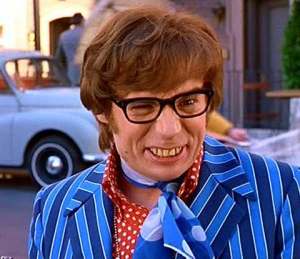
Whenever I read the word randy (quoth the OED: “orig. Sc. and Eng. regional. Lustful; eager for sexual gratification; sexually aroused. [Now the usual sense.]”), my mind’s eye and ear  instantly visualize Austin Powers in full leer: “Feeling randy? Fancy a shag?” Then I start visualizing Brits “‘avin’ a laff” about all the Americans with names like Randy Newman, Randy Travis, and Randy Moss.

This has been happening more and more lately, most recently last night as I was reading a Jonah Lehrer article in the New Yorker in which he mused about the odd behavior of male Australian gray-crowned babblers: “Instead of acting like randy juveniles, seeking out mates and getting into territorial fights, they are content to remain at home.”

But it’s not just The New Yorker, as witness:

“In the Mood,” a new song and a strong indication of where New Edition is likely to go next, was a randy, simmering seduction anthem. (Newark Star Ledger, February 21, 2012)

Seth [the Justin Theroux character in the film “Wanderlust”] suggests a cross between Charles Manson and a randy hobbit. (Boston Herald, February 23, 2011)

The only conceivable response is:

“Yeah, baby.”

“Loo”

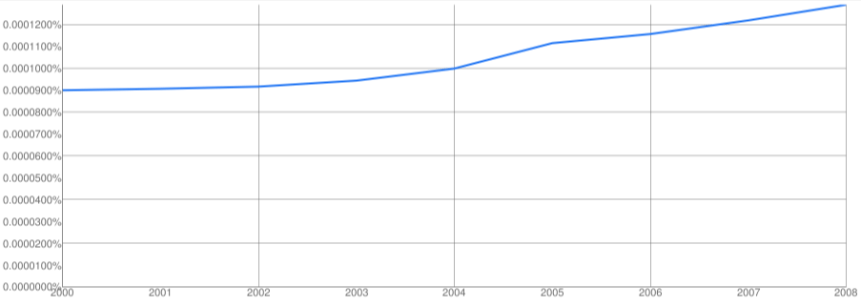
I first presented this “U”-phemism–first cited by the OED, appropriately, in a 1940 Nancy Mitford quote–as a Portland, Oregon, outlier, but I now believe it’s made the grade as a NOOB. The Google Ngram chart, below, shows a more than 50 percent increase in U.S. use between 200o and 2008:

Then there are these recent quotes:

I saw Another Happy Day, and thought you really brought it home playing the bitch ex stripper, coke-whore mom — nearly spitting nails with every word catapulted at your co-star, Ellen Barkin. That cat fight in the loo alone was worth the price of admission (“An Oscar-Themed Open Letter to Demi Moore,” Huffington Post, February 28, 2102)

SUSPECTED PEEPING TOM HITS CAMPUS LOO (Coast Report Online, Costa Mesa, Cal., February 21, 2012)

…it’s no longer the morning news that dad is reading on the loo, but rather a tablet computer. (Consumer Reports.org, February 17, 2012)

I can’t top that, so, like George Costanza and Mitt Romney, I will just say:

Gotta go!

No pun intended.

“Sport”

I know Michael Sokolove. Michael Sokolove is a friend of mine. I have not served in the Senate with Michael Sokolove, but I have broken bread with him and played basketball with him and happen to know he hails from Lower Bucks County, Pennsylvania. And so I was surprised to read him say–in a Q and A  at the New York Times website regarding his excellent recent article about Oscar Pistorius:

One of the great things about sport is that it is in some ways primitive, or we want to imagine it is.

The surprising thing was that he said sport, a Britishism, rather than the American sports. (We do, however, refer to baseball as a sport and to a person asa good sport.)I asked him about it and he blamed it on his English son-in-law.

But Sokolove is not alone. Times columnist David Brooks, theorizing on the Jeremy Lin phenomenon, recently wrote:

The moral ethos of sport is in tension with the moral ethos of faith, whether Jewish, Christian or Muslim. The moral universe of modern sport is oriented around victory and supremacy.

A headline in the Philadelphia Inquirer late last year read: “Money, not sport, the name of the game.” And a while back, Slate had this one: “Politics and sport: a dangerous mix.”

The next thing you know, we’ll be talking about maths.

“Ginger” Fail

Jennings

@KenJennings of Jeopardy fame tweets:

What is going on where we are suddenly calling redheads “gingers”? People, we won the Revolutionary War, we don’t have to put up with this.

Hey, Ken, you may be the king of all trivia but you have to brush up your NOOBs: Ginger is the second most all-time most popular entry on this blog. (FYI, bits is first and wanker is third.) You and any other interested party can sort out what’s going on with ginger here.

“Hang on!”

The phrasal verb has assorted meanings, most of them common to both British and American English: retain (“he hung on to his mother’s jewelry”), refrain from telephonically hanging up (Blondie’s “hanging on the tel-e-phone”), and remain clinging (the Supremes’ “you keep me hangin’ on”).

That leaves hang on is an imperative verb, metaphorically requesting or demanding a time out. The American equivalents are wait (a minute) or hold on (a minute);  the OED quotes an 1841 dictionary of Americanisms describing the latter as “originally a sea phrase.” The OED’s first citation for this hang on is a surprisingly late definition in a 1941 dictionary of Australian (!) slang. But now it is  so much a Britishism that I can’t even say it in my head other than in my lame British accent (believe me, you don’t want to hear).

All the more reason why the American chattering classes seem to be lapping it up:

... spelling out that members of Congress shouldn’t use non-public information gained through their jobs to line their pockets? As Financial Services Committee Chairman Spencer Bachus allegedly did, according to a 60 Minutes investigation? That’s more in the category of hang on, I can’t believe this is not already against the rules. (Andrew Rosenthal, New York Times, January 27, 2012)

Scientology appears to be giving you the promise of a better knowledge of God, perhaps an attractive prospect for youngsters who might be feeling that more mainstream organized religion leaves them cold. But hang on a minute. What “god” do Scientologists believe in? (Villagevoice.com, February 7, 2012)

Milestone

Not One-Off Britishisms is one year and one day old, so happy belated birthday to me!

The very first post (on advert) has been followed by 142 more; there have been 686 comments and 79,492 page views. Massive attention has been paid, to which I say, “Cheers!” (a word that so far on these shores is seen only as a drinks salutation and e-mail closing, not as a substitute for thank you. Give it time).

Unaccountably, new NOOBs keep turning up, so I will carry on for a while. Talking of that, my next post will be on turn up (as a substitute for show up) and the one after that on talking of (speaking of).

The

“Straightaway”

Immediately. The OED cites a use as early as 1662; the subsequent examples given suggest that in roughly 1900, the predominant form changed from two words (straight away) to one (straightaway), though both versions are still found.

Since straightaway has a 100 percent precise and unobjectionable American equivalent, to wit, right away, its quite frequent use nowadays by U.S. writers is an excellent gauge of their unwavering fondness for NOOBs.

“I knew straightaway what had gone wrong—caps lock was depressed by accident—but instead of simply taking my lumps and re-entering my password, I vented: ‘Is there anything on the computer keyboard more annoying than the caps lock key?'” (Mathew X.J. Malady [“a writer and editor living in Manhattan”], Slate.com. February 1, 2012)

“A comedy about business consultants? Get them to a strip club straight away (‘House of Lies’ pilot, last month).(Neil Genzlinger, New York Times, February 4, 2012)


“Picture”

A picture of Martin, which can be yours for $750

In a short New York Times essay about his personal art collection some time back, Steve Martin wrote,  “There are great pictures mixed in with good pictures, mixed in with oddballs, but I endorse and have found something worthwhile in every one of them.” In all he used the word picture or picture fifteen times, always as a synonym for painting.

This is a distinctly British, U (in the sense of U vs. non-U) and old-fashioned sense of the word. John Ruskin wrote in 1852, “Every noble picture is a manuscript book, of which only one copy exists or ever can exist.”

Wilde didn’t call his novel The Painting of Dorian Gray, after all. In that book, Lord Henry Wotton, after seeing the title portrait for the first time, tells the man who painted it, Basil Hallward: “You must certainly send it next year to the Grosvenor. The [Royal] Academy is too large and too vulgar. Whenever I have gone there, there have been either so many people that I have not been able to see the pictures, which was dreadful, or so many pictures that I have not been able to see the people, which was worse.”

Most Americans tend to use painting for paintings, reserving picture for photographs, drawings or what children produce at nursery school. But the Ruskin-Wilde-Martin picture crops up now and again, for example in the title of Richard Wollheim’s 1988 book Looking at Pictures the Old-Fashioned Way: Painting as an Art.

And then, as is often the case with NOOBs, there is The New Yorker, which is quite fond of pictures, as in a 1935 Talk of the Town piece: “A cold cop wandered into one of the most elegant art galleries in town the other day and asked the lady in charge if he could stay until his hands got warm. He walked around for a while, blowing on his hands, and looking at the pictures.”