
More on the migration of sports into sport: a Nike gift card.
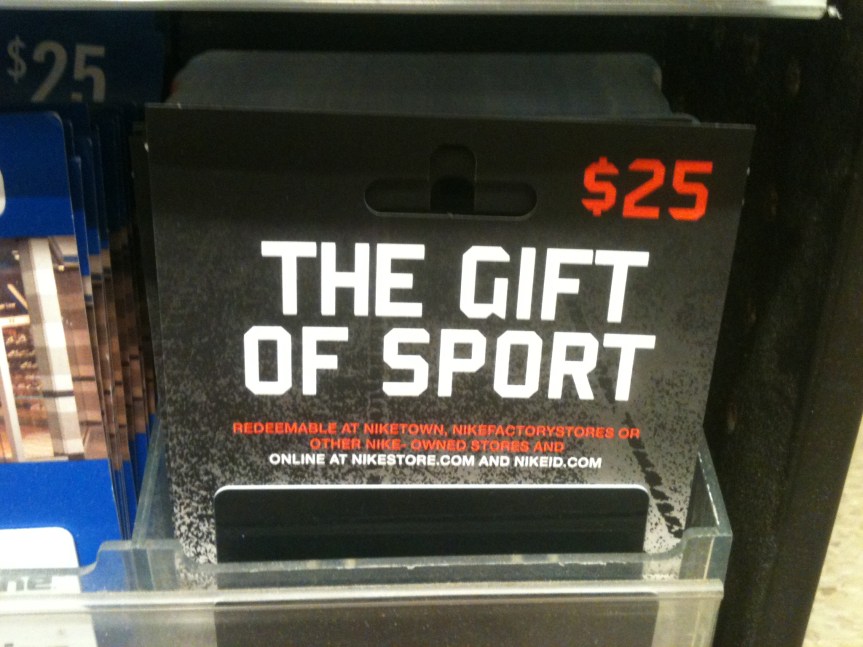

More on the migration of sports into sport: a Nike gift card.
The 2013 Philadelphia Flower Show will be, apparently, brilliant.

Lynne Murphy alerted me, via Twitter, to this photograph posted on the UK website The Poke:

It inspired various thoughts.
 My friend Andrew Feinberg e-mailed me as follows:
I just came upon the following in a new book called “The Escape Artists: How Obama’s Team Fumbled the Recovery,” by Noam Scheiber. On page 41 Scheiber writes: “Simply put, Summers believed that a $1.2 trillion proposal, to say nothing of $1.8 trillion, would be dead on arrival in Congress because of the political resistance to such gob-stopping sums.”
Personally, I was gob-smacked by this locution and so startled that I gobbed on my carpet. Where it all will end knows Gob.
For the record, Scheiber was a Rhodes scholar. Have you come across “gob-stopping” before?
Well, no–and neither, I discovered, has the Oxford English Dictionary. The OED does, however, have an entry for gobstopper, to wit: “a large, hard, freq. spherical sweet for sucking.” Fans of Roald Dahl may recall the “Everlasting Gobstopper” featured in “Charley and the Chocolate Factory” and the subsequent film “Willie Wonka and the Chocolate Factory.”
Is Noam Scheiber alone in making a sweet into an adjective having nothing to do with sweets? Well, no again. It has been used a total of three times by The Times (of London), most recently this by A.A. Gill in October 2011: “…if you ask me, and I suppose you are, to recommend just one gobstopping, heart-racing dinner in all of London, it would be Hedone.”
Moving to the New York Times (of New York), it appears exactly once, in a 2007 quote from the blogger Sara Robinson: “Reading [Steven] Gilley on NYC was like reading Molly Ivins on Texas. You could only sit back, mute, at the gobstopping wonder of it all.”
Gobstopping and the phrase a gobstopper of a show up occasionally in various internet outposts, generally meaning something along the lines of astounding or amazing. (If you have tender sensibilities, I suggest you do not read the entries at Urban Dictionary, which are very different.)
My best guess is that gobstopping happened because gobsmacked doesn’t easily converty to an adjective meaning that which causes one to be or feel gobsmacked. But behold, gobstopper already existed, and the suffix -stopping did, too, in such words as heart-stopping and show-stopping. Hence, gobstopping.
Make sense, Andrew?

My NOOB ears perked up when I recently read in my local newspaper, The Swarthmorean, this line from an editorial supporting a local traffic project: “The proposed single-lane traffic-circle, or roundabout, with proper signs, would direct traffic to multiple destinations at slower rates of speed.”
What got my attention wasn’t a proper, which I’ve already covered, but roundabout, which struck me as a NOOB variant of the tried-and-true U.S. traffic circle or rotary. Sure enough, quite a few U.S. uses turned up, for example, this article posted today in the East Cobb (Georgia) Patch.com: “Dozens of East Cobb residents brought questions and concerns to Monday night’s information session about the roundabout being installed in their neighborhood this summer.”
Turning to the OED, the dictionary indeed says that roundabout, in a traffic sense, is “orig. and chiefly Brit.” The definition:
A junction of several roads consisting of a central (usually circular) island around which traffic moves in one direction. Vehicular roundabouts developed from large-scale circuses or rond-points in France and America … Typically smaller in size, British roundabouts are sometimes distinguished from similar junctions by the rule in which oncoming traffic must give way to traffic moving around the central island. Traffic circle and rotary are the more common terms in America …
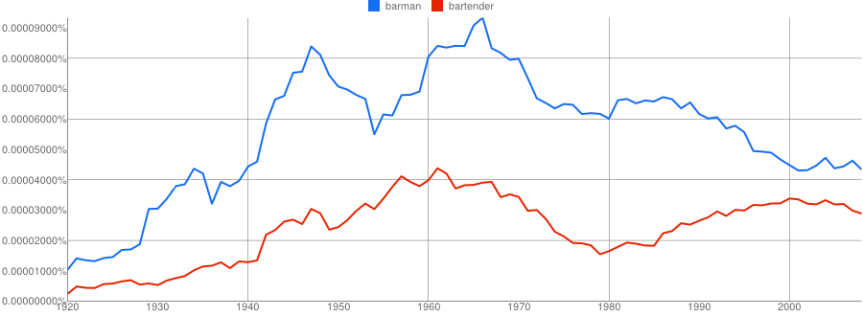
This is a pure play. By that I mean there is a precise (?) U.S. equivalent, bartender, so that the use of barman in the U.S. can be explained only by the desire to use a Britishism, or the conscious or unconscious imitation of others who have done so. (I suppose another possibility is retrograde sexism.)
According to this Google Ngram, the use of barman increased about 20 percent in the U.S. between 2000 and 2008 (actually, between 2000 and 2005; it has held steady since then):

(It’s interesting to look at an Ngram, below, showing the use of barman [blue] and bartender [red] in British English between 1920 and 2008. At least since about 1960, it appears to be a case of an encroaching Americanism, with the two terms recently nearing equality. However, barman is still used about twice as often in Britain as in the U.S., and bartender is six or seven times more prevalent in the U.S.
 )
)
The New Yorker has used barman 34 times from 1937 to the present, including in a 1939 poem called “Forsaken Barman,” a 1964 Talk of the Town piece called “Barman,” and this, from a January 30, 2012, Profile by Nick Paumgarten:
He cuts off the drinks, keeps spare umbrellas on hand for sudden squalls, shuffles customers around to make space for someone’s mom, and, like any barman with a following, dispenses a lot of free drinks.
But you can find the word in all sorts of other sources as well:
“Whiskey You’re the Devil”: The best version of this traditional song is the one you sing right before the barman kicks you out. (Rosie Schaap, New York Times, March 8, 2012)
I grabbed a spot at the bar and was immediately greeted by the friendly barman, Christopher. (HoustonPress.com, March 2, 2012)
Etc.
This slang term would be a useful NOOB, in not having a good U.S. equivalent. Pimply would be the closest, but that sounds kind of weird and maybe too clinical: the kind of thing that Holden Caulfield would say about Ackley. My sense is that in the U.K., spots and spotty can refer to all sorts of blemishes and markings on the skin.
I was interested, therefore, to pick up today’s New York Times and read theater critic Ben Brantley (who has made numerous appearances in these pages) mentioning “YouTube videos of spotty shut-ins making like divas in their bedrooms.”
But I had to go back to 2007 to find another use in the Times: a reference, in an article about skin care, to “half-hour Proactiv infomercials using ordinary people to recount their transformations from reticent loners with spotty skin into pimple-free social butterflies.”
On reflection, I’m inclined to doubt that spotty will catch on over here. To my ears, its teasing overtones (even when used about oneself) clash with the blue-sky self-esteem that our language, at least, insistently promotes.
The OED defines this noun as: “A person who has charge of or looks after a specified thing or operation, esp. in the course of employment. Without defining word esp.: = baby-minder.” There are many variants, in the realms of public relations, crime and sport, where it refers to a goalkeeper.
Indeed, one indication that minder has moved to NOOB status is this recent quote from a New York Times blog about (U.S.) college hockey: “Patterson had 44 saves on the weekend, Tigers’ net minder Josh Thorimbert had 73.”
There was also this from the Times capsule review of “Alvin and the Chipmunks: Chipwrecked”: “The furry guys and the Chipettes, the gal pals they acquired in an earlier installment of the franchise, find themselves shipwrecked along with their human minder, Dave (Jason Lee).”
In a similar human-on-animal way, there is a dog-walking company in Philadelphia called Monster Minders.
If further proof is needed, I offer the fact that minder recently figured in the popular TV series “Gossip Girl.” I confess I couldn’t udnerstand the references I found on the web, so I turned to my colleague Dawn Fallik, a “GG” aficionado, for explanation. She did not disappoint:
Blair was married to King Louis. She never really loved him, so she came back to New York while he headed to Monaco. But he send a royal minder to watch over her every move, so that he’d find out if Blair cheated on him, thereby annulling the marriage and costing Blair big money in dowry. Alas, it turns out the minder was secretly in love with the prince and did all she could to help Blair slut around. The minder is now back in Monaco.
Barack Obama sometimes pronounces the word divisive with a short i in the second syllable (similar to permissive or dismissive). In his March 2008 speech on race, he says it twice in a row that way, at about the 7:50 mark. (He also uses it in the traditional long--i pronunciation, a la incisive, at 5:44.)
There has been a fair amount of grumbling about Obama and various members of the chattering classes using the “divissive” pronunciation, much of which assumes they are aping the British. That is understandable, given the way the Brits say “vittamin” and “dinnasty,” but it is not correct. The OED lists only one pronunciation for the word: with a long i. A lengthy discussion at the Washington Monthly website (which descends to personal invective at the end in a predictable, almost ritualistic manner) suggests the short-i is an American regionalism, found in New England and the Midwest. (Apparently former South Dakota Senator Tom Daschle said it that way.)
Regionalism aside, to my ears the “divissive” pronunciation comes off as an affectation, that is, a case of saying something differently for the express purpose of saying it differently, similar to pronouncing the word “negociate.” One of the first people to gripe about it was Charles Harrington Elster, in his 1999 “The Big Book of Beastly Mispronunciations: The Complete Opinionated Guide for the Careful Speaker.” His target was another president, George H.W. Bush, who apparently said “divissive” in his inaugural address in 1988. Elster asks rhetorically: “Was this just a venial bit of Ivy League snobbery, or was the president letting fly with a beastly mispronunciation?” I vote for the former.

A couple of days ago, I posted in Lingua Franca, the Chronicle of Higher Education Language blog I contribute to, a post about American glottal stop. A slightly edited version of it is below, followed by some additional thoughts.
The post:
If you associate with American females in the age range of roughly 15-25, or if you are one yourself, I bet you have heard the word important pronounced in roughly this way: imPOR-unh.
I first started noticing this among my students a half-dozen years ago. My first thought was, why are young Mid-Atlantic Americans glottal stopping?–the glottal stop being a consonant-swallowing vocalization found many places around the world but most famously in the British Isles. You can hear it in your mind’s ear if you think of Stanley Holloway singing “With a lih-ill bi’ o’ luck” in My Fair Lady or one of the Beatles saying, well, “Bea-ulls.”
Glottalization, especially on the t sound in the middle and at the end of words, has traditionally been associated with working-class Cockney, Liverpudlian and Glaswegian, but in an interesting recent development (since the 1980s, in any case) it has migrated upward socially, as a prominent feature of so-called Estuary English. This is a manner of speech favored by the middle-class youth of the greater London area, sometimes referred to as “Mockney.” For classic examples of Estuary, listen to the comedian Ricky Gervais or the celebrity chef Jamie Oliver; not 30 seconds will go by without at least one glottal stop. (Jamie, especially, also goes in for another notable feature, pronouncing th as f–“I’m firty-free years old.”) Here is Gervais emceeing last year’s Golden Globes; note the way he says settled and variety.
But how did glottal stop make its way to 20-year-old New Jerseyans? Since I have a strange fascination with the many British expressions, as witness my blog Not One-Off Britishisms, I was tempted to view this as another example of the phenomenon. But that doesn’t wash. The Britishisms I chart on the blog are driven by the chattering classes; glottalization clearly springs from a very different segment of society.
When I looked into the scholarship, I found it unhelpful. As the authors of one recent (2009) study note, “While there is an abundant literature on t-glottalization in the United Kingdom, investigation into the linguistic, geographic, and social factors that influence it in American English is in its infancy.” True that. They themselves tested just 58 speakers and found, not surprisingly, that t-glottalization was most common among the young and females. For reasons I don’t completely understand, only two-word combinations were tested–foot away, street outside, right ankle, etc.–not what appear to me to be the most common and noteworthy examples, single words like important, Clinton or button.
There are actually four possible pronunciations of the middle t sound in those words. British “received pronunciation” would give it a hard t. Americans only do that when the final consonant is stressed–pretend, return. Otherwise, we traditionally employ the “syllabic n,” in which the t is pronounced as t, but the subsequent syllable as a sort of vowel-less n. I recall in 1992 that northerners were instructed that the correct pronunciation isn’t Clin-ton but rather Clint-‘n.
Next, there is “flapping,” which Americans favor especially when the final syllable doesn’t end with n; thus, we say latter as ladder and city as siddy. Then there’s the new kid on the block, glottal stop. Getting back to the 2009 study I mentioned, an even more significant shortcoming is that none of the 58 participants was African-American. I say that because my observation is that the main manifestations of glottalization in popular culture are the expression “Oh no she dih-ent” (which originated, I think, as a ritualized audience response on The Maury Povich Show) and many, many rap songs. Glottalization has long been a characteristic of the form, at least as long ago as 1991, when Salt-n-Pepa released a song called “Do You Want Me.” In the clip below, (at about the 21-second mark), the male singer raps, “You gotta let me know suh-‘en.”
In the popular music sphere, at least, glottalization has crossed racial lines. Last year the (white female) singer Kesha released a song called “My First Kiss.” Listen to the way she glottalizes little.
As Mark Liberman of the University of Pennsylvania pointed out to me, the particular word is a surprising candidate for vocalization in not ending with an n; thus Kesha is glottalizing on a Jamie Oliver level.
I am left, in any event, with the observation that t-glottalization is rapidly spreading among young white female Americans, and the hypothesis that it came to them via an African-American style. How that style came about and how the transfer happened, I don’t know.
Anybody looking for a dissertation topic?
Additional thoughts: I had two reactions to the comments on the Lingua Franca post. Number one, linguists are rightfully concerned about the cataclysmic consequences of anyone without a PhD in the field commenting on language matters. I don’t know what came over me. Number two (and more seriously), a couple of the commenters proposed that t-glottalization in words that end with “n” (Manhattan, button), is a fairly long-time New York vocal characteristic. I am inclined to go along with that, and suspect that both the prevalence of glottalization in rap music and in my students stems from this regional pronunciation.
 notoneoffbritishisms.com