“Do” (food)

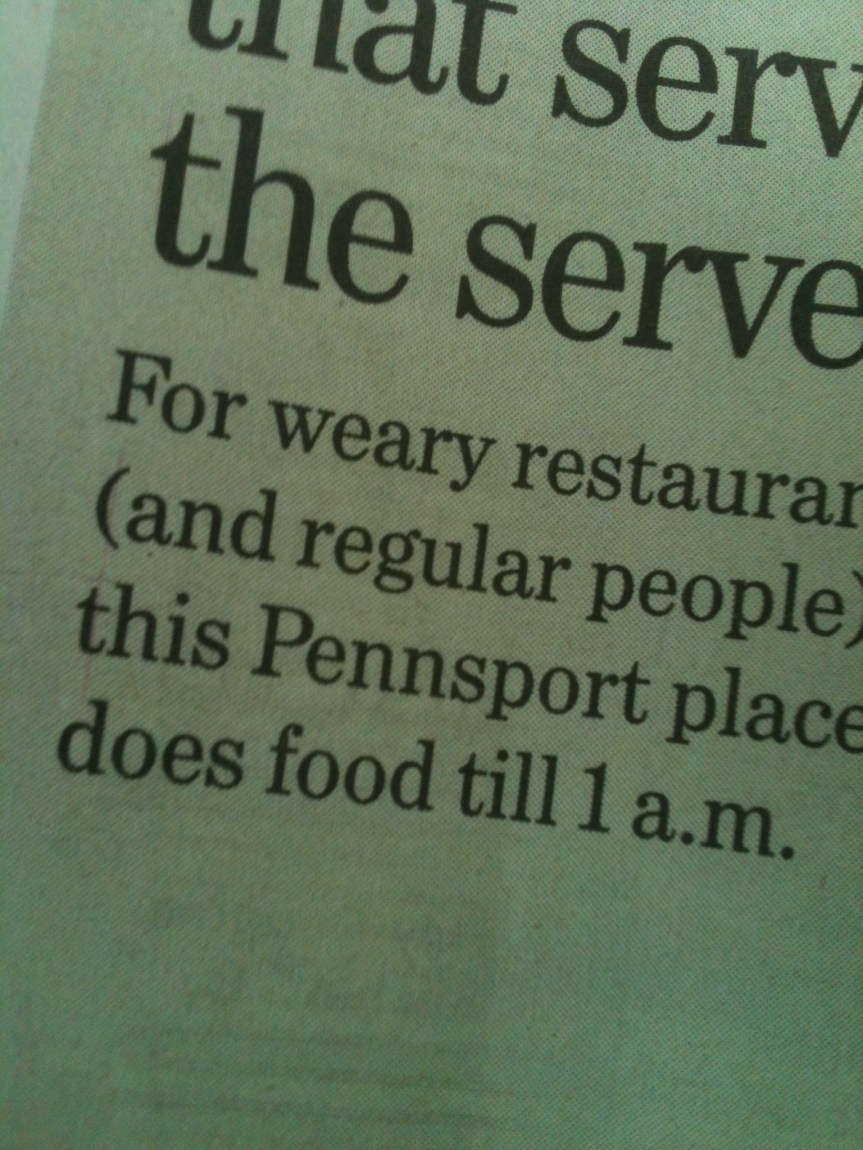
Among the no doubt hundreds of meanings of the verb to do is a particularly British one. It relates to food in general or a particular dish; the American equivalents are serve or offer. Thus an English tennis partner of mine once described a dinner part in which he “did pass-ta [the first syllable rhyming with class] and turkey.” Or one might inquire of a pub, “Do you do meals?”

I have been on the lookout for American uses of this do, with no luck until a couple of says ago, when I spotted this headline in the Philadelphia Inquirer:

So let’s see if do does America.

“Directly”

The British use this adverb, in a time sense, where Americans traditionally use right or immediately or just, most commonly in such phrases as directly after or directly before, but also by itself, to mean straightaway, as in this line from Jane Eyre (1847): “He sat down: but he did not get leave to speak directly.”

It is popping up over here, prominently in a Sam Sifton New York Times Magazine recipe for rosemary-garlic crusted pork butt that I aim to make tomorrow night (I will let you know how it goes):

“These [peaches] you will cut in half and pit, directly before cooking.”

And there is also:

  • “CBS is preparing online specials for directly before and after its television coverage, the latter anchored by Scott Pelley.” (Philadelphia Inquirer, August 25, 2012)
  • “Maj. Gen. Paul Lefebvre retired during a small, private ceremony directly before handing command of Marine Corps special operations to Maj. Gen. Mark Clark…” (Jacksonville Daily News, August 24, 2012)
  • “Littlepage stated that directly after hearing the noise, her steering wheel began to jerk from side to side.” (Surfky.com News, August 25, 2012)

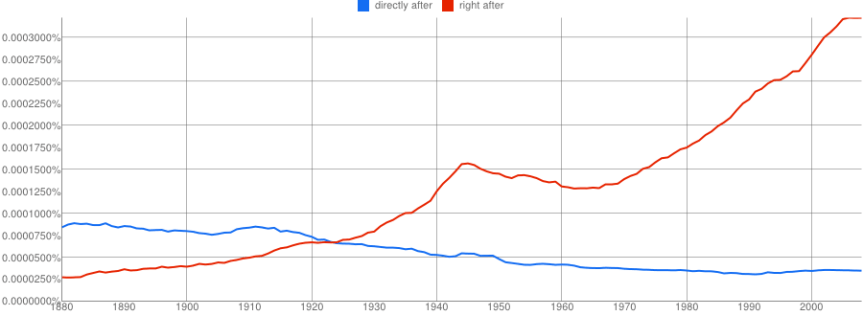
I used Google Ngram to compare relative frequency of right after and directly after in the U.S. because I couldn’t figure out any other way to isolate this meaning from all the (many) other ones directly has. The results in the chart below show that right after (red) overtook directly after (blue) in about 1925, but that d.a. stopped the lexical bleeding in the ’90s and is starting on the road back. (In Britain, directly after didn’t take the lead till the ’50s and even since then has had a respectable showing.)

“Da”

Every day, I read the Tirdad Derakhshani’s “SideShow” gossip column in the Philadelphia Inquirer. I would call it a “guilty pleasure,” except that I don’t really enjoy it all that much. But anyway.

I have noticed that, probably because of the banality and repetitiveness of his material, Derakhshani makes a (visible) effort to use unorthodox lingo. Sometimes the lingo consists of Britishisms, and that is the case today, when he writes about Britney Spears: “her finances are still under the control of her da, James Parnell Spears.”

If I’m not mistaken, da is actually (unlike mum, which by the way I just heard Tom Magliozzi use on the radio show “Car Talk”–is it a Boston thing?) not a Britishism but an Irish diminutive for “father.” I first became aware of it when reading about and then seeing Hugh Leonard’s excellent play of that name, in a 1978 Broadway production starring Barnard Hughes.

Surprisingly, the OED doesn’t mention this, even though its only two twentieth-century citations are from Irishman: James Joyce (“Waiting outside pubs to bring da home.”–Ulysses) and C. Day-Lewis, writing under his pen name “Nicholas Blake” (“Miss Judith grew up to be..the apple of her da’s eye”).

The New York Times recognized the Irishness of the term just last week, in an article about an Olympic boxing gold medalist: “As the years passed, and as [Katie]Taylor became well known, Ireland grew evermore fond of her: a nice girl without any airs, coached by her Da.”

In any case, it’s clear to me that Derakhshani pretty much all alone in the American use of da, and in fact that inspires me to start a new category: Outliers. I will be retroactively adding stroke, zed and a bunch of other one-offs.

“Stroke”

I always listen carefully when Mike Nichols is talking–he is as smart, witty and sophisticated as they come–and that was the case last month, when he appeared on NPR’s “Talk of the Nation” to discuss the production of “Death of a Salesman” he recently directed. Referring to the library research he did about two previous directors of Arthur Miller’s play, Nichols commented: “I saw a letter from [Elia] Kazan to [Harold] Clurman, who is sort of his partner-stroke-nemesis.”

Naturally, what struck me was the word stroke. I sensed from context and subsequently confirmed that it is the British equivalent of the punctuation mark Americans call slash (/), or nowadays forward slash, and similarly used orally, as the OED puts it, “to indicate or stress alternatives.” The dictionary lists these examples:

1965   M. Allingham Mind Readers xv. 153,   I have my own feel, of course, which would be ‘glad stroke laughing at’ in his case.
1971   J. Yardley Kiss a Day ii. 39   The Truman stroke Eisenhower regime.
In recent years, the “model slash actor” (or “actress”) has become a U.S. trope, mocked in the 2001 comedy “Zoolander,” where Fabio receives as “Slashie” award and is gratified by the word order: “you consider me the best actor slash model… and not the other way around.”
I was only able (in my admittedly limited research) to find one similar use of stroke in the U.K. In her Twitter profile, Liz Richardson describes herself as “Actress stroke comedienne stroke Wren cyclist stroke dogs (because they’re nice).”

As for U.S. use of stroke, I haven’t been able to find a single example other than Nichols’. That makes sense. If it emerged from the mouth of anyone of lesser stature, it would come off as insufferably pretentious.

“Have a Quiet Word” with someone

Some time ago–never mind how long exactly–my colleague Dawn Fallik suggested I do a post on “have a quiet word with,” which, she explained, was  Britishism meaning to scream at remonstrate someone in private. I looked at her with elevated eyebrows, having never heard of such a thing. But over the months I have come to understand that it’s a solid Britishism.

I was roused into action a couple of nights ago watching Olympics soccer, when, after a miscue (British) announcer Arlo White commented, “Abby Wambach is going to have a quiet word with her about that.”

Also in the world of sport, the expression came up last year when (Australian) caddie Steve Williams apparently gave an interview that deflected too much attention from his employer, (Australian) golfer Adam Scott. The New York Times reported:

“The calmest reaction of the day belonged to the always-unruffled Scott, who laughed Tuesday when asked if he had had a  ‘quiet word’ with Williams about his televised interview and said: ”You know, having a quiet word with Steve is not very easy. He’s a big guy, you know.”

Quiet word shows up frequently in U.K. sources, way back to around the turn of the twentieth century. The other Times, the one in London, commented in 1908 that one of the duties of officers in the Metropolitan Police is to offer “a quiet word to one who suspected if complicity in some offence but who has not yet embarked in a life of crime.”

But is it a NOOB? Not quite yet. Only a couple of hits come up:

“At the funeral of Sen. Edward M. Kennedy in August 2009, Boston’s Cardinal Sean Patrick O’Malley pulled President Obama aside for a quiet word. It was a sign of things to come: the first failure of the president to understand the moral dimensions of his health-care proposal.” (Washington Post, June 30, 2012)

“[Penn State administrators had] thought about telling someone who could actually do something about evidence that [Jerry] Sandusky had raped a child in a locker-room shower, but, after Curley conveyed Paterno’s doubts, “humane” is what they told each other it would be if they had a quiet word with Sandusky instead.” (New Yorker, July 18, 2012)

Then there’s this comment on a CBS News blog, which is inadmissible because you can’t tell if the commenter is American:

Very interesting how CBS, last evening had the article headline: “Pregnant Pa. woman, baby killed by lightning” Today, the article was re-written, with a new more P.C. headline: “Pregnant Amish woman, fetus killed by lightning” The liberal editor had a quiet word with last night’s reporter.

In any case, quiet word is officially on the radar. Thanks, Dawnie.

“Knacker’s”/”Knackers”/”Knackered”/”Knacker”

I was recently e-mailed by reader Peter Hirsch as follows: “Today’s FT [The Financial Times] (arguably not a British paper except for their persistent use of the verb to ‘back foot’) carries a column by US financier Steven Rattner which uses the term ‘knacker’ without its conventional accompaniment ‘yard.”

I confessed that I wasn’t familiar with the term and he explained:

The phrase that I grew up with (I have now lived in the US for 30 years), is “knacker’s yard,” a place to which aged and worn out horses were once sent to be killed and turned into useful post-life products — lard, rope material, bone meal etc.  The knacker was the man responsible for this work and the phrase was most commonly used in sentences like “he’s only good for the knacker’s yard.”

I looked up Rattner’s article. He said that under Republican Congressman Paul Ryan’s draft budget, Medicare “would be turned over to cash-starved states, the fiscal equivalent of being sent to the knacker for execution.”

Peter’s dissing of Rattner’s command of U.K. vernacular is mostly correct, my investigations find. That is, it appears, first, that a large majority of knacker’s are followed by yard. The OED cites this poem by Thom Gunn: “The graveyard is the sea… They have all come who sought distinction hard /To this universal knacker’s yard.”

And even when there’s no yard, the preferred form is knacker’s or knackers, not Rattner’s knacker. For example, this comment to an article about protest over treatment of show horses in the Greater Dandenong Weekly. (Yes, that is what the publication is called. See for yourself–and by the way, can anyone help me out with “furphy”?) “Do not believe the furphy that they are saved from the knackers either — do we honestly think owners and trainers bleeding the last dollars from the jumpers will retire them gracefully?”

But, in any form, is this a NOOB? No, Steven Rattner stands alone.

However, another sense of the word is definitely a comer, in my opinion, as seen in this 2011 quote from the New York Times:

Last week the prophet Elijah made a personal appearance at every Passover Seder around the world, or so we are told: most people are unable actually to see him, although parents have traditionally found ways to convince their children that Elijah sipped from the wine cup left for him. Taking all that on faith, you have to think that Elijah is one knackered prophet just now…

The etymology is interesting. Knackers was once used to mean castanets, from which derived its sense as slang for testicles (pause for chortle). This was used by James Joyce in Ulysses (1922): “Eh, Harry, give him a kick in the knackers.” That meaning in turn led to verb to knacker, which originated in late nineteenth century as a synonym for castrate and not until about 1970 (according to the OED) took on its current familiar (in the U.K.) meaning, knackered=exhausted.

Knacker, as a noun, has a new meaning, most common in Ireland, undreamt of by the OED. It can be seen in this recent online comment: “sad man indeed, sitting in his sad cooncil [sic] house with his sad little life ….what a knacker.” A column in the Irish Independent explains:

Knackers, for those naive souls unfamiliar with the word, is a term of abuse for what the urban dictionary describes as an “Irish adolescent subspecies”… “originally a derogatory term of reference for Travellers but nowadays covering a whole spectrum of degenerates”. Members of the tribe can generally be found hanging around outside fast food outlets and off- licences, picking fights with random strangers. ‘Skanger’ would be another term.

That’s all for now. I’m knackered.