“On the back foot”

Reader Richard Raiswell, of Prince Edward Island, Canada, writes:

You don’t seem to have done “on the back foot”. This (I think) comes from cricket and refers to a defensive shot which also has some attacking merit. I have heard it creeping into use in US English recently.

Well, yes. You need only look at today’s Chicago Tribune to find it in a baseball article: “In Oakland, starter Travis Blackley tossed six solid innings while his offense scratched out enough runs to seize their fifth straight win and put the Rangers (93-68) on the back foot.”

Then there’s this, from an early September post on NewsBusters, a blog dedicated to “exposing & combating liberal media bias”: “New York Times campaign reporter Ashley Parker tried to put Mitt Romney on the back foot from the opening sentence of her article on his speech to the National Guard convention in Reno.”

But in the Times itself, you have to go back to March 2011 to find a non-sporting, non-direct-quote back foot: “Activist investors generally prefer to be on the attack. So it’s odd to see them on the back foot, fighting to preserve an important arrow in their quiver.”

Interesting that these uses don’t appear to conform with Richard’s notion that the phrase suggests a ploy that “has some attacking merit.” I am sure that readers will weigh in with their thoughts on this matter. As for NOOB status, it appears that on the back foot is only on the radar at this point. Time will tell if it has (sorry) legs.

“Dab hand”

This noun phrase meaning “expert” (usually followed by at, as in “a dab hand at cookery“) derived from the now-archaic dab, meaning the same thing, which is “frequently referred to as school slang,” according to the OED. The first citation is from The Athenian Mercury in 1691: “[Love is] such a Dab at his Bow and Arrows.”

Dab hand apparently originated as Yorkshire dialect pre-1800, but didn’t become widely used in Britain until the 1950s, according to a Google Ngram. Following a familiar pattern, it peaked in Britain in about 1990, while U.S. use continues to rapidly increase (though it’s still used less than half as often here as there).

There are many dab American  hands nowadays. The distinguished Stanford Berkeley linguist Geoffrey Nunberg was quoted in the New York Times in 2011 as follows: “I fancy myself a dab hand at Google, but it drives me crazy,” but the term shows up in less elevated company as well:

“Hughes graduated in May with a degree in entrepreneurship management from Boise State University. Now he’s putting what he learned to work as he functions as a driver, a furniture mover, and at times a dab hand with the little wrenches IKEA encloses in its packaging (his business offers assembly).”–Idaho Business Review, August 22, 2012

“[‘Abraham Lincoln: Vampire Hunter’ director Timur] Bekmambetov, who proved himself a dab hand at vampire thrillers (‘Night Watch,’ ‘Day Watch’) before he directed the 2008 graphic-novel adaptation ‘Wanted,’ handles the violence in an arresting if flashily impersonal style.”–Variety, June 22, 2012

“At Virginia Polytechnic, [architect Kimberly Peck] started playing around with industrial design, and became a dab hand at using the lathe, the milling machine and other mechanical equipment.”–New York Times, April 15, 2012

“Toff”

Reader Bruce Stoneback sends along the quote below, and suggests looking into toff (i.e., upper-class twit). I have done so, and strangely found that every recent American reference is to the same person:

“And if you are Mitt Romney, with Mitt Romney’s biography, résumé and bankroll, there are certain things you don’t want to be filmed saying in a dining room full of toffs in a Boca Raton, Fla., mansion that looks like a location from Eyes Wide Shut (and whose owner reportedly threw a tabloid-notorious sex party at an estate in the Hamptons).”–James Poniewozik, Time, October 1, 2012

“Romney isn’t the bumbling toff he’s made out to be.”–The Daily Beast, September 17, 2012

“We may wince when the blithering toff, or want-wit, as Shakespeare would say, arrives at the Brits’ home and throws his Cherry Coke Zero can in the prize rose bushes. But what drives his gaffes is his desire to preen over accomplishments.”–Maureen Dowd, New York Times, July 28, 2012, referring to Mitt Romney.

“Brilliant”

My word for the many, many (, many) comments that have come in since BBC.com featured NOOBs in Cordelia Hebblethwaite’s excellent piece about Britishisms in American English. I have to approve them all before they’re posted, and they are so generally clever and well-written that I don’t want to rush the process–that it, I read them all and comment on some. I’m only about halfway through, the redundancy (not in the British sense) is my fault, not the commenters’.

“Endeavour”

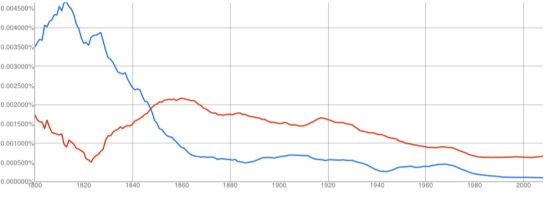
All the coverage of the Space Shuttle Endeavour’s ongoing cross-country farewell tour made me wonder, naturally, about the ou spelling in its final syllable. It turns out it was named–u and all–after the first ship commanded by the eighteenth-century English explorer James Cook. It’s not a natural spelling for us Yanks, hence this mistake in a sign some well-meaning NASA folk constructed to cheer on a 2005 launch:

Despite the shuttle’s fame, the u-less spelling (indicated by the red line on this Ngram chart, showing use of both spellings in American English between 1800 and 2008) remains a strong preference on these shores, as it has been since 1850:

“Opening Hours”

In the previous post (piece of kit), I promised to feature another Nancy Friedman find. It’s “Opening Hours,” capitalized because it’s what you see on the signs of retail establishments in the U.K., indicating what U.S. stores would announce, simply, as “Hours.”

Nancy sent along a link to a profoundly twee-seeming San Francisco establishment called MAAS & Stacks, which describes itself as “a purveyor of classic pieces with modern tailoring. Inspired by the simplicity of a well-constructed garment, the store aims to present customers with a curated selection of everyday wears.” Their opening hours don’t commence till noon on weekdays; I guess they need extra time for curating.

In these parts, two examples constitute a trend, so I offer this, also from a posh West Coast outfit:

“Piece of kit”

Nancy Friedman has once again alerted me to to a NOOB of which I was not aware. (If you want to know about the other occasions, just key her name into the search field at right.) I was certainly familiar with the BrE kit, meaning both “uniform” (what football players wear) and “equipment,” and had indeed been keeping my eye out for American uses.

Thanks to Nancy, I now know the latter kit, at least, has established a capacious beachhead on these shores. She sent along a link to a September 14 blog post by John Scalzi, about the new iPhone, which includes this line: “As advertised, it is a very lovely piece of kit.”

I poked around the Web for other uses and found it’s most popular among techies like Scalzi. Thus Zack Whitaker, on ZDNet: “It doesn’t matter where you are in the world: a media on-the-go bag has to have every piece of kit you may or may not need.” And Elizabeth Fish, in PCWorld: “The Sandia Hand by Sandia National Laboratories is an impressive piece of kit for a troop to own.” (Both quotes appeared in the last couple of months.)

Besides spotting this rather annoying piece of pretentiousness, Nancy offers a credible starting point for its U.S. popularity: Lenny Kravitz’s 1999 song “Black Velveteen,” which refers to a “nice piece of kit.”

As if all this weren’t enough, Nancy has identified another new NOOB. Watch this space to learn about it.

Oh, come on

In a profile of the director Robert Wilson in the September 17 issue of the New Yorker, Hilton Als relates how Wilson studied as an undergraduate at the University of Texas in his native state. Als then writes:

“While at university, where he enrolled in business administration to please his father, he took a job as a kitchen aide at the Austin State Hospital for the Mentally Handicapped.”

The “at university” sets a news standard for conspicuous and gratuitous use of Britishisms (CAGUOBs), even for the New Yorker.

“Fingers crossed”

Yes, yes, I know this is a venerable U.S. expression, so hold your fire. Americans say things like “My fingers are crossed” or “Keep your fingers crossed,” to indicate a wish for good luck. The Brits like to use the phrase by itself, as Americans would say, “Good luck!”, or, similarly, to more or less mean, “Here’s hoping for…” An example is this headline from the local newspaper in the West Midlands town of Solihull: “Fingers Crossed for a Sunny Shirley Carnival.”

I have some sense that the expression is in the early stage of incipient NOOB-itude. I offer this from Andy Benoit’s New York Times preview of the NFL Dallas Cowboys: “The budding star receiver (fingers crossed on off-field matters) Dez Bryant is 23.”

And this quote from American Canadian director James Cameron, about the recent release of his most famous film on Blu-Ray: “We’ve been holding back Titanic. So, fingers crossed.”