“American football”

ImageI meant to note a Britishism uttered on my favorite television show, The Simpsons, a few of weeks ago. I figure that two days after the Super Bowl is about the right time! In the words of the recap on Celebrity Cafe:

Lisa emerges in the kitchen with a book titled “Pretending to Like Football” by Mrs. John Madden. Lisa dishes out a fact about “American football” before Bart interrupts her saying that it’s not “American” football; it’s just football. Lisa rubs it in that Milhouse invited her to the “American” football game instead of Bart. And Bart tattles on Lisa to Marge.

Congrats to the Seattle Seahawks side and their supporters for a brilliant match.

Lisa emerges in the kitchen with a book titled “Pretending to Like Football” by Mrs. John Madden. Lisa dishes out a fact about American football before Bart interrupts her saying that it’s not “American” football; it’s just football.

Lisa rubs it in that Milhouse invited her to the “American” football game instead of Bart. And Bart tattles on Lisa to Marge.

Read more at http://thecelebritycafe.com/feature/2013/11/simpsons-recap-labor-pains#1w1VrtCrQvlwo4Lw.99

Lisa emerges in the kitchen with a book titled “Pretending to Like Football” by Mrs. John Madden. Lisa dishes out a fact about American football before Bart interrupts her saying that it’s not “American” football; it’s just football.

Lisa rubs it in that Milhouse invited her to the “American” football game instead of Bart.

Read more at http://thecelebritycafe.com/feature/2013/11/simpsons-recap-labor-pains#1w1VrtCrQvlwo4Lw.99

Lisa emerges in the kitchen with a book titled “Pretending to Like Football” by Mrs. John Madden. Lisa dishes out a fact about American football before Bart interrupts her saying that it’s not “American” football; it’s just football.

Lisa rubs it in that Milhouse invited her to the “American” football game instead of Bart.

Read more at http://thecelebritycafe.com/feature/2013/11/simpsons-recap-labor-pains#1w1VrtCrQvlwo4Lw.99

Lisa emerges in the kitchen with a book titled “Pretending to Like Football” by Mrs. John Madden. Lisa dishes out a fact about American football before Bart interrupts her saying that it’s not “American” football; it’s just football.

Lisa rubs it in that Milhouse invited her to the “American” football game instead of Bart.

Read more at http://thecelebritycafe.com/feature/2013/11/simpsons-recap-labor-pains#1w1VrtCrQvlwo4Lw.99

Lisa emerges in the kitchen with a book titled “Pretending to Like Football” by Mrs. John Madden. Lisa dishes out a fact about American football before Bart interrupts her saying that it’s not “American” football; it’s just football.

Lisa rubs it in that Milhouse invited her to the “American” football game instead of Bart.

Read more at http://thecelebritycafe.com/feature/2013/11/simpsons-recap-labor-pains#1w1VrtCrQvlwo4Lw.99

“Aeroplane”

I’ve been reading about the return tour of an American cult rock band from the 1990s, Neutral Milk Hotel. The reviews all mention the album that’s considered their best, “In the Aeroplane Over the Sea.”

Aeroplane was first used for a “heavier-than-air aircraft,” according to the Oxford English Dictionary, in 1868, that is, before the aeroplane before it was invented. The OED describes airplane as “chiefly North American”; its first citation is from a 1906 Scientific American article that notes: “Air-plane is a much better word than aeroplane. It is as good etymologically, and much better when it is spoken.” The OED comments: “Airplane became the standard U.S. term (replacing aeroplane) after it was adopted by the National Advisory Committee for Aeronautics in 1916. Although A. Lloyd Jones recommended its adoption by the BBC in 1928, it has until recently been no more than an occasional form in British English.”

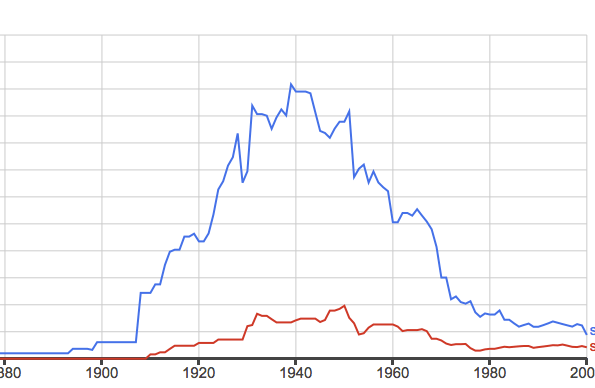
Google Ngram Viewer confirms this analysis:

Screen Shot 2014-02-01 at 11.16.32 AMIf the chart is too small to make out, it shows that aeroplane is still (barely) the preferred spelling in the U.K., and is virtually never used in the U.S.–other than in Neutral Milk Hotel albums.

Of course, I’d bet that in both lingos, the far preferred term is plane.

Implied Offscreen NOOB

A few years back, a friend of mine was watching a horror movie with his precocious ten-year-old son. A couple of characters were out rowing on a lake, and then there was some sort of horrible sound. My friend’s son turned to him and whispered, “Hmmm. Implied off-screen suicide.”

That came to mind the other day when I read a Philadelphia Inquirer article in which Brett Brown, the coach of the 76ers basketball team, made some comments about a young player, Nerlens Noel:

brown

It was clear to me that Brown used the words tick and ticking, and the reporter supplied the American equivalent, check, in brackets. The backstory is that while Brown is a native American, he spent many years playing and coaching in Australia, which is presumably where he learned about ticking boxes.

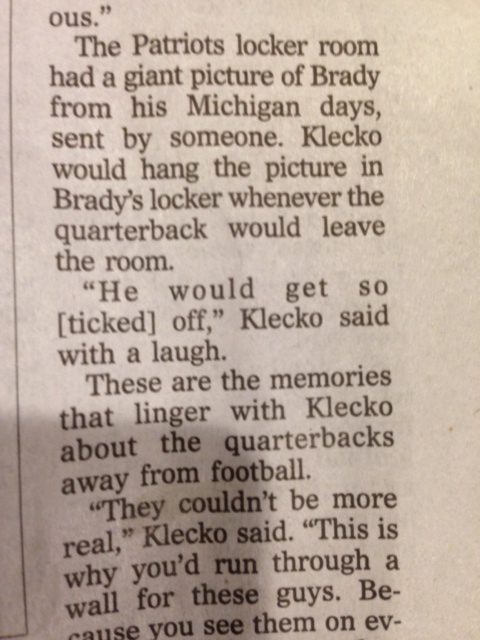
Coincidentally, just a couple of days later, this appeared in the very same Inquirer:

kelcko

I would bet dollars to donuts that the word Dan Klecko used to refer to Tom Brady was pissed, which, of course, means something very different in the U.K.

“Naff”

The indefatigable Nancy Friedman sends along a sentence from a New Yorker blog post by Adam Gopnik: “Then Bob Dylan showed up from Minnesota—telling various tales about places he had never actually been, with his naff, made-up name—having nothing but genius.”

She sent it along, of course, because Gopnik (a native Canadian who has lived in the U.S. and written for American publications for numerous decades) used the word naff.

The OED defines the adjective as “Unfashionable, vulgar; lacking in style, inept; worthless, faulty.” The first citation is a 1966 quote from  B. Took & M. Feldman in B. Took, Best of ‘Round the Horne’ (1989): “I couldn’t be doing with a garden like this… I mean all them horrible little naff gnomes”

The OED has a lengthy etymological note, which I have slightly abridged:

Origin unknown . Probably unrelated to slightly earlier naff v.

Various theories have been proposed as to the origin of this word. It has been suggested that it is (in Polari slang: see polari n.) < naff in naff omi a dreary man (compare omee n.), in which naff may perhaps be < Italian gnaffa despicable person (16th cent.).

One of the most popular theories is the suggestion that the word is perhaps an acronym either < the initial letters of Normal As Fuck , or < the initial letters of Not Available For Fucking , but this seems to be a later rationalization. O.E.D. Suppl. (1976) compares the earlier English regional (northern) forms naffhead , naffin , naffy , all denoting a simpleton or idiot (see Eng. Dial. Dict. s.v. Naff v.), and also niff-naff n., niffy-naffy adj., and nyaff n., nyaff v.

The OED defines the “unrelated” verb naff, bluntly, as “fuck,” and notes it is often followed by off.

The etymology may be unknown, but it is unquestionably the case that naff is British to the core. I searched the entire run of The New Yorker (which has been publishing since 1925) and found seven previous naffs. Six either referred to a person named Naff or were spoken or written by British people. The seventh was from, yes, Adam Gopnik, who wrote in 2004: “Being an expert on wine and writing about it is what the English call ‘naff,’ embarrassing and uncool…” (“Uncool” is right, but I’m not sure about “embarrassing.”)

The New York Times has been publishing since 1851, so has printed naff more than the New Yorker, though not that much more. Twenty-one times in the Times’ pages, the word either been uttered or written by a British person, or presented as a British term. On three occasions, it has been used by the fashion writers Suzy Menkes and Cathy Horyn. That leaves this quote, from a 1999 review of Martin Gardner’s Annotated Alice: “An English author, one fears, would have found it ”naff,’ embarrassing, to point out what a hansom cab is…”

The writer of the review? Adam Gopnik.

“Crisps,” “Builder”

In the last couple of weeks, I came upon two examples of a not uncommon phenomenon: an American, writing for an American publication, using an obvious Britishism when writing about Britain or a Briton. You might call it protective coloration, or going native. The first one was in a New Yorker article by Elizabeth Kolbert in which she describes what she finds in a parking lot (which she does not call a car park) near her airport hotel at Heathrow: “empty water bottles, crumpled candy wrappers, crushed soda cans, half-eaten packages of crisps.”

Of course, crisps is the word British people use for what Americans call potato chips or chips (which is what British people call what Americans call french fries or fries). But, as a matter of fact, crisps has been worming its way into AmE of late, specifically for products that are more off-beat than your typical Wise or Lay’s potato chips. This one, for example:

010114_42903_BrownRiceCrispsGardenSalsa_D

So I will categorize crisps as “on the radar.”

The other example came in a New York Times obituary of “Micky Lay, a bibulous retired builder who helped Mark Rylance craft his performance in Jez Butterworth’s hit play about British outcasts, ‘Jerusalem.'” The relevant term is builder. In the U.S., that word is used pretty much exclusively by newspapers in describing people like Donald Trump–that is, real estate developers.

In Britain, the OED says, “As the name of a trade, builder now denotes the master artisan, who receives his instructions from the architect, and employs the masons, carpenters, etc., by whom the manual work is performed.” That is what Americans would call a “contractor.” But I believe that British builder also refers to a lower-level laborer, what we call “construction worker.” I await enlightenment on this point.

Builder has made some inroads into the youth of America via the animated children’s series “‘Bob the Builder,” which has aired here since 2001. Some of the kids who watched it back then have grown up by now. But I don’t see any evidence of builder being used here in the British sense. That may have to do, unfortunately, with our construction slump. It’s not a job with great prospects, so no one under thirty has much reason to talk about it.

Good On Us

When I started Not One-Off Britishisms, nearly three years ago, it was a sort of experiment. In retrospect, I see that I was testing the commonly voiced proposition that the best blogs tend to be about the narrowest topics.

Well, narrow I have been. And while I won’t make any judgments about “best,” NOOBs recently passed the 750,000 page view mark, which is not nothing. (273,894 have come from the U.S. and 257,247 from the U.K.) Beyond the numbers, it’s been greatly rewarding for me. I’ve been able to explore a fun hobby and add infinitesimally to the fount of knowledge, all while never (knowingly) harming anybody. Best of all for me have been the comments, which continually delight and instruct. There are too many examples to name, but just in the past week, in the discussion of Titbits, I learned about the venerable magazine of that name and even heard from someone who’d worked as an editor there in its last days.

In this general air of self-congratulation, I thought I’d pass along some statistics, To start with comments, there have been 3,981 of them, and the most prolific recent commenters are:

  • Hal Hall
  • Martin James
  • IvanOpinion
  • czyrko
  • DW
  • Bren

Thanks, mates.

The most commented entry has been “Arse” with 99 of them, followed by:

European Date Format is the most-read single post, followed by

All that must mean something, but for the life of my I can’t think of what it is. Anyway, thanks again for stopping by. Talk to you again when we reach a million.

That Olde-Time Feeling

The indispensable Nancy Friedman forwards an e-mail she just got from the American grocery chain Trader Joe’s:

Screen Shot 2014-01-07 at 9.26.24 AM

I guess they’re trying to get an old-fashioned feel. And by “old-fashioned” I mean 1842–which was the last time favourite was more common than favorite in American English, according to this Google Ngram Viewer chart:

Screen Shot 2014-01-07 at 9.30.34 AM

“Queue” (verb)

Long ago I wrote a post on queue, meaning what Americans would traditionally call a lineand have returned to the word from time to time. But I have concentrated on the noun form, as I’ve felt that Americans would much more frequently talk about “a queue” than say they “queued up” or “queued.” (I’ll note that I’m specifically talking about a physical line with physical people in it, not the variants of the word in music and computers, in which queue has particular meanings that are found on both sides of the Atlantic.)

Even in Britain, the noun came first, with an 1839 citation (from Thomas Carlyle) compared to this 1920 Times advert for the verb:  “Taxi-Cabs queued up for their supplies of ‘Shell.’” The first up-less verb queue isn’t until a 1978 quote from a Dick Francis novel: “We are damned lucky to have been given the few weeks’ option. They’ve got other buyers practically queueing for it.”

Francis chooses one of the two variants for the gerund, the other being queuing. They have duked it out over the years, with the streamlined form surging ahead since the 1990s, according to Google Ngram Viewer chart of British usage since 1930:

Screen Shot 2014-01-05 at 10.29.23 AM

At this point, American queue (noun) is quite common, one reason being that line has so many meanings that it’s not always clear which one is intended. Queue up has developed a strong presence as well, for the same reason. Yesterday this was in the Los Angeles Times–“The union hall closest to Boeing Co.‘s biggest manufacturing operation swarmed with activity Friday afternoon, as hundreds of machinist union members queued up to vote on the aerospace giant’s latest contract”–and this in the Kansas City Star: “Chappell is the first, but a few others are queued up to receive the implant, including one surgery planned for next month.”

But the up-less verb form is much less common, similar to how Americans will ring someone up, but rarely just “ring” someone. It is making inroads, however, and what a surprise that evidence should come from what could be considered the very epicenter of hipness, a Whole Foods store in San Francisco. Nancy Friedman sends in this photographic proof:

Whole Foods queue

And what a surprise: they stuck in that second “e.”

“Titbit”

Hanks and Thompson, as DIsney and Travers
Hanks and Thompson, as Disney and Travers

My first thought was that I had misheard. I was watching a scene in the film “Saving Mr. Banks” where Walt Disney, played by Tom Hanks, is giving a tour of Disneyland to P.L. Travers (Emma Thompson), the author of Mary Poppins, which he would dearly love to film. What I seemed to have heard didn’t make sense to me. But a tweet from @NickyD pointed out the same thing and directed me to the movie’s screenplay. That document confirms that Disney tells Travers, “In Adventureland there is a tree–this is a fun fact. A titbit … ”

Then Travers interrupts and corrects him: “Tidbit.”

Disney goes on: “… It has three million leaves, four million flowers”

The surprising thing isn’t that Travers would presume to correct the great Disney. According to the film, that is the very core of her character. Rather, it is an apparent reversal of the characters’ presumed position on the corrected point. I had thought of titbit as both a Britishism and the original form of the expression, and tidbit as a predominately American corruption.

The OED and Google Ngram Viewer gave me some nuance. The first use cited in the OED comes from 1649, is British, and is in fact tidbit, spelled a little differently: “A tyd bit, i.e. a speciall morsell reserved to eat at last.” The first titbit (also British) appears in 1697 and the last, from T.A. Trollope, in 1887: “During the singing of the well-known tit-bits of any opera.”

Ngram Viewer gives a sense of the popularity of the variants in the two countries:

Screen Shot 2014-01-01 at 3.49.42 PM

The “Mr. Banks” scene takes place in 1961, at which point, according to Google, tidbit was indeed the favored version in American English and titbit in British English. Now, titbit was still relatively common in AmE until beginning a steady decline in around 1930. (Presumably, that coincided with the rise to prominence of the slang tit, referring to a [usually woman’s] breast, making titbit seem improper, albeit unfairly.  British titbit began a decline of its own commencing in around 1950, possibly because by that point the anatomical  tit had crossed the Atlantic.) So it’s possible that Disney, who was born in 1901 to an Irish-Canadian father, would indeed have used the term. But that seems far too convoluted a linguistic possibility for this film to make note of.

IMDB tells me that one of the screenwriters of the film, Kelly Marcel, is British, and the other, Sue Smith, is Australian, as was Travers. And it would seem that the only plausibility for the anomaly is the Australian connection. Is it the case that tidbit was and is favored in Oz, to the extent that Aussies would think of titbit as an American corruption? I await wisdom from NOOB readers Down Under.