Red Nose Day

150428_2862418_Red_Nose_Day_Is_Coming
Nick Offerman with red nose

John Wall writes with the suggestion of new concept for this blog: the cultural Not One-Off Britishism. The import he has in mind is Red Nose Day, which I just learned was started in the U.K. in 1988 as a way to raise money for charitable causes through comedy performances on TV and, apparently, rampant photos of people wearing red noses, in the manner of clowns.

On May 21, Red Nose Day is coming to the U.S., through a variety of NBC broadcasts and other events.

It seems like a good cause, but with all due respect, the brand needs some work, since (in my humble opinion), there is little that’s unfunnier than a clown.

“A Piece of Cake”

It started with an email from my eclectic friend Wes Davis. He said he’d been reading Tinkerbelle, by, he told me, “Robert Manry, a copy editor for the Cleveland Plain Dealer who, in 1965, took a leave of absence from his job and sailed a 13-and-a-half-foot wooden boat across the Atlantic, from Falmouth, Mass., to Falmouth, England.” He’d come upon a passage he thought would interest me. Manry is just starting out and it’s a beautiful day, “the wind strong enough to keep us moving along briskly.” He observes: “I told myself that if most of the days ahead were as pleasant as this, our trip would be a breeze, or, as the English say, a piece of cake.”

Wes sent me the quote because his sense (like mine) is that “a piece of cake” is as American as red velvet cake. So what was with Manry’s attribution to the English?

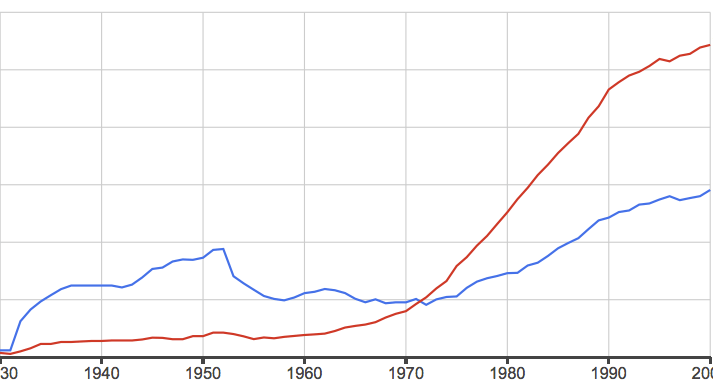
As usual in such matters, I turned first to Google’s Ngram Viewer, which yielded the graph below. (The blue line represents British uses of the phrase “was a piece of cake” and the red line, American uses.)
Screen Shot 2015-04-29 at 10.21.54 AM

Thus at the time Manry was writing, it was still predominantly a British phrase, but that would soon change.

There’s a bit of noise in the graph — that is, it tracks not only the figure of speech but literal uses, like “What they served me was a piece of cake.” The Oxford English Dictionary’s first citation for the phrase is from a 1936 poem by the American Ogden Nash: “Her picture’s in the papers now,/And life’s a piece of cake.” But I feel that’s an outlier — merely a fresh metaphor concocted by Nash. I wasn’t able to turn up any additional uses until 1942, and all of the ones from then through the early 50s are English.

And specifically English military, and even more specifically, RAF. The first quote in the Google Books database comes from a 1942 Life magazine article written by an RAF pilot: “It sounds incredible considering that we were 150 miles from the target but the fires were so great that it was a piece of cake to find the target area.” The phrase, so redolent of the plucky fliers, really caught on. The same year, Terrence Rattigan’s play Flare Path has the line, “Special. Very hush-hush. Not exactly a piece of cake, I believe.” By 1943, it had become so well-known that Cyril Henry Ward-Jackson titled his book It’s a Piece of Cake: or R.A.F. Slang Made Easy.

As the Google chart indicates, American use started to pick up but often (as with Manry) with attribution to the English. A 1951 article in an American flying magazine had the line, “The radio operator’s weather reports show all stations ahead in good shape and as the English say, ‘It’s a piece of cake.’” Eventually, we took it to heart, and rightly so, since it’s a great phrase, nicely complementing easy as pie (which refers to a process, rather than a task) while still staying in the realm of baked goods. As with a number of other phrases I’ve covered — including bonkers, nonstarter, and ta-ta (meaning “goodbye”) — Americans have ended up using it far more than the Brits.

There’s a coda to the tale of a piece of cake. Fans of Roald Dahl may recognize it as the title of one of his short stories, included in his 1946 collection Over to You: Ten Stories of Flyers and Flying. That story is actually an extensive reworking of his first published work, an article in the August 1942 edition of The Saturday Evening Post called “Shot Down Over Libya.” In the piece, labeled a “factual report,” Dahl talks about being given the assignment, in 1940, to bomb a group of Italian trucks in the Libyan desert. One of his fellow flyers remarks, “Hell’s bells, what a piece of cake!” Another agrees, “What a piece of cake.” (This is retroactive evidence of an earlier British use of the expression than given in the OED, but can’t be included in the dictionary as such since the publication date is 1942.)

It wasn’t a piece of cake for Dahl. As the story describes, he had a bad landing and was badly injured. But the story was far from a “factual report.” His plane was not shot down, as the title asserts and the text strongly implies. His biographer Jeremy Treglown writes, ”He stopped twice to refuel, the second time at Fouka, where he was given directions that may have been confused by events. 80 Squadron was not where he expected to find it, and as dusk gathered over the North African desert and his fuel gauge fell, he decided to try to land.”

The 1946 reworking was presented as fiction but had a more accurate account of the forced landing. In fact, just about the only thing it has in common with the 1942 version is “a piece of cake.”

“Cuttings”

“Cuttings” is the BrE equivalent of the AmE “clippings”–that which one clips, or cuts, out of the newspaper and puts into a scrapbook or whatever. It turned up in a New York Times article the other day about Herbert Warren Wind, the late golf writer for the New Yorker, whose papers at Yale University, Karen Crouse wrote, “contain seven boxes brimming with the cuttings of a well-sown life.”

I had been a longtime reader and admirer of Wind (who died in 2005) and, because of his name and literary style, always had a sense that he was British–which would make the “cuttings” rather appropriate. But no–Crouse’s article reveals that he was a native of Brockton, Mass.

[Update: The comment by “popegrutch,” below, convinces me that I made a mistake and Crouse wasn’t perpetrating a Britishism at all: the “cuttings” she referred to was a botanical metaphor, not a journalistic reference.]

More on “Weds.”

I’ve just finished the new thriller “The Girl on the Train,” written by the Englishwoman Paula Hawkins. I read the American edition and I’m not sure to what extent (if any) British expressions in the original were translated into Americanese. But there were a few that cropped up repeatedly: “buggy” (Americans would say “stroller”), “come round for a visit” (“around”), and one I wasn’t aware of–the transitive verb “quieten,” as in “quieten a baby.” Americans say “quiet.”

When I was almost done with the book, I came upon this (I’m pretty sure there aren’t any spoilers):

IMG_1914

The thing that caught my eye was “Weds.” Longtime readers may recall my dislike of this abbreviation for “Wednesday” (my preference is “Wed.”), and my not notably successful attempt to determine if it’s a Britishism.

(If you want to know why it annoys me, here’s why: “Wed.” is a perfectly good, shorter, abbreviation; there is no tradition of skipping over letters in abbreviations [there is “Dr.” and “Mr.” but they go right to the last letter in the word]; and “Weds.”–unlike a decent abbreviation–doesn’t even represent how the first part of the word sounds–that would be “Wends” or “Wens.”)

“The Girl on the Train” would suggest, though it doesn’t prove, that a Britishism “Weds.” is.

“On the up and up”

Jan Freeman remarked on Twitter that she had been hearing the phrase “on the up and up” meaning “improving” instead of “honest.”

There are indeed two general meanings of the phrase. The one I’m familiar with is “honest” or “on the level,” and the OED identifies it as originally American, with citations going back to 1863.

The OED doesn’t specify any nationality for the “Steadily rising, improving, or increasing” meaning. The first citation is from The Baltimore Sun, 1930: “From now on, we are led to believe, law and order will be on the up and up, as the current phrase is.” But that strikes me as ambiguous–that is, it could mean that law and order is on the level, as opposed to on the rise. All the other citations are from British sources.

But in any case, as Jan suggests, it’s now being used in the U.S., as in this  from a March post in Forbes.com: “to say that Thrive [Capital] is on the up and up would be a massive understatement.”

Any Yanks out there who have a sense that  “on the up and up”=”on the rise” is a long-term thing over here?

Results are in

Thanks to all who participated in the survey on pronunciation of the “-man” suffix in such words as “policeman” and “gunman.” I reported on the results yesterday on the Lingua Franca blog.

One finding I didn’t report was the difference between U.K.  and U.S. respondents. For certain words it was rather dramatic.

Here is a graph showing respondents from the U.S.:

Screen Shot 2015-04-04 at 10.47.01 AMAnd this one shows U.K. respondents:

Screen Shot 2015-04-04 at 10.55.27 AM

Generally speaking, U.K. respondents use the schwa more often than do American ones. Here are the three words with the biggest difference:

Screen Shot 2015-04-04 at 11.06.47 AM

My hypotheses for this relates to the general idea expressed in The Longman Pronunciation Dictionary, that reduced-stress schwa-vowel “-man” tends to occur in “well-established formations.”  The three words in the chart above are nothing if not well-established–and were established in the British Isles long before there even was a United States.

Also supporting the hypothesis is results on “lineman,” which I threw into the survey without thinking about the fact that it’s a mainly American term, either as a football position or the job memorialized in Glen Campbell’s song “Wichita Lineman.” (Google Ngram Viewer shows much greater use in the U.S.) Sure enough, U.K. respondents–to whom it’s unfamiliar–significantly outnumber Americans in reporting an equal-stress  /æ/ vowel in “lineman.”

Pronunciation of “-man”

This is (probably) off-topic, but I’d appreciate your help in something I’m looking into for another blog, Lingua Franca. I’m investigating how people pronounce the suffix “man” in such words as policeman, mailman, gunman, etc. (understanding, of course, that they are sexist and on the way out). The issue is whether the syllable is pronounced with a reduced stress and a “schwa” vowel, as in “woman,” or with equal stress, rhyming with “can” or “fan.”

Please take the survey at the link below, and do your part in helping the advancement of (pseudo-)science.

https://delaware.qualtrics.com/SE/?SID=SV_cMUN9GM9BbwcXXv

“Bog standard”

Keith Huss (@keithhuss) writes on Twitter: “Having British wife and friends, I’m familiar with the phrase “bog standard”. Recently read it twice on US tech blogger sites.”

New one on me!

The Oxford English Dictionary describes “bog standard” as: “slang (depreciative, chiefly Brit.). Ordinary, basic, standard without extra features or modification; unexceptional or uninspired.”

The citations (the earliest one is from 1962) all refer to cars or computers, with the exception of this 1995 quote from Empire magazine: “A bog-standard biography with a cheap ‘Psycho’ sales gimmick, you can’t help thinking [Anthony] Perkins deserved better.”

An Urban Dictionary definition from 2006 goes:

“Completely, utterly, absolutely ordinary in every way. British slang. ‘Dave drives a totally bog standard Escort. Not even aircon. Dave is a cheap bastard.'”

The etymology is uncertain but interesting. The OED suggests that it may have derived from “box-standard,” an obsolete noun denoting “a frame or standard hollow tubing forming the main framework of a machine, engine, etc.” “Box-standard” shows up as an adjective meaning the same thing as “bog-standard” in 1983. According to Google Ngram Viewer, the two phrases were roughly equally popular until the late 1990s, when “bog” took off and crushed the opposition.

Is “bog-standard” a NOOB? It’s out there, a little. Suzy Menkes wrote in the New York Times in 2012 that a fashion show has a “focus on outerwear, including cropped jackets rather than the bog-standard trench.” But most of the quotes I find are, as Keith Huss suggests, on tech sites, such as this from Ziff-Davis’s Extreme Tech: “The company’s plans for an ARM-based server business may be in their infancy, but AMD has built at least one bog-standard ARM core.”

Whatever that means.