“Lift” is such a sensible way to say “elevator,” if only because it has three fewer syllables, but I have never encountered it in the U.S., maybe because it is such a quintessential Britishism.
Never encountered it until now, that is. Here’s what I saw on the lower level of the Chelsea Market in New York City:
Was “lift” used here merely because “elevator” wouldn’t fit? Or is this the harbinger of a “lift” incursion on U.S. shores? Only time will tell.
Some friends and I were exchanging e-mails about two possible menus for a planned get-together. One of them wrote: “We, too, will happily tuck into either option.” (He was speaking for his wife, not using the royal “we.”)
That naturally made me think about the expression “tuck into”–meaning heartily eat–specifically that I’ve encountered it quite a bit recently. For example, a February 13 New York Times article about the American figure skater Adam Rippon notes that on the day of the interview, “he went to a restaurant and tucked into a lunch of leafy greens tossed in Caesar dressing and topped with pieces of seared ahi tuna.” A February 16 article from the (California) Mercury News about eating more healthily advises, “Tuck into a banana instead of a bag of pretzels.”
I suspected this was a Britishism, the rough American equivalent being “dig into.” My investigations confirmed my suspicions. A Google News search for “tuck into” yielded 18 hits, and the only American source was the Mercury News article. Most of the rest were British, with a few from Australia and one each from Israel and Malaysia.
I asked Anglo-American linguist Lynne Murphy her thoughts and she said she thought it sounded “Britishish.” Being a scientist, she tested the hypothesis with non-anecdotal evidence and searched the Corpus of Global Web-Based English (CoGWBE)–which contains 1.9 billion words, all from 2012–for the expression “tucked into a.” There are 46 hits from American sources, but none of them relate to food, instead to other things that can be tucked, such as shirts into pants or content into legislation; from PBS.org, “Even just a few lines tucked into a lengthy bill.” On the other hand, 17 of the 43 British hits referred to food, such as this caption to a DailyMail photo showing then-Prime Minister David Cameron watching a basketball game with Barack Obama: “As befits a spectator at a U.S. sports event, the PM … tucked into a hot dog, with Mr Obama, washed down with a Coke.”
According to the OED, the verb “tuck” began to be used in reference to food in the late 1700s, to imply “put away” or “put out of sight.” It quotes an 1834 source: “Now that I’ve cured you, you’ll be tucking all that into your own little breadbasket.” Note that the food is tucked into a person. Eventually, “tucking in” became an intransitive verb and is still about; Green’s Dictionary of Slang quotes The Guardian, 2000: “The 500 faithful meet, greet, chat and tuck-in.” The first to use transitive “tucking into,” not surprisingly, was Charles Dickens, one of the great literary appreciators of food. In Nicholas Nickleby (1839), a character says, “If you’ll just let little Wackford tuck into something fat.” According to Green’s, “tuck” was first used as a noun to mean food in 1835. In Australia and New Zealand, this was lengthened to “tucker” as early as 1858 and is still used. In Trevor Noah’s wonderful memoir Born a Crime, he talks about the “tuck shop”–snack bar–at the school he attended in South Africa.
All the above citations are from British or Commonwealth sources. And so are the rest in the OED and Green’s. As recently as 2012, the CoGWBE suggests, the expression was still overwhelmingly British. But–at least as far as “tuck into” goes–things have changed.
I need to come up with a term for the phenomenon where Americans adopt a British term but get it wrong. It has come up quite a bit on this blog, recently with “garden/ing leave,” and now with this term for what Americans call and “on [or entrance] ramp” or “off [or exit] ramp.”
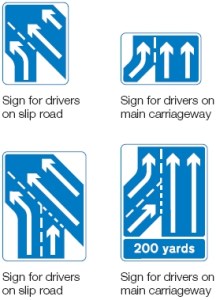
The OED defines “slip road” as “a short (usually one-way) road giving access to or exit from a main highway, esp. a motorway; an approach road.” The first citation is from 1953; it and all the other ones are from British sources.
On January 25, Lynne Murphy, of the Separated by a Common Language blog, tweeted this as her “Difference of the Day.” @zekeys_mom responded, “‘Slip ramp’ is creeping into AmE. Used for toll road, minor exits to relieve congestion at major exits. Must have an auto-pay EZPass [the regional electronic toll collection system] to use it.”
Note: she said “slip ramp,” not “slip road.” When I checked Google Books for “slip road,” all the hits appeared to be from British sources, except a quote from a 2014 book by David Reynolds called Slow Road to Brownsville (Texas): “I took a slip road off 83, thinking it would lead into town—and found myself on a dark and crowded interstate heading west away from town.” But it turns out Reynolds is a Brit who wrote about his U.S. travels. I checked the New York Times archives and found “slip road” had been used exactly twice–once in a Reuters news article from London, and once in an article about Formula One car racing. Further research suggested that the term is used racing to mean a sort of escape path, for example: “That wing of his ended up 100 yards from where the car ended up down the Turn 1 slip road.”
That’s pretty much it for U.S. “slip road.” “Slip ramp” is another story. There is no definition for it in the OED, dictionary.com or merriam-webster.com. However, @zekeys_mom sent some links with uses of it, including a 2002 news release from the (U.S. state of) Pennsylvania, which helpfully defines the term: “The Pennsylvania Turnpike Commission today announced it will not advance preliminary plans to design and construct two ‘slip ramps’ — which are unmanned, E-ZPass only ramps built between existing interchanges.” The quotation marks indicate a newish usage, but as of 2015 it still hadn’t taken hold; a Pennsylvania newspaper article that year refers to “so-called slip ramps.”
Consulting Google Books, I found the earliest use of “slip ramp” in a 1959 issue of a state of California publication, “California Highways and Public Works.” The caption to a map says, “The circled ‘A’ and arrow point out the new slip ramp on the Harbor Freeway.” This was long before the invention of E-ZPass and such systems and suggests the term was used more generally, for exit ramp.
But it’s been used in different ways as well, as shown by a 2011 discussion on the AARoads Forum. Someone asked, “Maybe I’m crazy, but I don’t know exactly what a slip ramp is? What is it, and how does it differ from a normal freeway exit ramp?”
The answers were somewhat all over the map. A San Diegan said he had always used it to mean “a ramp between parallel sets of carriageways – for example, freeway main lanes to the frontage road, or vice versa. Basically, you end up ‘slipping’ over a few feet, but going in the same direction as before.” A number of commenters agreed with this, but a New Jerseyan posted, “My understanding was that it was a connector between two freeways, that was full speed, at least that is what I think.”
Then a Bostonian said, “I’ve regularly heard and used the term to refer to a right turn at an intersection separated by an island of some sort from the intersection, like this example at Causeway and Washington Streets in Boston.” But then someone else said that what he was really talking about was a “slip lane,” not a “slip ramp.” (I’m not sure why I assume all these people are male, but I feel pretty confident about it.)
Someone from Virginia said, “I remember the old version of the AAA map of Northern Virginia from the mid-1980s used the term ‘slip ramps’ … in reference to the ramps connecting the Dulles Toll Road and the Dulles Access Road. For those unfamiliar, it’s a quad-carriageway with two carriageways in each direction; the inner (free) ones serve airport traffic and the outer (tolled) ones serve local traffic.”
No one could top (or possibly understand) that, and the discussion ended.
Every December, Lynne Murphy, who runs the blog Separated By A Common Language, chooses two Words of the Year: an American word that has gained popularity in the United Kingdom (US>UK) and one that has gone the other way (UK>US). Recent winners in the latter category (obviously more interesting for NOOBS purposes) are gutted, backbencher, gap year, dodgy, and bum.
Yesterday, Lynne announced “shitgibbon” as her 2017 UK>US word, and I’m chagrined to say I have not yet covered it. It first got notice in the U.S. as one of a flurry of insults hurled at Donald Trump in 2016, the only one of which I wrote about was “wazzock.”
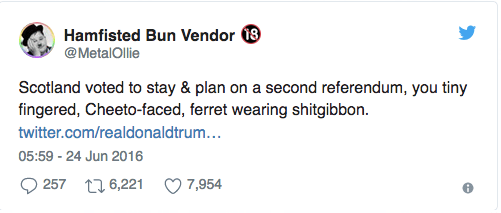
One of the prominent insults was this tweet, posted after Trump (falsely) claimed that Scotland had voted in favor of Brexit.
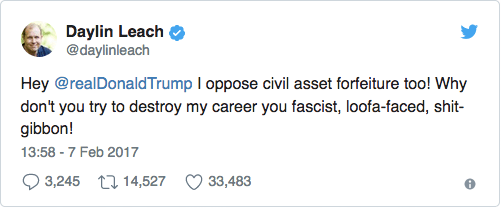
Among the prominent Americans to pick it up, Lynne notes, was a Pennsylvania Democratic state legislator from my home region, the suburbs of Philadelphia.
Leach seems to have come up with “loofa-faced” on his own. Coincidentally, he is currently in a bit of hot water for matters unrelated to his Trump insults.
“Shitgibbon” is an insult of rather recent provenance. Uber language guy Ben Zimmer investigated its history in two articles published in Slate. He reported
My fellow word sleuth Hugo van Kemenade found examples as early as 2000 in Usenet forum posts about bootlegging in the British music scene, where shitgibbon was deployed against ungrateful traders of copied music. More than a decade later, it got a boost from an early episode of HBO’s Veep in 2012, wherein the character Sen. Andrew Doyle calls a rival a “gold-plated fucking shitgibbon.”
And there the hunt might have remained, if not for a comment on my original post on the Strong Language blog. The British writer David Quantick dropped this bomb:
“Hi, I wrote the Veep line. It was originally ‘spunk-faced shitgibbon,’ a phrase I used in a 1988 column in New Musical Express and have put in most of my writing since. PS I’m not Scottish and have nothing to do with bootlegging.
Ben confirmed Quantick’s claim.
Well, this is probably my last post of 2017, so I will say Merry Christmas and Happy New Year to all you wazzocks and shitgibbons.
This is a red-letter post: the 500th one since I started doing Not One-Off Britishisms more than six years ago. The surprising thing is that the NOOBs keep coming.
I was alerted to the latest by Andrew Mytelka of the Chronicle of Higher Education, who noted that two op-ed pieces in the December 8 issue of the New York Times, both about Middle East politics, use the same British expression.
Bret Stephens (an American): “One piety is that ‘Mideast peace’ is all but synonymous with Arab-Israeli peace. Seven years of upheaval, repression, terrorism, refugee crises and mass murder in Libya, Egypt, Yemen, Iraq and Syria have put paid to that notion.”
And Roger Cohen (an Englishman): “Well, some would argue, Trump put paid to any notion that the United States is an honest broker between Israel and the Palestinians.”
The OED defines “put paid to” as “to deal finally or effectually with; to place out of contention or consideration; to terminate or thwart (an aspiration, plan, etc.) conclusively.” The first citation is from 1901. It is definitely a Britishism, as seen in this Google Ngram chart showing the term’s frequency of use in British and American books:
As the red line suggests, there have been occasional appearances in U.S. sources. Some from the Times:
Sports article, 1970: “Rod Laver, the defending champion, put ‘paid’ to Cliff Richey’s astonishing run of successes and soundly spanked the little Texan 6-3, 6-4, 6-4, to take the Embassy indoor tennis final with the winner’s check of $7,200.”
Unattributed 1986 opinion piece: “Certainly, the deal with France and the French illusion that safety can be bought this way should put paid to the misty arguments that terrorism must be addressed by resolving its so-called political cause of Palestinian grievances.”
Essay by A.O. Scott, 2007: “The movie western had retreated from its position as a quintessential and vital form of American storytelling, undone by the same cultural tumult that had put paid to other manifestations of midcentury consensus.”
And from a 2012 New Yorker piece by D.T. Max, a use that doesn’t quite seem to fit the OED definition (except maybe ironically): “Thus my son and I, side by side supine in the bed, conquered ‘Treasure Island’ and ‘Robin Hood,’ ‘The Jungle Book’ and ‘The Hobbit,’ and this week we put paid to ‘The Time Machine.'”
Over the past couple of years, every time I’ve done a NOOBs post, I’ve thought to myself, “That may be the last one.” But the experience of continually encountering new ones has put paid to that notion. See you at 501!
Katherine Connor Martin, the head of U.S. dictionaries for the Oxford University Press, tweeted me a quote from a Nov. 30 New York Times article about a potential state visit of Donald Trump to Britain: “Even before the latest uproar, there was speculation that the state visit was being pushed into the long grass.” She commented, “First time I recall seeing this BrE soccer metaphor (it’s usually ‘kick’) in a US pub[lication].”
The OED says “kick into the long grass” was originally political and defines it as “to put aside, defer; to sideline.” The first citation is a 1973 quote from The Times, which the OED notes employs an extended football (soccer) metaphor: “Mr Rippon set himself up as the archapostle of community politics..with all sorts of pledges about not ‘kicking the ball into the long grass’ from which it might emerge muddier than before.”
(Jonathon Green, in Green’s Dictionary of Slang, gives another meaning for “long grass,” defined in a 1986 quotation from Bob Geldof: “When you have not seen someone for a long time and you ask them where they have been they might replay, ‘Oh, I’ve been in the long grass,’ meaning they’ve been around but not visible.”)
As Katherine suggested, the phrase is not commonly encountered in the U.S. All the Google Books hits for “kicked into the long grass” are British. And as she also suggested “push” is a fairly rare variant, with only twenty total Google hits for “push/ed it into the long grass.” The first seems to have been a 2011 quote from the actor Hugh Grant, referring to his campaign against newspapers’ phone hacking: “Grant called this an ‘enormous national scandal,’ saying, ‘The politicians will for sure try to push it into the long grass.'”
Two of the hits are from American sources, one being the New York Times article I mentioned at the start. It actually doesn’t count as a NOOBs source because it was written by Cambridge graduate Stephen Castle. The second is a testimonial from someone identified as “Nick from NYC” to a company called Speedy Papers, which sells students plagiarized term papers. He supposedly said:
“My paper was easy from the first sight and I pushed it into the long grass. I had only 24 hours to complete it. Speedypaper writer did my 3 page writing in 16 hours. You helped me out of difficulties. Keep right on!”
If Nick exists, he is almost certainly not from NYC as no one there says “pushed it into the long grass.” And “Keep right on” is a pure British phrase, originating in a Scottish hymn sung by Harry Lauder and adopted by the Birmingham City football club. (“From the first sight” also sounded odd to me–the familiar expression is “at first sight” or “at first glance”–but it seems like it’s used by Americans.)
Because of the lack of U.S. examples, I’m categorizing this as an “Outlier.”
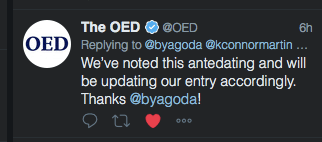
In the course of my research, I came across a 1966 quote from a Parliamentary debate: “”In other words, how long is the ball to be kicked into the long grass?” I tweeted it out since it predates the first OED citation by seven years. A few days later, the official OED Twitter account, @OED, replied:
That truly made my day; for a geek like me, contributing an initial citation to an OED definition is an achievement along the lines of a birder spotting an orange-bellied parrot. A friend asked, “Is this like winning an Oscar for you?” I said: “No. Lifetime Achievement Award.”
I love it that New York Times food editor Sam Sifton, in his Thanksgiving Cooking newsletter, not only used “pear-shaped” but linked to the NOOBs post on it.
Recently this exchange occurred on the American radio show/podcast “On the Media”:
KATHRYN VAN ARENDONK: …. when you go about separating art from artist, you can then run into all of these problems where you love work and you love an understanding of that artist that turns out to not actually be at all who they were in life.
BROOKE GLADSTONE: Did I just hear you say “Louis C.K.”?
VAN ARENDONK: I may have done.
And this from a recent New Yorker article: “Araten acknowledged that, relative to sales, the Hatfield factory employed fewer people than it had done in the past.”
The “may have done” and “had done” are examples of what ace Anglo-American linguist Lynne Murphy calls “pro-predicate ‘do'” (which I’ll abbreviate as PPD). As she explains in a blog post, in expressing the same thought, British people would say, “I ate all the chocolate, even though I shouldn’t have done,” where Americans would say, “I ate all the chocolate, even though I shouldn’t have.” In the examples at the top, the normal American constructions would be “I may have” and “… than it had in the past.” (Lynne doesn’t mention this, but I think an American alternative in the first case is to extend the sentence with another pronoun–that is, “I may have done it,” or “I may have done so.”)
In her post, Lynne has a full explanation of the relevant grammar, as well as a quote from a scholar who has found that the construction only became popular in Britain in the 1920s. (By the way, the “pro” in PPD stands for “pronoun”; as with pronouns, the “do” stands in for another word, in this case a verb.)
Since starting this blog six years ago, I’ve been on the lookout for American uses of PPD, with very little results, until now. Over the last year or so, I’ve noticed a handful examples, the “On the Media” and New Yorker ones being the most recent. Will Americans soon adopt PPV more broadly?
The hot kitchen appliance in the U.S. right now is the Instant Pot, a programmable electric pressure cooker that can also be used as a slow cooker and does various other things as well. I’ve been in the market for one and in the store snapped this picture, which shows just some of its functions.
The function that caught my eye was “Porridge,” which is a word we don’t really say in the U.S. (other than in “The Three Bears” and other fairy tales). Having been served it in English B and Bs, I had the sense that in the U.K., “porridge” means what we call “oatmeal.” Anglo-American linguist Lynne Murphy confirmed this, basically. Over Twitter, she said that in Britain, “the default porridge is made of oats…. if you ask for porridge, you will get oatmeal. For others, you’d need to specify–‘buckwheat porridge’ or whatever.”
It turned out that Instant Pot’s “porridge” isn’t a pure NOOBs. Although the product is hugely popular in the United States, it originated in Canada, whose residents seem to use “porridge” much as the British do. Indeed, Lynne forwarded me an article from the Canadian grain journal Grainews (and it somehow warms my heart that there’s such a thing as a Canadian grain journal) titled, “What’s more Canadian than a bowl of porridge?” The article seems to use “oatmeal,” “porridge,” and “oatmeal porridge” interchangeably.
Of course, Instant Pot could have changed “porridge” to “oatmeal” for its U.S. shipments. But keeping the original term adds an exotic flavor that–who knows?–could have contributed to the product’s immense success.





 notoneoffbritishisms.com