Imagine it is the autumn of 2018. You want to refer to something that will happen in 2019. Do you say it will happen A, “next year,” or B, “in the new year”? I contend that it you are British, the answer is likely to be B, and if American, A. My sense is that I encountered the whole “in the new year” thing for the first time while reading British novels and the British press and watching British TV.
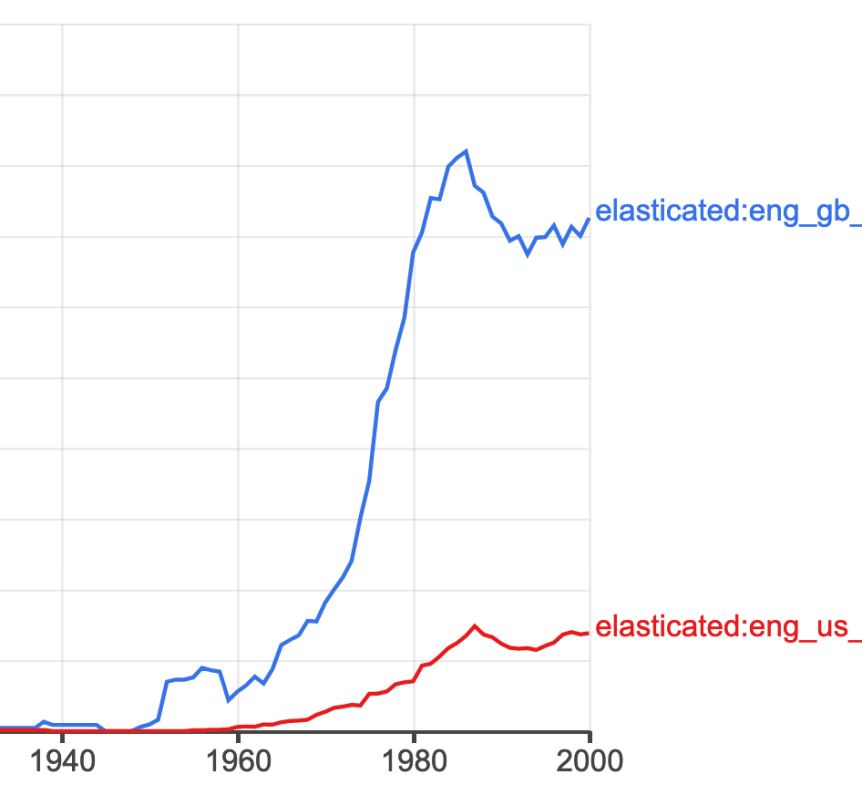
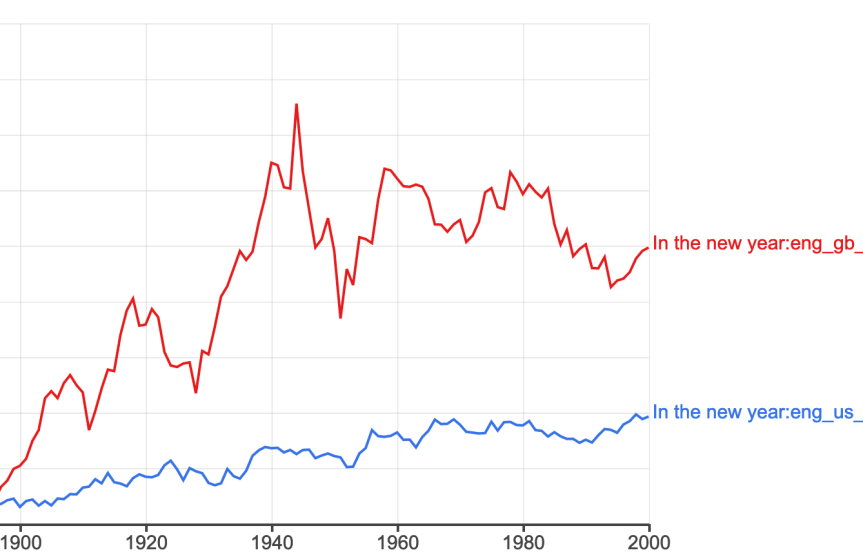
It’s a bit hard to quantify my contention using many of my go-to databases and other tools, because Americans do say “ring in the new year” and similar expressions. However, Google Ngram Viewer allows for case-sensitive searches, so I searched for “In the new year” — the capital “I” ensuring that the phrase wouldn’t be preceded by “ringing,” “seeing,” “welcoming,” “bringing” or any such verb. Here’s what I got:
That is, it appears that in the twentieth century, “in the new year” as a standalone phrase was consistently more than twice as popular in the Britain than in the United States. And note that I’m not saying it wasn’t used at all here; it was just used less often.
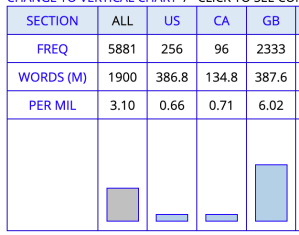
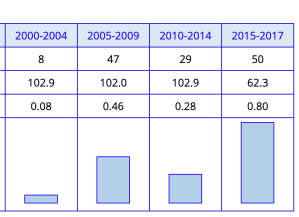
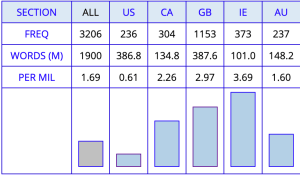
The Corpus of Global Web-Based English, which offers a snapshot of nearly 2 billion words of text in 2012-2013, doesn’t allow me to separate out the “ringing-in-the-new year”-type usages (or at least I don’t know how to), but even so, it shows “in the new year” as being generally much more common in Australia, Canada, Britain, and (especially) Ireland than in the United States.
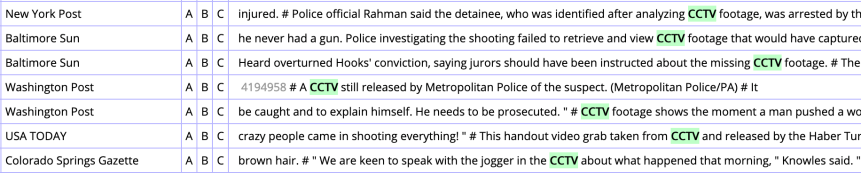
Here are just a few of the 1,153 times the phrase was used in British web pages:
And here are some of the 236 American hits:
Numbers 1, 2, and 8 are of the “welcome-in” form, but the rest have a definite British “in the new year feel.” Enough, at least, for me to designate the phrase On the Radar.
Back in 2013, I looked at U.S. adoption of the British political word “backbencher,” referring to junior members of Parliament who literally sit in the back benches. [Update: As the comments reveal, this is not a good definition of British “backbencher.”] Three years later I noted failed Republican presidential nominee Jeb Bush’s habit of using the word to disparage his rivals in the race.
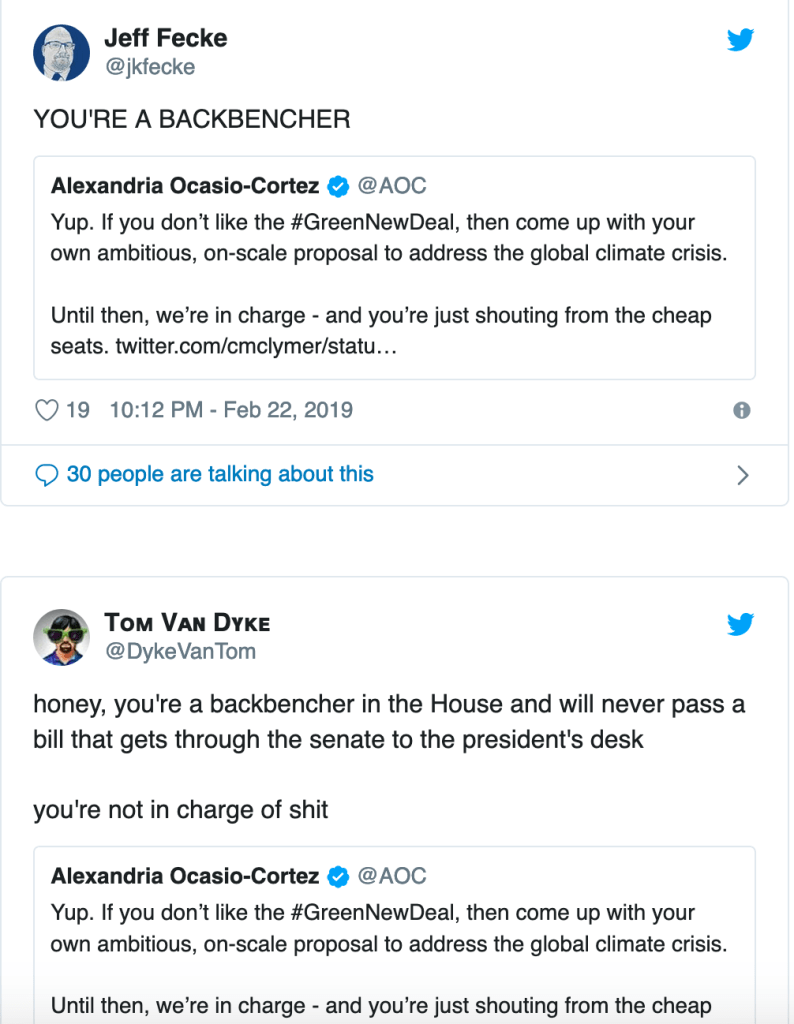
Now, Nancy Friedman reports a surge in U.S. use of the word, thanks to newly elected Representative Alexandria Ocasio-Cortez (aka AOC), a liberal Democrat who seems to really get on Republicans’ last nerve. “Backbencher” is actually one of their milder epithets for her, but it might be the most popular. Nancy writes:
Do a Google search for “Ocasio Cortez backbencher” and you get results from the Orlando Weekly (“For all the attention paid Ocasio-Cortez, however, she’s just a backbencher”), The Federalist (“She could easily become yesterday’s news, dismissed like other backbenchers and cranks within the House Democratic caucus”), The Hill (“[I told her] to pick some of those issues and really lead on them from day one and not to be told to keep her head down or be a backbencher, but to come here and lead” – California Rep. Ro Khanna), The Advocate (“If she wants to even be moderately effective as a legislator and not some permanent backbencher … she’s gonna have to play the game”), and Esquire (“that backbenchers-should-be-seen-and-not-heard business should’ve died with Sam Rayburn”).
And she reproduced some tweets, including:
It’s almost makes you think that all these people were working from the same talking points.
A few days ago, Fred Vultee posted about a CNN article in his HEADSUP blog. The article was about a college basketball game between Duke and the University of North Carolina in which Duke star Zion Williamson suffered an injury after his shoe fell apart while he was playing. Here’s the online headline:
The language was a bit off, as Vultee, a copyeditor (subeditor in BrE) turned college professor, noted: “I don’t recall much transitive scuppering from my years of reading American sports pages.” (In 2016 I did report on a rise in U.S. use of the word, though my examples were from coverage of politics, not sports.)
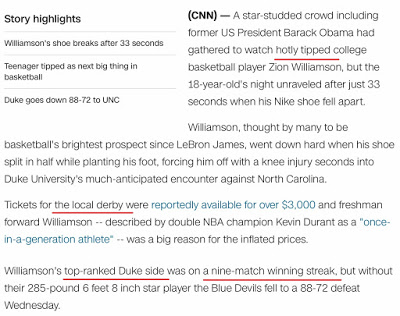
The CNN article went all in on the Britishisms. Vultee supplied an annotated screenshot of the first few paragraphs.
Of the underlined phrases, I’ve covered”match” (AmE: “game”) and I believe “side” (“team”) as Not One-Off-Sportisms. “Forcing him off” (not underlined by Vultee) also is familiar from soccer/football coverage. But I would guess that “hotly tipped” (“highly touted”) and “local derby” (meaning a game in a regularly played regional rivalry) have never appeared in a U.S. publication.
You’ll note I didn’t write “have never before appeared…” That’s because the CNN article came out of the network’s international division and was written by a staffer named George Ramsay, who appears to be based in England and who almost always writes about rugby. I tweeted Ramsay at @georgeramsay6 to ask whether he was aware that the expressions he used were so unfamiliar in the U.S.–whether he was having a bit of fun–but haven’t heard back from him yet.
Comments to the recent post on “potted,” meaning summarized or abridged, led me to understand that British people use the the word “pot” to refer to smallish containers for food, whereas for Americans, a pot is strictly the thing you cook in, frequently mentioned in company with pans. (British) Catherine Rose commented:
Potted food is in pots. It isn’t even always in a closed pot – potted shrimps are in an open-top pot which is sealed with a layer of butter, and has a very short shelf-life. Sometimes it’s in a ceramic pot with a ceramic lid, and sometimes in a glass jar with a lid that closes down with a seal (like a Kilner jar).
That made me remember that in Britain, a single-serving receptacle of yog(h)urt is called a pot, whereas I would just call it a container. (Being a native New Yorker, I would use the same word for the vessel in which you get coffee to go, properly pronounced “a containuh of cawfee.”) Some research confirmed this distinction. For example, consider this Google Ngram Viewer chart showing phrases’ frequency of use in books in the Google Books database:
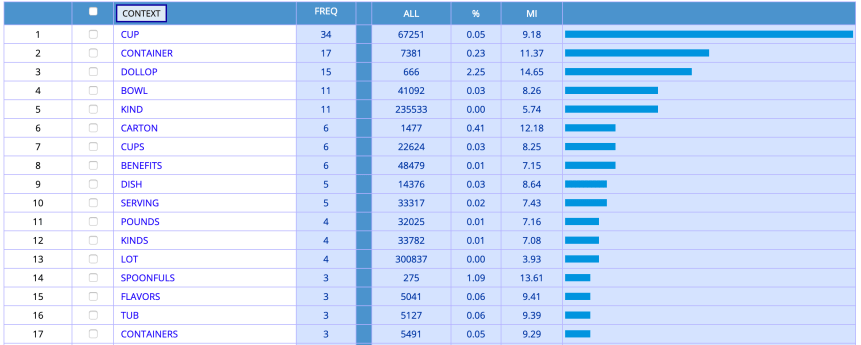
I included British “container of yoghurt” in my search, but it doesn’t show up on the graph because, seemingly, that phrase has never appeared in a British book. The Brigham Young University Corpus of Contemporary American English, comprising 560 million words of text uttered or written in the U.S. between 1990 and 2017, allows you to search for the words that most commonly occurred before the phrase “of yogurt.” Here are the results:
“Cup”‘s 100 percent margin of victory over “container” is a bit misleading, I would say, because the word is also a unit of measurement (8 ounces), and is used that way in many of the thirty-four hits in COCA. But “cup” definitely is also used for a single serving (and not a measurement), as seen in this photo of a Dannon yogurt’s nutrition label I snapped at a supermarket. The serving size is listed as “1 cup,” but 150 grams is only 62 percent of a measuring-cup cup.
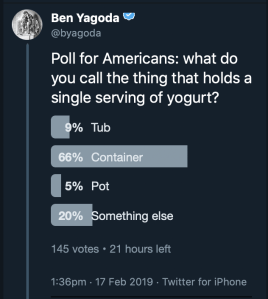
For additional research, I created separate Twitter polls for British and American people. Here’s the result of the British one.
And here’s the American one:
That 20 percent “Something else” response is a sign of a poorly designed survey. The Twitter comments revealed that the most popular other term was, you guessed it, “cup.” “Thing” and “carton” also got some mentions.
The question remains, is “tub of yogurt” a Not One-Off Britishism? The phrase occurs exactly once in the Corpus of Contemporary American English, in a 2007 New York Times article about a redesign of the 1957 Fiat 500: “In France, … the original 500 was lovingly known as the ‘pot de yaourt,’ or pot of yogurt, for its soft shape.”
But the 5 percent showing in my American Twitter poll, and its presence in the Ngram Viewer chart, suggests “pot of yogurt” is making a U.S. incursion. My daughter Maria Yagoda, the digital restaurant editor at Food and Wine magazine, wrote me that she felt “pot” had gained popularity in the last ten years or so: “Because ‘container’ just wasn’t a good, specific enough word so we jumped on the opportunity to use pot.” A few examples pop up when you search in Google News. Last year, in Elite Daily, American Jordan Bissell wrote, “Who wants a little plastic pot of yogurt when you can have a frozen stick full of delicious, nutritious goodness?” And in 2017, the Wall Street Journal published this headline:
Bottom line, expect to see more American “pot of yogurt.”
The current issue of the New Yorker has an interesting article about the novelist Dan Mallory, who under the pen name “A.J. Finn” wrote a best-selling thriller, The Woman in the Window. The first line of the article is “Dan Mallory, a book editor turned novelist, is tall, good-looking, and clever,” and the use of the “clever” (instead of the more common Americanism “smart”) is a clue that the New Yorker writer, Ian Parker, is English.
But that is neither here nor there. What’s interesting for the purpose of this blog is a paragraph where Parker describes some affectations of Mallory, who is American-born but partly educated at Oxford:
Whereas in London Mallory had sometimes seemed like a British satire of American bluster, in New York he came off as British. He spoke with an English accent and said “brilliant,” “bloody,” and “Where’s the loo?”—as one colleague put it, he was “a grown man walking around with a fake accent that everyone knows is fake.” The habit lasted for years, and one can find a postman, not a mailman, in “The Woman in the Window.”
Hmm, the British use “post” as both noun and verb while Americans say “mail,” but I hadn’t thought of “postman” as a particularly British term. In fact, the first thing that comes to mine is James M. Cain’s quintessentially American 1934 noir novel, The Postman Always Rings Twice. And, as Dan Geringer reminds me, the Marvelletes’ 1961 Motown hit was “Please Mr. Postman.”
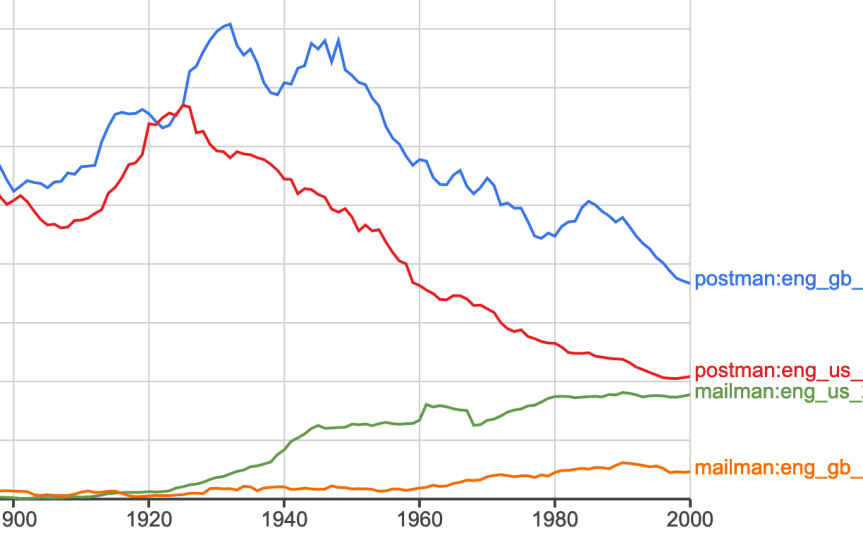
Google Ngram Viewer, which charts words’ frequency in the Google Books database, suggests while “postman” is indeed (much) more popular than “mailman” in Britain, “postman” is also more popular than “mailman” in America (at least through 2000, the last year for which the application has reliable data).
The New York Times archives tell a similar story. Since 1950, the paper has used “postman” 1,966 times, and “mailman” 2.203 times. (There’s a bit more of a gap than those figures suggest, since “Postman” at least occasionally appears as a surname.)
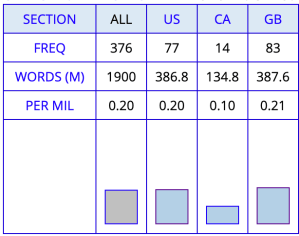
However, Brigham Young University’s 1.9 billion-word Corpus of Global Web-Based English, which offers a snapshot of the use of the language in 2013-2014, suggests that “postman” has recently gotten less common in the U.S. Here’s its chart showing relative use of the word in the U.S., Canada, and Britain.
So I think we can conclude: in addition to his other sins, Dan Mallory is guilty of pretentiousness.
My observant friend Pat Raccio Hughes remarked that she’s lately been noticing young people ordering food in restaurants in a particular way. Let’s say they want a hamburger. Instead of saying “I’ll have a hamburger,” or “I’d like a hamburger,” or even the dreaded supposed Americanism, “Can I get a hamburger?”, they’ll say, “I’ll do the hamburger.”
This was a new one on me, but I immediately started to notice it in my travels. It seemed a sort of reversal of another food-related “do,” previously covered in NOOBs (“This restaurant does a nice pot roast”), so I had a hunch it has a British origin.
The only online dictionary in which I found a relevant definition was in one of the OED‘s many, many meanings for “do”: “To partake of (a portion of food or (esp.) an alcoholic drink); to eat or drink, esp. in a social context.” “Let’s do lunch” is a common phrase. But neither that nor and of the OED citations seem quite the same thing as ordering a particular item in a restaurant:
1853 ‘C. Bede’Adventures Mr. Verdant Green x. 78 To ‘do bitters’, as Mr. Bouncer phrased the act of drinking bitter beer.
1867 J. S. BorlaseNight Fossikers 116 I asked him to come to Poole’s shanty and do a chop and a nobbler with me.
1888 Civil & Mil. Gaz. (Lahore) 8 May 2/1 Hulloo! Back again, old man?.. I think we might do a drink together in honour of the occasion.
1908 S. R. LeeOther Sara v. 65 I feel as if I could do a chop and a glass of stout now.
1987 Sunday Tel. 19 July (Colour Suppl.) 39/3 An invitation to lunch might be pitched as, ‘Come on, let’s dosushi’, or ‘We have to do some Korean’.
In 2013, someone on the WordReference.com forum asked about “I’ll do the salad.” Only a few of the respondents had encountered it, but, amusingly, most of the British ones contended it was an Americanism, and most of the Americans contended it was a Britishism. Someone posted a link to a California magazine article from 1985 about demanding and entitled restaurant customers, an example being a woman who told a waiter
Also suggesting an ’80s origin was the Random House editor and word maven Benjamin Dreyer, who responded when I brought it up on Twitter: “I’m sure I remember ‘will do the lobster’ from the last years of my restaurant career, so NYC in the late eighties.”
In 2013, an American blogger complained about the usage but had no idea where it had come from. In 2017, another blogger who also appears to be American noted:
“I’ll do the [food]” is one such phrase that’s been bothering me for the past few years—likely because I overheard it on an episode of some Beverly Hills reality show that I hated both for its existence and cult-following. Since then, I’ve continued to hear this phrase assertively stated at formal and fast-casual restaurants, bars and coffee shops.
Finally, I asked my daughter Maria, who is young and who is a writer and editor for Food and Wine magazine. She replied,
I think there’s something slightly pretentious about it, but i definitely do it maybe 50 percent of the time.
It often comes up when servers are describing specials, and they say, “We have a lovely sole meuniere with chanterelle mushrooms, and we have a pork chop with an apple demi glaze.”
And then you say, “I’ll do the pork chop.”
My conclusion: this do isn’t a Britishism, one-off or otherwise. And it seriously annoys some people.
New York Times book critic Dwight Garner has the usual high number of good lines in his review today of former New Jersey governor Chris Christie’s new memoir. Here’s the one that especially interested me:
“Let Me Finish” is a superficial and ungainly book that tries to cover so many bases at once — it’s a series of attacks and justifications, it’s a master class in sucking up and kicking down, it’s a potted memoir, it’s a stab at political rehabilitation — that reading it is like watching an octopus try to play the bagpipes.
The reason for my interest is a NOOB–“potted.” The OED‘s definition is: “Of a piece of information, work of literature, historical or descriptive account, etc.: put into a short and easily assimilable form; condensed, summarized, abridged.” The first citation is from the magazine The Galaxy in 1873: “If I skip the lad’s measures and tidbits of potted history, yet these letters from Augustus are none the less welcome, revealing the traveller in a new light.” Subsequent citations, all from British sources, refer to “potted” abridgments, prose, abstracts, and, again history. That seems to be the word that most commonly follows this adjective, so I used the whole phrase for a Google Ngrams Viewer search to compare frequency of use in Britain and the United States through 2000, the last date for which the application supplies reliable data. (I couldn’t very well search “potted” alone, because that would give me American references to drunkenness, British references to what we would call canned laughter and to food preserved by the process we call “canning,” and reference in both countries to plants in their planters.)
I’m pretty sure American use jumped not long after that, because of the Harry Potter theatrical satirical abridgment Potted Potter, which has been playing in the U.S. for more than a decade. In any case, I found a number of American uses, including one from Times drama critic Jesse Green in November 2018. Some skits within The Thanksgiving Play, he wrote, “are selections from actual lesson plans and Pinterest boards posted by teachers to share ideas for classroom Thanksgiving activities. They include potted history and offensive ditties and, in one case, a suggestion to split the pupils into Pilgrims and Indians ‘so the Indians can practice sharing.”’
And the previous year, book critic Laura Miller wrote in The New Yorker that “newsreel-like interludes of potted history … are constantly interjected” into Paul Auster’s novel 4 3 2 1.
This line appeared in a December 2018 New York Times review of the Nicole Kidman movie Destroyer: “That she’s also a better detective than a mother makes her somewhat of an outlier, at least in American movies. If Bell [the Kidman character] were a man and father, and played by, say, Denzel Washington, this wouldn’t be a big ask.”
That “ask” is a shift of the word from verb to noun, meaning, basically, “request.” (“Request” started as a noun in about 1400 and was being used as a verb no later than 100 years later.) The OED cites uses of noun “ask” back to the 13th century, including this from a 1656 Bible translation: “God saith concerning Christ, thou art my Son, there presently followeth an Ask of me and I will give thee.” The dictionary says it is now “somewhat rare,” with three exceptions. The first is in bridge and whist, where it means “A play or bid having the primary purpose of eliciting information about a partner’s hand.” (“Who has not suffered when he has played correctly second hand..from his partner assuming that there has been an ask for trumps?” Westminster Papers, 1872.) The second is in finance, where it means “asking price.” And the third is when it’s modified by an adjective like “big,” “huge,” or “impossible, as in the Times quote above.
I would tend to disagree with the last category. That is, I accept that the current popularity of “ask” as a noun started with “big ask,” as we’ll see, but I think it’s very much out there by itself, as are such similar nouns as “get,” “reveal,” and “fail.” See the title of a 2017 book about fundraising by Laura Fredericks, The Ask: For Business, For Philanthropy, For Everyday Living. So I would recommend including “big ask” citations in the main definition.
As I say, the recent surge in “ask”-as-noun started with “big ask,” and it started in Australian sport(s). The OED has a 1987 quote from the Sydney Morning Herald, the quotation marks indicating a fairly recent coinage: “Four measly pounds is what the critics say. But according to his trainer..that four pounds is ‘a big ask’.”
I believe I can antedate that. The Google Books database has a “big ask” from what appears to be a short story in the Australian journal The Bulletin, vol. 97, 1975. “A big ask, though. They wanted a grand. Anyway I got two spot bail and the case is still swingin’.”
The phrase stayed in Australia for a while. Writing on the American Dialect Society listserv, Peter Reitan reported checking the newspapers.com database and finding that “every single hit from 1988 through 2006 is either from an Australian newspaper, or quotes a native Australian, typically athletes.”
Some American uses in that period can be found elsewhere. The (California) Orange County Register, August 29, 1993, referring to a program at the University of California, Irvine, reported: “[The American-born director] bundled seven projects into one BigAsk, for a regional alliance called Defense Photonics Medical Consortium.”
A chart showing frequency of “big ask” in American newspapers in the Lexis-Nexis database shows growth that’s gradual in the decade of the 2000s, and dramatic in the 2010s.
Over in the U.K., the phrase was in circulation no later than 2006, when Friends of the Earth started a “Big Ask” campaign to fight climate change.
And someone posted this definition on Urban Dictionary in 2012:
Misused by stupid British soccer commentators as a substitute for job, task, or assignment.
“He has to stop Messi from scoring tonight: that’s a big ask.”
A 1963 novel by a quintessentially British author.
I was directed to the (British, as you can tell from “mum“) Mumsnet.com website because, in a discussion of Americanisms, someone nicely posted a link to NOOBs. Looking around on the discussion, I noted one person who listed the expression “stiff upper lip” as an Americanism. Another commenter responded: “I beg to differ. That’s really quite Brit.”
The first person was right.
Learning that surprised me, because the expression, suggesting stoic keeping calm and carrying on, is so strongly associated with the British national character and lexicon. But so is “bumbershoot,” and that word is as American as a McDonald’s apple pie.
The OED confirms that with these early citations (Thomas Haliburton was Canadian):
1815 Massachusetts Spy 14 June I kept a stiff upper lip, and bought [a] license to sell my goods.
1837 T. C. HaliburtonClockmaker 1st Ser. (ed. 2) x. 77 Its a proper pity sich a clever woman should carry such a stiff upper lip.
1852 H. B. StoweUncle Tom’s Cabin I. x. 152 ‘Well, good-by, Uncle Tom; keep a stiff upper lip,’ said George.
The popularity of the phrase was boosted by a oft-reprinted poem by the Ohioan Phoebe Cary (1822-1871), “Keep a Stiff Upper Lip,” whose last stanza is:
Through childhood, through manhood,
Through life to the end,
Struggle bravely and stand
By your colors, my friend.
Only yield when you must;
Never “give up the ship,”
But fight on to the last
“With a stiff upper lip.”
Not until 1887 does a British example appear, from The Spectator: “The Financial Secretary, who, it is supposed, will have a stiff upper lip and tightly buttoned pockets.”
As this Ngam Viewer chart shows, the phrase continued to be more popular in the U.S. through the early 1940s:
In the fall of 1937, something–I don’t know what–seemed to happen to establish the phrase’s connection to British people. On November 7, the New York Times used it in reference to the Duke of Windsor.
More important, on November 19 Damsel in Distress opened. The movie featured a number, lyrics by Ira Gershwin and music by his brother George, and sung by Gracie Allen, George Burns and Fred Astaire, that took the expression’s Britishness as a matter of course. It starts off:
What made good queen Bess
Such a great success?
What made Wellington
Do what he did at Waterloo?
What makes every Englishman
A fighter through and through?
It isn’t roast beef, or ale, or home, or mother,
It’s just a little thing they sing to one another.
Stiff upper lip, stout fellow,
Carry on, old fluff.
Chin up, keep muddling through.
Stiff upper lip, stout fella
When the goings rough
Pip pip to old man trouble
And a toodly-oo too
And, in case you could use some delight in your life (who couldn’t?), here it is:
From then on, upper-lip stiffness was more and more thought of as a British thing. In 1940, the New York Times, reporting on English children coming to America to escape the war, “In the face of a barrage of questions and attentions from the curious, the English children trickling into this country in the past few months have maintained a solid front of poise, courtesy and the traditional stiff upper lip.”
In 1944, The New Yorker ran a Talk of the Town item with the title “Stiff Upper Lip,” summarized this way in the magazine’s internal filing system:
An American officer stationed in a remote English village writes us that he didn’t have much to do during the cold winter evenings while waiting for the invasion except read the books in the local lending library. He says that they served beautifully as reminders of certain quirks and crotchets of the native soul, and he gives an example. This is the opening sentence of an autobiographical volume he found: “In 1928 my foot was hurting all the time, so they took it off and gave me an aluminum one.”
(I learned through a Google search that the book in question was a 1943 novel, The Small Back Room, by Nigel Balchin, and that the actual first sentence was longer than the New Yorker quote. The whole thing: “In 1928 my foot was hurting all the time, so they took it off and gave me an aluminum aluminium one that only hurt about three-quarters of the time.”)
The difference between “bumbershoot” and “stiff upper lip” is that the former was never adopted by the British, while the latter has been. You can tell that by series of citations in the OED, all from British sources.
1961 A. O. J. CockshutImagination of Charles Dickens viii. 116 He oscillated between indignation, self-pity, and reticence of the stiff-upper-lip English school.
1961 John o’ London’s 19 Oct. 447/2 The second film contains a firmly disciplined..undercurrent of Miniverish stiff-upper-lippery.
1963 Listener 3 Jan. 42/1 It was all very improbable and too stiff-upper-lippish to have been written by anybody but an anglophile Frenchman.
1973 New Society 31 May 483/2 MPs, in praising stiffupperlippishness, used sex as a stalking horse.
1977 Broadcast 14 Nov. 10/3 The British are stiff upper-lipping through power cuts.
I suppose it caught on in the U.K. because of the lesson in the expression, “if the shoe fits…”–the British version of which, I just learned, is “if the cap fits…”
I was initially going to write about “betwixt,” as the third item in a trilogy started by “whilst” and “unbeknownst.” It is true that this synonym for “between” has traditionally been more popular in Britain than the U.S.
And it’s true that it seems to be popping up in America a bit more frequently as a cute and old-timey variation, especially in a mystical or fantastical context, as in the title of this book by a Maryland-born author.
The most common use, in my experience, remains the phrase “betwixt and between,” which, of course, means “between and between.” Google Ngram Viewer shows that after it came into prominence in the mid-1800s, Britain and the U.S. alternated in liking it more, with a long period in the mid-20th century with Britain in the lead, followed by equality since about 1980.
But “betwixt” ultimately isn’t popular or interesting enough for me to say anything more about it. So I’m just going to leave it there.