This appeared on my New York Times app this morning:

I previously discussed “shock” as adjective here.
This appeared on my New York Times app this morning:

I previously discussed “shock” as adjective here.
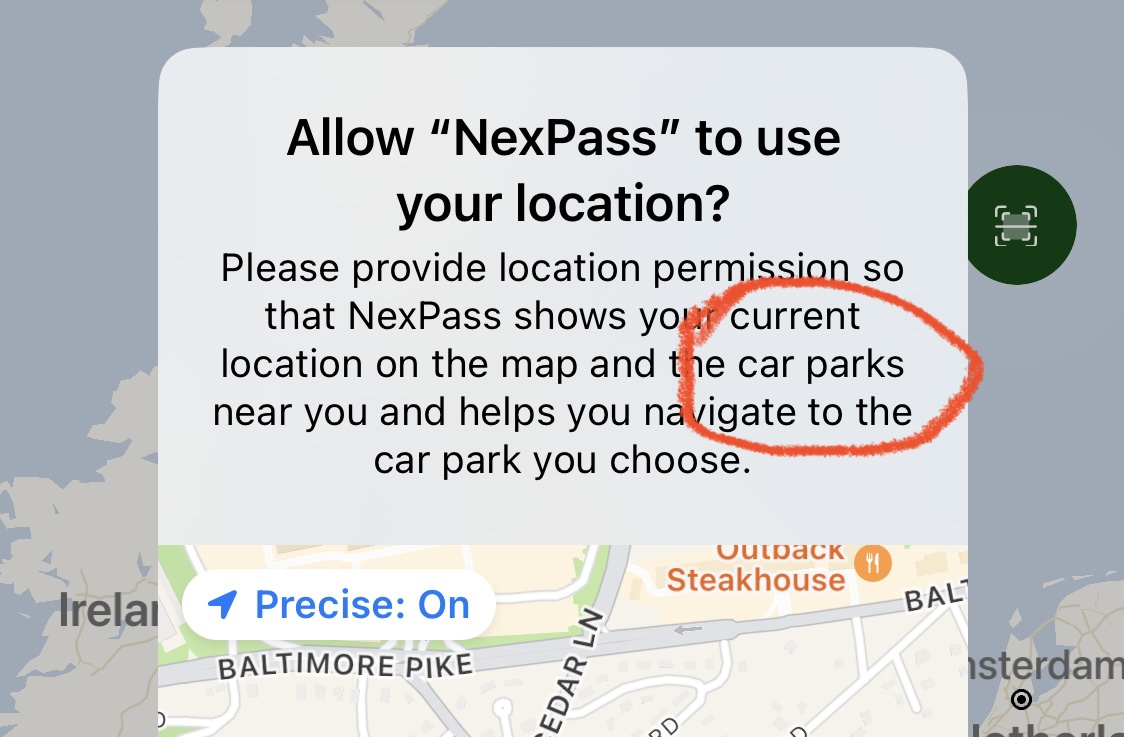
As previously noted, Americans say “parking garage” for a building and “parking lot” for an on-the-ground parking facility, but the British “car park” is occasionally found here. (Commenters suggested that Grand Theft Auto, whose script apparently uses it, might have been an influence.)
The term popped up just today when I downloaded an app from a New Jersey real estate and parking company, Nexus Properties:

Ben Zimmer, language columnist for the Wall Street Journal, messaged me the other day:
Are you watching “Succession”? And if so, are you noticing occasional Britishisms sneaking through from the British writers on the show? Tom says “could do” (periphrastic “do”!) talking to Shiv in “Living+,” and Shiv says “Sorry to break up the brains trust” (instead of “brain trust”) in “Tailgate Party.” Of course, Matthew MacFadyen is British and Sarah Snook is Australian, so it’s possible the actors themselves tweaked the lines. Someone also pointed out that “sex pest” was used in a Season 2 episode (by Kendall, I think).
I am perhaps the only person I know who is not watching Succession, so all this was new to me. I had never actually heard of “sex pest,” but just a few days later, someone wrote to the American Dialect Society listserv about a headline on the Jezebel website: “Lauren Boebert Filed for Divorce, and Her Sex Pest Husband Didn’t Take It Well.” None other than Ben Zimmer replied: “‘Sex pest’ is a popular in British tabloid headlines for, e.g., allegations against Prince Andrew. ‘Sex pest’ is actually a useful term, since it implies something a bit less extreme than, say, ‘sexual predator.'”
The OED ‘s definition: “a sex offender; a person who sexually harasses another.” The first citation is what appears to be a headline from The Times in 1985: “Sex pest’s one-way ticket back. A convicted sex offender, sent by a Californian judge..to Florida,..is to be returned to where he came from.”
The phrase has appeared in the New York Times eight times since 1991. They have mostly been in British contexts, including a reference to a report on predatory behavior of Jimmy Savile which said “it appeared to be an ‘open secret’ that Mr. Savile was a ‘sex pest.'” However, that 1991 example was from a humorous essay by American writer Elinor Lipman about the guy at work who “sniffs a woman’s hair at the copy machine and asks what kind of shampoo she uses.” The title was, “Are You the Office Sex Pest?”
In 2020, reviewing Curtis Sittenfield’s novel Rodham, book critic Dwight Garner, a NOOBs icon, wrote, “The portrait of Bill Clinton as sex pest in this novel is dark, and grows darker.” And in 2021, the Times reported on an SNL skit in which a talk-show host introduced Rep. Matt Goetz (played by Pete Davidson) this way: “As we’d say in the early 2000s a hot mess and as we’d say today, a full-on sex pest.”
On her blog, Fritinancy, Nancy Friedman has chosen as the Word of the Week “perk-cession,” defined (by the Wall Street Journal) as the way “companies are cutting back on prized employee perks from fancy coffee to free cab rides as they vow to trim costs and prioritize efficiency.” She writes:
Perk, by the way, is a truncation of perquisite, which entered English from Latin—“a thing acquired or granted”—in the 1400s. Since around 1567, perquisite has meant “any casual profit, fee, remuneration, etc., attached to an office or position in addition to the normal salary or revenue,” as the OED puts it. The “perk” abbreviation started appearing in truncated form around 1869 in the UK. I’ve been trying unsuccessfully to determine when it migrated to the US; I’m pretty sure it was within my own lifetime. (When I started working, I would have used the term “fringe benefit” rather than “perk.”) Anyone out there able to trace perk’s procession?
OK, OK, I’ll do it.
Nancy specified 1869 because that’s the date of the first citation in the OED, from a muckraking book by James Greenwood called The Seven Curses of London. In a chapter on thieves he writes about a species of “small pilfering”:
Ordinarily it is called by the cant name of “perks,” which is a convenient abbreviation of the word “perquisites,” and in the hands of the users of it, it shows itself a word of amazing flexibility. It applies to such unconsidered trifles as wax candle ends, and may be stretched so as to cover the larcenous abstraction by our man-servant of forgotten coats and vests. As has been lately exposed in the newspapers, it is not a rare occurrence for your butler or your cook to conspire with the roguish tradesman, the latter being permitted to charge “his own prices,” on condition that when the monthly bill is paid, the first robber hands over to the second two-shillings or half-a-crown in the pound.
But by 1887 the word had lost its nefarious connotation, the Pall Mall Gazette referring that year to “an order that free blacking is no longer to be among the ‘perks’ of Government office-keepers.”
As for Nancy’s question about precisely when “perk” migrated to the U.S., Green’s Dictionary of Slang has an 1882 quotation from the National Police Gazette, published in New York: “Detectives must have some protection and privileges […] not to mention the ‘perks’.” But I’ve got to think that’s an outlier, written by a British correspondent for the magazine. Myinitial research suggests the abbreviation arrived here about 1970, which is indeed (I don’t think she’ll mind me saying) within her lifetime. The first use in the New York Times came that year, in Phil Dougherty’s long-running column on advertising, the quotation marks and the explanation suggesting his readers wouldn’t be familiar with the word: “For such men as Mr. Norins and Mr. Kershaw, the cost of commuting is a perquisite— ‘perk’ in Madison Avenue jargon—bestowed by grateful management.”
Google Ngram Viewer shows British use perking up (sorry) in the 1970s and ’80s, followed by American in the ’80s and ’90s (I searched for “a perk” to limit other senses of the word.) It was used roughly equally in both countries in the 2000s, and since about 2013 it’s been more common in the U.S.

This is an interjection with a history, and a fair amount of complexity. It started as the nautical affirmative “Cheer ho!”, said in response to “What cheer, ho?” The variants cheeroh and cheero then became used as “a friendly greeting or a call to attract attention” (OED) and subsequently to express good wishes on parting, to express encouragement (“take heart!”), and as a toast or salutation on drinking. A bit of doggerel composed in 1919 by the American philologist Charles Alphonso Smith commented on the term’s all-purpose nature: “The British have a funny word—Cheer-O!.. They said it when we joined the fleet, They say it now when e’er we meet, Till smilingly we all repeat, Cheer-O.”
A third variant, cheerio, surpassed cheero in 1916 (according to Ngram Viewer) and became, along with old chap, one of main words the American caricature of an Englishman habitually said. The idea had been established by 1941, when Judy Garland encouraged a besieged Britain with the song “Chin Up! Cheerio! Carry On!”, lyrics by Yip Harburg, in the movie Babes on Broadway. The same year, General Mills introduced a breakfast cereal called Cheerioats. In 1946, faced with a legal challenge by the Quaker Oats, they changed the name to Cheerios.
Cheero and cheerio begat cheers, which took on all the old meanings. My experience tells me that the only one adopted in the United States was the drinking toast, which has been widespread here for as long as I can remember and served as the title of the NBC sitcom, set in a bar of the same name, which starred Ted Danson.
Meanwhile, over in the U.K., the word took on yet another sense. As Philip Howard wrote in The Times in 1976: “By a remarkable transition from the pub to the sober world at large outside cheers has become the colloquial synonym in British English for ‘thanks.’” In his 1978 novel Jake’s Thing, Kingsley Amis described a news agent saying “Cheers five times, the first time when he noticed the approach of his customer, again when he handed the magazines, again when he took money, again when he gave change and the last time when bidden good-bye.”
Flash forward twenty years, to when I started spending a good amount of time in London. I was struck precisely by a newsagent’s “Cheers” when I handed over payment for my Independent or Evening Standard. And over the next few years, as I paid attention, it seemed to me that “thank you” was indeed the preeminent meaning for the word.
Not long after that, the word exploded for a simple reason: email, where “Cheers” became immensely popular as a sign-off, first in the U.K. and then in the U.S. But here’s the odd thing: I believe that over there, it more or less means “thanks,” while in here, it more or less means “good tidings” or “all the best wishes” or something vague and positive along those lines. I acknowledge that, short of interviewing people who use the sign-off, I can’t prove or disprove my proposition. So I’m hoping readers will help me out. Those who sign off with “Cheers,” what do you mean by it?
I wrote about “x years on” in 2011, where “x” is a number and the phrase means, roughly, “x years later.” (I say “roughly” because I think “years on” is only used in ongoing contexts, whereas “years later” can be retrospective. You could write, Jimmy Carter was elected president in 1976. Four years later, he was defeated.” But not, “…. Four years on, he was defeated.”) The date of my previous post is significant, since it was prompted by discussions of the 9/11 attacks on their tenth anniversary. A good number of them used the expression, especially in headlines, where the brevity of “on” is a virtue. For example, “10 Years On: Finally, Smarter Airport Security Screening?” (Wall Street Journal). And “Though we’ve felt the impact of 9/11, more will yet unfold. Ten years on, it still might be too soon to tell.” (Sacramento Bee.)
We’ve just experienced the twentieth anniversary of of the U.S. invasion of Iraq and my sense is that “years on” is even more popular in discussions of it. Thus, from Google News, and then the New York Times:


The phrase is hard to research since it’s used in many other contexts, e.g., “She served two years on the president’s staff” or “I’ve spent five years on the problem.” But I can say a few things about it. First, it’s fairly new, and second, it’s British in origin. The first use I’ve been able to find is in a Parliamentary address in 1964: “We are more than ten years on since Aneurin Bevan uttered those words.” Four years later, an Alan Bennett play called “Forty Years On” was produced in the West End. “Ten years on” was said Parliament twice in the ’70s and ten times in the ’80s, some in reference to a book called Ten Years On in Northern Ireland.
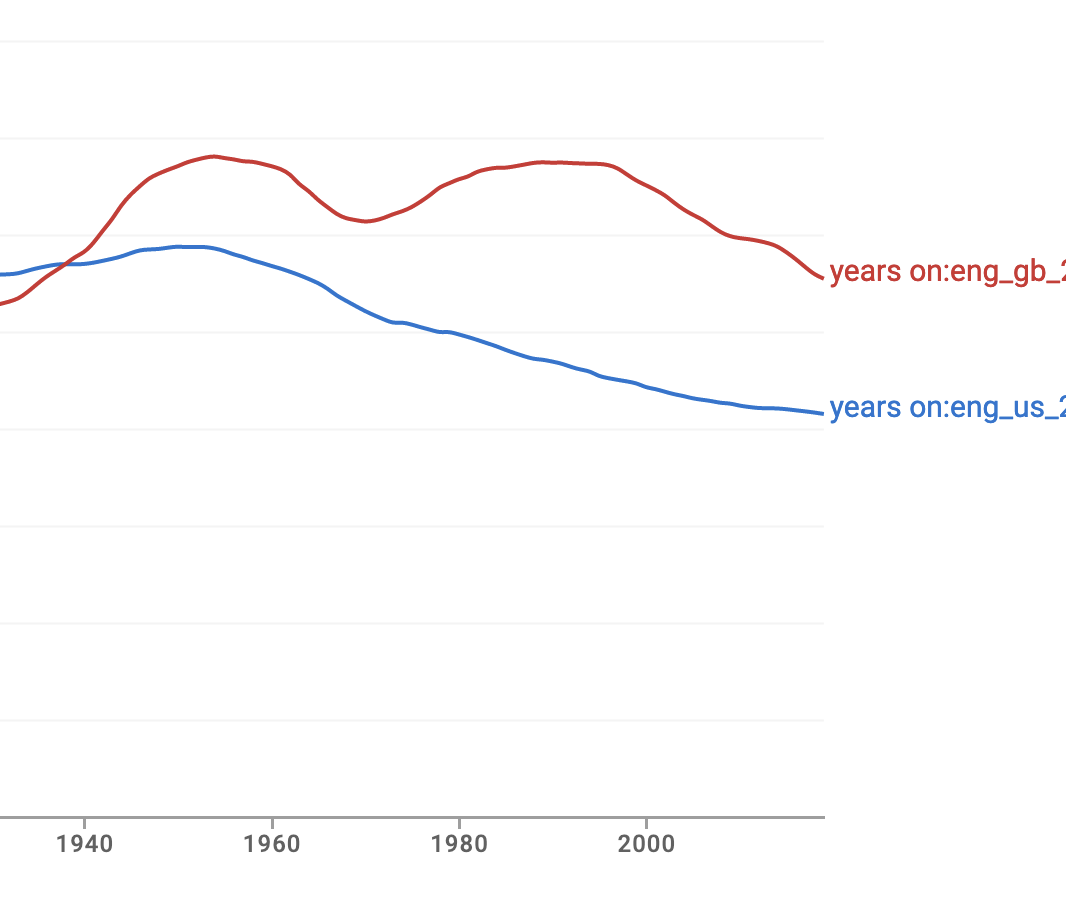
Here’s the Ngram Viewer graph for American and British use of “years on”:

There’s a lot of noise in the graph; that is, it includes uses of the phrase in other contexts. But I believe the gap that begins to yawn in the late ’60s represents British adoption of the “X years on” expression. The first American used I’ve been able to find is a headline from 1991: “A Consummate Teacher: Coach Robinson 50 Years On.”
Thirty-two years on, it’s fully arrived.
Update: Reader Ian Christian reports that the Harrow school song, composed in 1872, starts out:
“Forty years on, when afar and asunder
Parted are those who are singing today,…”
So obviously, Bennett’s was referring to the song in the title of his 1968 play. I still have the sense that the “x years on” formulation was rarely used until the 1980s. But I could be wrong.

As I have mentioned before, I am working on turning this blog into a book. True to form, I’ve left some of the most extensive and therefore difficult entries to the end, which is why it wasn’t until yesterday that I tackled “bits.”
To state the obvious, this is a common word. How common? It is the 808th most frequently used word in the Corpus of Contemporary American English (COCA), just behind “decade” and ahead of “reduce.” The OED considers it to be six separate words—two of them verbs and four nouns. I am concerned here with the one of the nouns (the others have to do with the biting of horses, leather flasks, and computer information) that denotes a piece or part of a larger whole, literally or figuratively bitten off. Its entry has within it twenty-five separate variations, most of which are as commonly used in American as British English. (And some more so: as in a “bit part” in a movie, calling twenty-five cents “two bits,” and the meaning of schtick or well-rehearsed routine, as in this quote from Fred Astaire’s autobiography: “We were in Detroit—stranded—and that is where Mother did the pawning-of-the-jewels bit.”)
If you want my full thoughts on the matter, you’ll have to get the book (hopefully available later this year), but I’ll share here some thoughts on what I view as the main NOOB “bit”: using the word for what an American would most likely say “part,” often used in the plural and often preceded by an adjective. An early British example is from an 1873 humorous sketch in The St. Pauls Magazine, where the narrator describes wandering the halls of Parliament and coming upon a man who’s endeavoring to teach the members to “talk better.” This fellow poses a question:
“One of your great debates that fills three or four pages of your Times with the smallest of small print and runs over into the supplement—how much do you read of it next morning ?”
“Well, I generally glance my eye down the columns, and read the sentences where I see there have been ‘laughter’ and ‘cheers.'”
“Ah, just so, you read only the good bits. Now my plan is to make my pupils say nothing but the good bits. None of them shall speak longer than half an hour, and each sentence shall have a Thought in it.”
“The juicy bits” and “the naughty bits” show up in Britain in the 19th century as well, but really established themselves as phrases in the twentieth. An American would say “the good parts,” “the juicy parts,” and “the naughty parts,” or rather “the dirty parts.”
Most Americans, that is. One finds the occasional literary sort, like critic Richard Eder of the New York Times, writing of a Lina Wertmuller revival in 1976, “Enthusiasm for Miss Wertmuller’s later work may arm the spectator with the fortitude to mark out the good bits.” The same year, American science fiction novelist Ursula Le Guin wrote of H.L. Lovecraft in the Times Literary Supplement, “He imitated the worst bits of Poe quite accurately.”
This use of the word picked up steam in the U.S. in the ‘90s and 2000s, as in a 1999 quote from Time magazine, referring to prosecutor Kenneth Starr’s report on the alleged misdeeds of President Bill Clinton: “He wants America to believe he’d only included the good bits to help the legislature reach an informed decision.” More recently, a reader reports that the Turbo Tax program, while it’s loading, displays the message, “Hold on, we’re getting all the technical bits together.” (The be really British, it would have said, “Hang on.”)
One particular kind of “bits” deserves mention. A 1970 episode of Monty Python’s Flying Circus had a sketch called “How To Recognise Different Parts of the Body,” which included this, well, bit (I quote from the Python Wiki):
A voiceover (John Cleese) points out more parts of the body:
10. The big toe
11. More naughty bits (a man standing wearing spotted Bermuda shorts)
12. The naughty bits of a lady (a lady posing wearing spotted Bermuda bra and shorts)
13. The naughty bits of a horse (a horse wearing spotted Bermuda shorts)
14. The naughty bits of an ant
15. The naughty bits of Reginald Maudling (a picture of Reginald Maudling wearing spotted Bermuda shorts)
In his humorous 1988 book God—The Ultimate Autobiography, Jeremy Pascall uses the phrase “dangly bits” five times, including his reference to the creation of Eve: “So much better formed, softer, rounder, smoother, with none of those ugly dangly bits.” “Dangly bits” caught on as a reference to men’s genitals and by 1999, according to Green’s Dictionary of Slang, had been shortened to just plain “bits.” An example is a quote from Twitter, which I especially like because it uses “bit” twice: “I was in the Sistine Chapel on Tuesday. My favourite bit was where Michelangelo painted in the Pope’s advisor, whom he detested, with a snake eating his bits.”
No surprise that at the U.S. vanguard was NOOBs hall-of-famer Dwight Garner of the New York Times, who, in a review of basketball star Jerry West’s memoir in 2011, wrote, “West seems here like both the Hatfields and McCoys. He shoots himself repeatedly in the head, feet and private bits.” The following year, Garner wrote that an author portrayed gay people as “pretty much like straight people, that is, except for what they do with their dangly bits.”
“Dangly bits” and “bits” appeared to be exclusively male provinces. To the rescue came “lady bits,” first spotted in 2005 and growing apace since then. Google reveals that “Lady Bits” is currently the name of a soap, a physical therapy practice, a zine, and an Australian cross-dressing salon.
The phrase is still an outlier in the U.S., but I imagine gained some traction after a 2021 exchange on Drew Barrymore’s talk show with Gwyneth Paltrow (an honorary English person, of course). Barrymore tasked her guest with coming up with alternatives to words you can’t comfortably say on morning network TV, like “something beginning with v that ends in ‘ina.’”
“Lady bits?” Paltrow offered.
Apologies for the long gap in posting — I have been in Melbourne, Australia, leading a study abroad program for the University of Delaware, and pondering whether the preferred spelling is “brekky” or “brekkie.” The program is winding down and I have a free moment, so wanted to tardily report on Lynne Murphy’s annual U.K.-to-U.S. Word of the Year selection.
As the heading says, it was “fit,” in the sense of sexually attractive. Lynn notes that I have deemed it an “outlier,” but, as she delicately and accurately suggests, “Ben’s probably not in the right demographic for hearing it.”
The OED has the word first showing up in an exchange quoted in a 1985 Observer article: “Better ‘en that bird you blagged last night.” “F—— off! She was fit.” It seems to have been given a boost by its use on Sacha Baron Cohen’s Da Ali G Show and on British reality TV shows, such as Made in Chelsea; the clip below is from a “super-fan show,” “Mad on Chelsea.”
Lynne suggests that the U.S. uptick in awareness of “fit” is largely due to another reality show, Love Island, where the word apparently is uttered so often that it’s included in an American glossary of unfamiliar terms used on the show. (And by the way, I think I have to take another look at “banter.”) The British characters on Ted Lasso throw it around as well.

And it shows up in a Love Island takeoff on SNL (at 1:12).
All well and good. But I still say it’s an outlier.
Lynne Murphy’s final nominee for U.K.-to-U.S. Word of the Year is “shrinkflation,” a portmanteau coinage so new it’s not even in the Oxford English Dictionary. Merriam-Webster added it just this past September, with the definition “the practice of reducing a product’s amount or volume per unit while continuing to offer it at the same price.”
The word’s certainly been used a lot in America of late — seven times in the New York Times in 2022 (and none before that). And it’s certainly a phenomenon. A brief glimpse of my own fridge shows me a 52-ounce Tropicana orange juice container that used to be 64 and a 1.5-quoart Breyer’s ice cream package that used to be 2.
And it’s certainly of British origin. In an online article about the word, Merriam-Webster credits it to the British economist Pippa Malmgren, in 2015 (while also noting than another economist used it with a different meaning, which didn’t catch on, in 2009). However, using the News on the Web (NOW), I found British journalist Marc Shoffman using it in 2013.

In any case, NOW shows the word being used fairly infrequently through 2021, all or almost all in U.K. sources. It expanded into the U.S. in 2022, but, as Lynne Murphy says in her newsletter, it may not “have had enough of a run as a ‘British’ term to be considered an import to the US.”
So what’s my vote for Word of the Year? As noted in the last post, “fit” is not yet common enough here. “Fiddly” is a solid choice, but I’m going with the cheeky one and casting my vote for “soccer.”
When Lynne names a winner, I’ll let you know.
I’ll get to the subject of this post in a minute, but first wanted to note that a couple of days ago, the blog had its three millionth page view. Luckily, I was there and ready to take a screen shot.

So hooray for us. Just goes to show that, for a committed and interested audience, there is no such thing as a too-narrow topic.
As long-time readers know, every year the estimable Lynne Murphy chooses two Words of the Year: an American word picked up in the U.K. and a NOOB. Last year’s U.S.-to-U.K. winner was the pronunciation of the title of the film Dune, and the U.K.-to-U.S. winner was “university,” which has been frequently discussed here. In her newsletter, Lynne listed this year’s nominees (as well as a link where people can express their preference or suggest other words). The U.K.-to-U.S. contenders:
As the links indicate, I’ve covered the first two. “Fiddly,” more or less meaning “balky” and frequently appearing in the expression “fiddly bits,” is a full-fledged NOOB and I would support it as WOTY. “Fit”–meaning sexually attractive–on the other hand is still, in my experience, an outlier in the U.S.
“Soccer” might be surprising to some, as nowadays (especially during the World Cup), Americans are sometimes mocked or derided for using it to denote the game the British (and more or less the rest of the world) know as “football.” But is indeed a NOOB. It originated as a a reference to the Football Association, and to differentiate it from other forms of football, notably rugby. OED citations from the first, in 1873 (with the spelling “socker”), through 1935 are all from British sources.

“Soccer” did get picked up fairly quickly in America, seeming first by headline writers as a conveniently short word, as in this from the New York Times in 1906:

And of course, since then it’s become the American term of choice. To a slight extent, “football” has emerged as a NOOB to indicate the game with the round ball. It’s been slight because 99.9 percent of Americans will understand “football” to mean the game with the touchdowns and helmets. I don’t think there’s been a real life counterpart to the uber-pretentious Lisa Simpson, who refers to the home-grown sport as “American football.”
Next: “shrinkflation.”