“Jumper” Sighting

I imagine “jumper” will never become a true, proper Not One-Off Britishism. That’s partly because it has (as I understand it) a precise American equivalent, “sweater,” and partly because, in the U.S., “jumper” refers to a different kind of garment entirely. (In Wikipedia‘s words: “a sleeveless, collarless dress intended to be worn over a blouse, shirt, T-shirt or sweater.”) Thus the few times the word been mentioned on this site have been novelties, such as Andy Murray’s Christmas sweater (type “jumper” in the search bar at right to see the others).

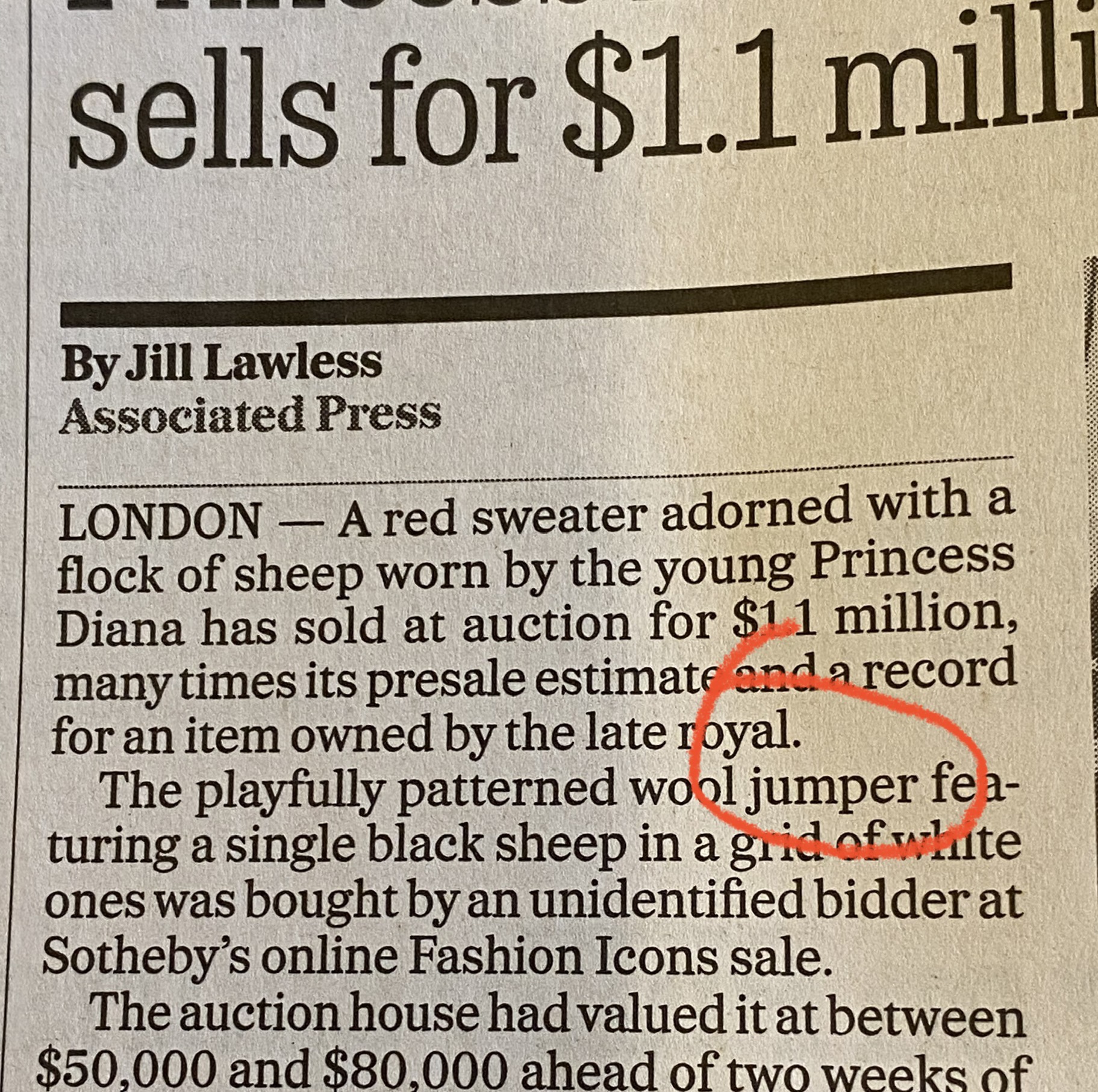
What I have to share today is the closest I’ve seen to actual American use, but even it has some special circumstances. It’s an article published in yesterday’s edition of the Philadelphia Inquirer.

What are the special circumstances? Let me count them:

  • The article is datelined “London” and is about stuff that happened in England; Princess Diana herself would probably have called the garment a jumper. So using the word in the article has a certain logic to it.
  • “Sweater” was used in the headline, the lede, and about a half-dozen times in article, so the two “jumper”s could be seen as elegant variation.
  • The writer of the article, Jill Lawless, is Canadian and has been based in England for a good amount of time.

Even so, it’s not nothing.

“Well done you!”

The other day, a Facebook friend posted about a recent achievement and, almost without thinking, I responded with the phrase that serves as the title of this post.

I suppose this is the time to admit, or confess, that my attitude about not one-off Britishisms has changed in the nearly thirteen years in which I’ve been doing this blog. At first, I looked at them somewhat askance. That is, unless they had been fully adopted in the U.S., like “a piece of cake,” or, at this point, “go missing,” I tended to think of them as pretentious or at least a bit affected. Maybe it’s getting older, but now I look at them with more equanimity. And I even use them myself.

As NOOBs go, “well done you” is no “go missing.” That is to say, it’s pretty rarely heard in the U.S. As is probably clear, the phrase means more or less the same thing as the Australian “good on ya” or the American “good job!” or “you go girl!” The first example I’ve been able to find is a line of dialogue in the 1860 novel Mr. Sponge’s Sporting Tour, by R.S. Surtees: “Well done you! Bravo!”

It shows up twice in Our Mutual Friend (1864-65), by Charles Dickens, the man with the preternatural ear:

  • “‘Well done you!’ cried the person of the house.”
  • “‘Well done you!’ said Fascination to himself.”

The phrase subsequently got picked up fairly widely in Britain, according to examples culled from Google Books. And it’s still in circulation today. A New York Times review of the American edition of The Graham Norton Effect noted, “”Well done, you!” he often exclaims to someone who proves game for his antics.” A band has taken its name from the phrase. And here’s a quote from a 2020 book called What Have I Done?: Motherhood, Mental Illness & Me, by Laura Dockrill:

And then, there was my pièce de résistance: I had the horror story ‘routine book’ wide open, on display, ready for the midwife to survey my strange scrawls and impressively rigorous timekeeping and applaud me with a gobsmacked, ‘Well done, you! I’ve never seen anything so incredible. You’ve totally nailed this motherhood thing.’

But the phrase has never really caught on in America. We’re far less comfortable than Brits with the direct-address “well verb-ed” construction (see “well played, sir“), and the syntax of “well done you” just sounds odd to our ears. Here’s a chart of frequency of “well done you” use in various countries, taken from the News on the Web (NOW) corpus of sources from 2010 to the present:

And note that many of the 45 U.S. uses aren’t valid ones, including quotes from the online Guardian and phrases like, “if you want your meat well done, you have to cook it long.”

However, the phrase has made its way into American usage, albeit tentatively. It shows up in a 2009 film called The Steam Experiment whose writer appears to be an American, and in a 2012 blog post: “So you finally managed to overcome the writers block. Despite all the distractions and apparently every force in the world conspiring to prevent you, you eventually got some words on the page. Well done you.” (In the U.S. as well as Britain, “well done you” is often sarcastic.)

It still sounded foreign in 2016, when a Time writer wrote about auto-generated responses in a Google messaging app:

A friend emailed me a couple months ago and I opened up the message in my Google Inbox app. He had been sick and miserable and wrote, with false enthusiasm, “Also, I haven’t pooped for two straight days!” The pre-written responses Google supplied me included “That’s brilliant!” and “Well done you!” Both of which would have made me sound not only insensitive but also kind of British.

But the phrase has gotten picked up sufficiently since then for me to label it “On the Radar.” Consider:

  • 2017, Apple Insider, on an app called Fantastical: “The instant you say next Tuesday it highlights that day next week and if you instead go on to type ‘Tuesday, July 4’, now Fantastical shows you July’s month and well done you for happening to know that Independence Day is on a Tuesday this year.”
  • 2021, The Motley Fool: “If you’re lucky enough to be the beneficiary of a major inheritance or happen to earn a six-figure income, well done you!”
  • 2023 the Chicago Sun-Times on the latest Indiana Jones movie: “they used footage and outtakes from every Lucas film featuring Ford to pick up various angles of his face and insert them into the picture, so well done you.”

Well done me?

“Diary” (with an asterisk)

For Americans, a diary is a book with blank pages in which one records ones thoughts, feelings, experiences. American diaries often come with a lock and key, probably less to use than to convey the idea that the contents are personal and secret.

This is the sense of Anne Frank’s Diary of a Young Girl. It’s sometimes used in Britain as well. See the fictional Bridget Jones’ Diary and the real-life diaries of such figures as Virginia Woolf and Harold Nicolson.

But I believe that the main British meaning is different. The Cambridge Dictionary defines it this way: “a book or piece of software with a space or page for each day, in which you record future arrangements, meetings, etc.” The dictionary gives these examples:

  • Is there anything in your diary for tomorrow afternoon?
  • Please check the appointments diary before scheduling a meeting.
  • She has a very full diary this week but she could see you next week.
  • Our CEO is seeking a part-time diary secretary to help him manage his appointments efficiently.

None of these would be used in the U.S., and I’ve yet to encounter an American use of this kind of diary (which we call a datebook or calendar). But a couple of days ago, I read this in a New Yorker profile of Eric Adams, the mayor of New York City: “Adams’s diary of official events seems far fuller than those of his predecessors.”

The asterisk mentioned in the title of this post has to do with the author of the New Yorker article, Ian Parker. He has been a staff writer for the magazine since 2000, but his New Yorker bio says that before then, “he was the television critic for the London Observer and a writer and editor at the Independent.” So I’d say that datebook “diary” qualifies as a NOOB, but only by virtue of the New Yorker editors who let it through.

“Trekking”

A couple of months ago, the New York Times ran an article called “2023 Is the Year of the Long Walk.” The sub-heading began: “The 500-mile Camino de Santiago has inspired a host of new treks in places from Canada to Bhutan that let travelers take the slow route.” To my American ears, the word “treks” sounded off; I would have expected “hikes.” Same with the following sentences:

  • “Here are seven new treks to keep in mind.”
  • “In an effort to showcase this history, the Soca Region Foundation has turned the former front line into a 310-mile network of treks.”
  • “Across the border in Georgia, Paul Stephens, who was volunteering with the U.S. Peace Corps, had begun envisioning a trekking route across the entire Caucasus range.”

Google Ngram Viewer reveals that “hiking” is about ten times more common in the U.S. than “trekking.” “Hike” and “hiking” are also used in the Times article, and to some extent the “trek”s are a case of elegant variation, or using a synonym to avoid word repetition. But Ngram Viewer also reveals that “trekking” is a Not One-off Britishism that has been gaining ground on these shores:

The OED reveals that the word derives from the Dutch trekken, meaning to pull, tow, or march, and was adopted by English speakers in South Africa in the late nineteenth century. This passage is from The Young Nimrods, 1882:

The OED reports that “trek” acquired the sense of arduous hike by 1911, and of an arduous hike one does for pleasure by 1955, when this quote appeared in The Times: “About 35,000 came last year, and more are expected this summer… They come to fish and shoot or to trek in the mountains. ‘Only the English like trekking,’ one agent said.” Unfortunately, the snippet doesn’t reveal the location being discussed.

Wes Davis credibly suggests that the American popularity of “trekking” may be correlated with the advent of trekking poles, which date from around 1990, and for some reason tend not to be called “hiking poles.” Just last month, the New York Times Wirecutter section ran an article called “The Best Trekking Poles” which used the term “trekking poles” nineteen times and “hiking poles” not once. No elegant variation for the Wirecutter.

Gill Sans

The headline above describes not only this blog post but also itself. That is, it consists of two words written in the Gill Sans font. The typeface has a storied past. It derived from Johnston, or Johnston Sans, created by Frank Johnston and used by London public transport (with some adjustments) ever since 1916. It is surely familiar to anyone who has ever ridden the tube in London.

Wikipedia informs me that Johnston is used for the logo of the fictional hospital where the American TV show House takes place (possibly a waggish nod to the Englishness of the actor who plays House, Hugh Laurie):

Eric Gill, a former assistant to Johnston, designed his own san serif font for the Monotype Company in 1928. It was dubbed Gill Sans and it gained wide currency due to its adoption by British Rail and, iconically, by Penguin Books.

Aside from any aesthetic attributes, Gill Sans was used much more widely than Johnston because the latter was the copyright property of London Transport until 2015. If you have Microsoft Word, you can use Gill, but still not Johnston. In any case, I confess that if you put me in a room with some examples of Johnston and Gill Sans, I probably couldn’t tell the difference. But from what I can gather, all or almost all of the examples of this style I’m seeing more and more in America are Gill Sans. Like this:

And this

It’s used in the website and some of the published work of information design guru Edward Tufte:

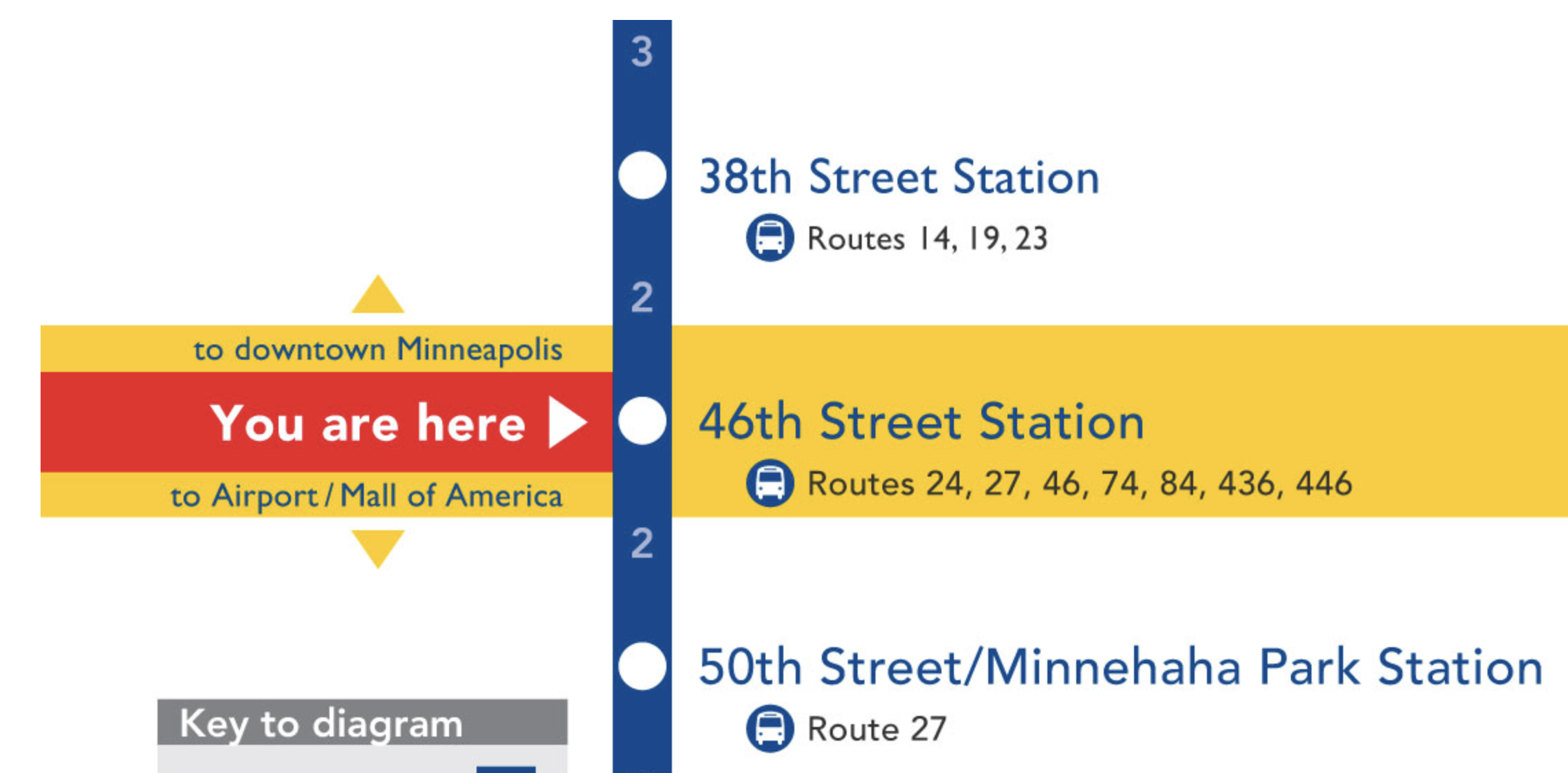
And, getting back to transport, in the graphics for the Hiawatha Light-Rail line in Minneapolis-St. Paul:

“Get up to” (something)

Last month on National Public Radio, longtime Los Angeles Times columnist Patt Morrison said about a venerable L.A. drive-in movie: “You can get up to some romantic hanky panky if you want. Or you can have the kids asleep in the back seat.”

A couple of years ago, Tim Hererra, or the New York Times Smarter Living newsletter, had this signoff at the end of an entry on what to do with a day off: “Tweet me … and let me know what you get up to, and have a great week!”

They were both using the expression “get up to” in the sense of this OED definition: “to become engaged in or bent on (an activity, esp. of a reprehensible nature).” The dictionary’s first citation is from an 1864 book: “And you know, when people do get up to mischief on the sly, punishment is sure to follow.” That and the next four cites are British, the most recent being Kingsley Amis’s The Old Devils (1986): “As anyone might who was as keen as he on what you could get up to indoors.” The sixth and final quote is from an anonymous 2009 article in the American magazine Wired.

I can’t resist one more example, from a 2021 New York Times obituary of the Montreal-born photographer Marcus Leatherdale, who lived on the Lower East Side of New York in the late 1970s:

The Grand Street loft was an unusual household. [His wife Chloe] Summers was a dominatrix working under the name Mistress Juliette; one of her clients cleaned the place free of charge. [Robert] Mapplethorpe assisted Ms. Summers with her work by offering her a pair of leather pants, a rubber garter belt and S&M tips. Mr. Leatherdale, sober, tidy and decidedly not hard core despite his leather uniform, was mock-annoyed one morning when he awoke to find an English muffin speared to the kitchen table with one of Ms. Summers’ stilettos. “What did you get up to last night?” he asked her.

The OED and Google Books Ngram Viewer agree that this was originally a British expression. The apparent recent American adoption isn’t surprising, given that we’ve long similarly used “up to” without the “get,” for example, “He was up to no good.” For now I’m labeling it “on the radar.”

New Meaning of ‘Hoover’

Fateful Faithful reader Stuart Semmel emailed that he had just heard an American reporter use the verb “hoovering” on National Public Radio. As it happened, I had also heard Bobby Allyn, talking about Elon Musk’s recent decision to limit the number of tweets individuals can see: “Musk says this is all about artificial intelligence companies, right? They train AI models, as we know, by hoovering up tons of data from websites like Twitter.” (Almost predictably, Allyn used the now near-mandatory Zuck-talk “right?”)

I’ve written several times about “hoover,” derived from the vacuum company, often (but not always) followed by “up,” and meaning, according to the OED, “To consume or take in voraciously; to devour completely.” But when I Googled the word before answering Stuart, I found almost the entire first screen’s worth of results had to do with a meaning I was unaware of. It’s not in the OED or Green’s Dictionary of Slang, but an Urban Dictionary post from 2010 has it as one of nine (count ’em, nine) “hoover” definitions:

v. colloquial Being manipulated back into a relationship with threats of suicide, self-harm, or threats of false criminal accusations. Relationship manipulation often associated with individuals suffering from personality disorders like Borderline Personality Disorder or Narcissistic Personality Disorder.

The next example I could find was in the title of a 2017 book by (American) Amber Ault: Hoovering: How to Resist the Pull of a Toxic Relationship & Recover Your Freedom Now. And the word seems to be very much still out there, as witness 2022 articles in Psychology Today and Bustle. Those are both American publications, which leads me to suspect that psychological hoovering is an American coinage. But I’m not sure and would be interested in evidence either way.

“Dead” As Adverb; “Dead Easy”

Fifteen years ago, Lynne Murphy wrote a blog post about the use of “dead” as an adverb in British English. She posted this photo of a sign she encountered in the village of Hythe:

And she gave two example she had found online. The first was from a comment on blog.pinknews.co.uk: “Dom looks dead sexy in eyeliner and black nail varnish.” (“Nail varnish” is BrE for “nail polish.”) The second were some excerpts from the blog of a band called MJ Hibbett & the Validators, describing a holiday in Singapore (capital letters in the original):

… I also watched “Sky High”, which was dead good. […] It’s odd really, some of it is DEAD POSH, like the lobby and the millions of people tidying plates away at breakfast, and some of it ISN’T, like the mucky marks on the walls and the water dripping on your head in reception. […] We then had a LOVELY bit of tapas (ooh, it was DEAD nice, roast potatoes and hot garlicy [sic] tomato sauce, ACE!)

Someone commented on the post: “My brother and his friend had rescued a rabbit from somewhere out on the farm and were enthusiastically telling us how well it was doing: ‘It’s dead alive, you know.'”

Lynne puckishly observed that the usage — “dead” as an adverb meaning “very” — is “dead British.” She’s right, though adverbial “dead” does show up in a small number of phrases that are familiar in America as well (I assume) as in Britain: “dead wrong,” “dead right,” “dead against,” “dead tired,” “dead drunk.” (The last two share the sense of the quality being so pronounced that the person having it appears dead, or close to it. Green’s Dictionary of Slang suggests that the adverbial form actually entered the language through “dead drunk,” which shows up in the 1600s and has been in common use ever since.) Dan Jenkins published a novel in 1974 called Dead Solid Perfect. And commenters on Lynne’s post noted that in boating contexts even in the U.S., “Dead Slow” is a familiar formulation.

Oxford Learner’s Dictionaries makes a useful distinction: the phrases that are common in the U.S. all use “dead” to mean “completely.” But only Britain is it also frequently used to mean “very.” The examples given by the dictionary, none of which are common in America, are:

  • The instructions are dead easy to follow.
  • You were dead lucky to get that job.
  • I was dead scared.

But hold on a second. What got me thinking about this was noticing American uses of the first one, “dead easy.” The phrase has shown up fifty-two times in the New York Times, all since 1996, and no fewer than five of them, including the most recent, from the pen of NOOBs legend Sam Sifton. In the piece linked to, Sifton is saying that a noodle dish is “dead easy to make,” and a substantial majority of the Times uses describe a recipe or cooking technique. (A number of the early ones have an interesting variation, including the 1996 article, which says the cook’s trick of using bottled salad dressing in preparing a dish is “is drop-dead easy, and it tastes good.”)

But hold on another second and look at the Google Books Ngram Viewer graph for American and British uses of “dead easy”:

My investigation on the Google Books database supports American origin of the phrase, specifically in a frontier, Western, or slangy context. In 1889, a Salt Lake City newspaper, the Deseret News, had the line, “It’s dead easy, see.” In Life magazine in 1896, there was this line of dialogue followed by a parenthetical comment. “‘You must get into the brainy set. Then it’s dead easy.’ (His language is so droll.)” It’s not “dead easy,” but Green’s Dictionary of Slang quotes an 1899 line from American humorist George Ade’s Fables in Slang: “She was going to be Benevolent and be Dead Swell at the Same Time.”

I’m sure there must be some, but off the top of my head I can’t think of any other examples of an American expression that fell by the wayside in the U.S., got taken up by the British, and then, more than half a century later, became a NOOB.

“Bubbles”

Some months back, my daughter Maria Yagoda alerted me to a vogue word she’d encountered in the food-and-drink world, which she thought was a Britishism: “bubbles,” as a synecdoche (part signifying the whole) for Champagne or more broadly sparkling wine. I took a stab at researching it but was defeated by the sheer abundance of uses of the word in all sorts of context, including non-synecdochical wine discussions. (E.g., “I love Champagne because of the bubbles.”)

But then I was walking in Manhattan and came upon this two-sided sign:

So, not only “bubbles” but also “brekkie” and “mate“: a veritable NOOBs-orama! My enthusiasm was dampened a little bit when I found out that the advertised enterprise, Bluestone Lane, was founded by a former Australian Rules Football player named Nick Stone and describes itself as “bringing Aussie café culture (and better coffee) to the USA.” Clearly, the signage is leaning in to the Aussie identity.

In any case, the Bluestone sign inspired me to research the issue. I found, not surprisingly, that the more common term in both Britain and the U.S. has always been “bubbly.” (That isn’t synecdoche but rather a nominalized adjective. I”ll also note that in hip-hop, the preferred term has been “bub.”) According to Green’s Dictionary of Slang, “bubbles”=sparkling wine actually first occurs in a 1945 American dictionary of criminal slang. But that appears to be a bit of an anomaly, as the next example I have, from the OED, is from a 1989 Brisbane, Australia, newspaper article: “The 1986 pinot chardonnay bubbles..will cost about $22 in the bottleshop,..close to the lower-priced French champagnes.” That might be an outlier, too, as the next cite (from Green’s) doesn’t come till 2010, in a South Africa newspaper: “Sip a glass of seriously posh bubbles.” The term had reached Britain by 2018, when a novel had this line of dialogue: “’I’m going to have some more bubbles; do you want a glass?’”

By that time, “bubbles” had arrived in America. The OED quotes a line from a 2017 romance novel by K.A. Linde: “We need ice cream and bubbles to celebrate.” And an undated article by an American wine writer has the line, “You should also know that the French government has strict rules for Champagne makers… and if they don’t comply, they can’t call their bubbles ‘Champagne’ either.”

Clearly, I don’t have an abundance of data. But the evidence would suggest that “bubbles” had emerged in South Africa and possibly Australia by 2010 and subsequently spread to the U.K and then, fairly quickly, to the U.S.

Update: After getting some blowback in the comments along the lines of “I’ve been British all my life and I’ve never heard of such a thing,” I decided to investigate further by searching for “have some bubbles” in a few recent corpora. News on the Web (NOW), which tracks usage from 2010 to the present and has some 17.5 billion words of data, had thirteen hits. (There are fifteen in the graphic below, but numbers 4 and 5 are the same, and 13 refers to the bubbles in pancakes.)

The nationalities are six from Australia, four from New Zealand, one from the U.K, one from Hong Kong, and one from the United States — but that really doesn’t count since it’s in a quote from someone from Northern Ireland, and the reporter defines both “bubbles” and “craic” (a laugh).

And that’s where we’ll have to leave it for now.