

 OED cites a 1914 use and defines it as “Smart, stylish, splendid, luxurious. Also (chiefly Brit.): typical of or belonging to the upper class; (affecting to be) superior or genteel; ‘snooty’, pretentious.” The closest American equivalent would be fancy, or maybe fancy-schmancy.
Posh has been used in the U.S. for decades, of course, but, until the mid-1990s, at roughly half the rate as in Britain and chiefly without the ironic or sardonic connotation noted by the OED. (It’s a similar case to brilliant, in that the word was used here but more sincerely than across the pond.) What happened in the mid-1990s? The Spice Girls, of course. The group was formed in 1994, but it was two years later that Melody Maker magazine bestowed nicknames on the members. Victoria Adams (now Victoria Beckham) actually had an upper-middle-class (what the Brits would call middle-class) upbringing, but she was dubbed Posh Spice because of her bearing, which was, well, posh.
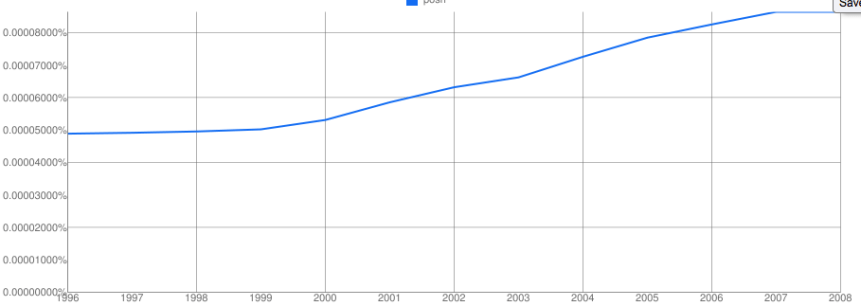
In his article ex-Buster [Thurman] Arnold judicially recorded his opinion that labor has become a national headache, that it is perhaps more unpopular in the slit trenches of World War II than in the posh clubs of professional New Deal haters, and that the great body of public approval essential for effective labor support is crumbling all along the line. (Time, October 18, 1943)/Discerning the difference between “posh” and “body hugger” denims was like trying to tell the Olsen twins apart. (New York Times, May 11, 2011)



 Verb, transitive or intransitive. The OED’s definition:

 In the UK, one disposes of unwanted stuff in the rubbish bin or merely the bin. The venerable U.S. equivalents are garbage can and trash can. In the April 18, 2011, edition of (yes) the New Yorker, one finds this in (American) Evan Osnos’s
  notoneoffbritishisms.com