Ninety percent of the ads I see on Facebook are either for shoes (especially with wide sizes), electric cars, or glasses, especially sunglasses and reading glasses. That’s because I’m interested in those things, and keep clicking on attractive ads. What can I say? It keeps me off the street.
The other day, I clicked on a shoe ad and this appeared:
I’ve been on the elusive trail of “trainers” (BrE for American sneakers, running shoes, or tennis shoes) for quite some time. My most recent post is here, and you can follow the trail back to the first one, or simply put “trainers” into the search bar at right.
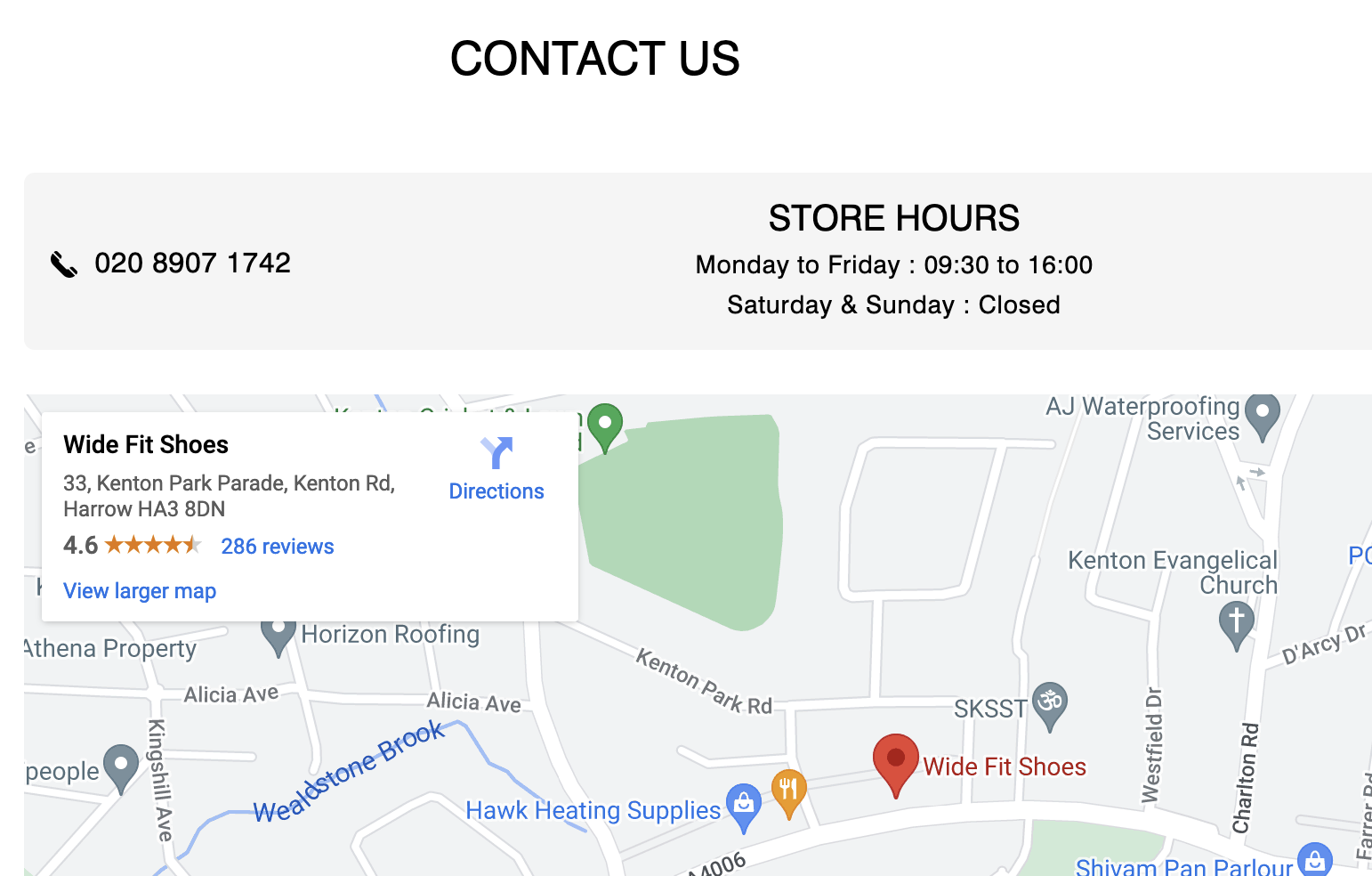
The New Balance ad seemed a palpable hit. But then I noticed the spellings “colour” and “grey”–the first completely British, the second still predominantly so. And when I clicked through to the “About” page of the company, Wide Fit Shoes, my fears were confirmed.
Oh well. At least I have a field trip for my next visit to London.
The New York Times had a nice headline the other day:
The word “swans” in the title of the TV series refers to the word author Truman Capote used to refer to the upper-crust New York women he socialized with, and ultimately betrayed. For an article about a party celebrating the series, the clever Times headline writer used the British verb “swan“–meaning (according to the OED), “To move about freely or in an (apparently) aimless way.”
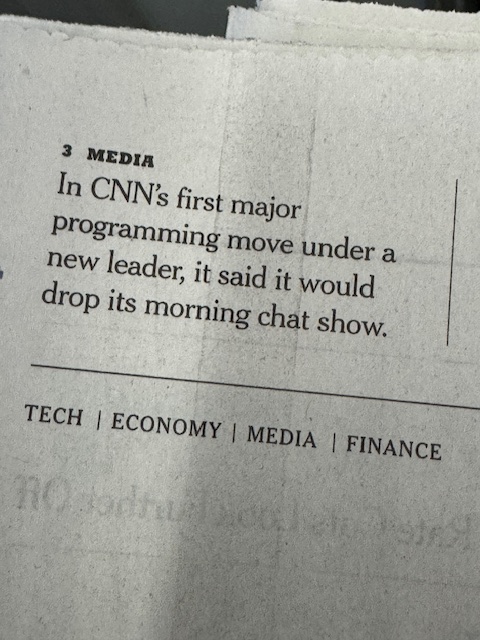
The next one’s from the print edition of the Times.
In this case, substituting the British “chat show” for the American “talk show” isn’t especially clever. It doesn’t even save any space in the headline. Possibly the term was meant as a criticism for the show in question, but as I’ve never watched it or otherwise heard of it, I can’t really say.
Someone I know has taken to using the word “wee” meaning to urinate, e.g., “Pretty soon I will need to to wee.” I recognized this as a British replacement for “pee,” along the same lines as “poo” substituting for American “poop,” and I thought it would make for a pretty easy post for this blog.
Well, similar to Bogart’s Rick in Casablanca, I misinformed myself. To be sure, “wee” in both the verb form and the noun (“He had a wee”) is indeed British, as well as Irish and Australian. The OED‘s first citation for the verb is a 1934 letter from the Welsh poet Dylan Thomas: “Wee on the sun that he bloody well shines not.” The first noun form is in Richard Clapperton’s 1968 book No News on Monday, with the line, “Wanda is downstairs having a wee.”
The problem was establishing that any American other than my one informant uses it. None of the citations in the OED or in Green’s Dictionary of Slang is American. Nor, as far as I can tell, has “wee” has ever been used to mean urinate in the New York Times. I searched “having a wee” in the News on the Web (NOW) corpus of more than ten million words published online in English-language sources from 2010 to the present. Here’s the geographical spread.
The first number represents the number of times the phrase was used, the second how many words (in thousands) in corpus come from that country. But the measly 13 in the U.S. isn’t even a legit number. Eleven of them are false positives (“having a wee drink”) and the other two are quotes from British people.
Most of the New Zealand hits were real, however:
In 2018 the Australian linguist Lauren Gawne posted an article on the Strong Language blog about the differences in nuance between “a pee” and “a wee.” She didn’t mention anything about America, but several commenters identified themselves as Americans and said they had never used or heard a countryman use “wee.” One wrote: “American-born in 1958. I use pee as the standard polite euphemism for piss, and it is both verb and noun. I don’t say wee; it strikes me as doubly euphemistic and (what can I say?) twee.”
That brings me to “wee-wee,” which actually is an American juvenile form to “urinate.” Green’s Dictionary of Slang has a quote from Sidney Kingsley’s 1934 play Dead End: “Wee-wee! He’s godda go wee-wee!” The duplicated term was used in my own family when I was a kid. To make matters more complicated, “wee-wee” also shows up in Britain and Australia.
But that still left me with no other American instances of “wee.” Desperate, I turned to Facebook and asked my friends if they had ever encountered it. I got more than a few negative responses, but also some positive ones:
“Yes, heard that all my life in Louisiana from family.”
“I’ve heard it all my life. I grew up in Texas and Louisiana. It was common.”
“Here in Kentucky wee-wee and taking a wee were the same thing. When we were littles it was taking a wee or going wee-wee — interchangeable. Starting around sixth grade taking a wee became taking a piss.”
“’Have to go wee’ is something we said as kids (growing up in the Detroit area) and (now) say to grandkids. Mom grew up outside of Pittsburgh, for what that’s worth.”
Ben Zimmer, language columnist for the Wall Street Journal, wrote that “Back in 2007, a Sacramento radio station held a highly misguided promotional contest called ‘Hold Your Wee for a Wii.’ A woman who participated in the contest died of water intoxication and her family won a settlement.”
And the distinguished novelist Richard Bausch wrote:
Bobby and I were five or six and our step grandfather Dick Underwood came by in a shiny new Packard convertible, and took us for a ride. We were riding past an army post—Korean War still going on across the world (I remember wondering why we couldn’t hear it). Dick Underwood looked over at us and said, “I’ve gotta wee.” Bobby and I had never heard an adult say anything like that. We laughed like hell, and we never forgot it.
I mentioned in the previous post that in his book The American Language, H.L. Mencken listed “pub-crawl” as a “Briticism” that had not caught on in America. Another one he mentions is “wowser.” In the 1936 edition, Mencken calls this “an excellent noun” of Australian origin and provides a definition: “a fellow who is too niggardly of joy to allow the other fellow any time to do anything but pray.” Mencken goes on: “I tried to introduce it in the United States after World War I, but without any success.”
That surprised me. I would have thought “wowser” had indeed found success in America. And in fact it did, but only after 1936, and with a different meaning.
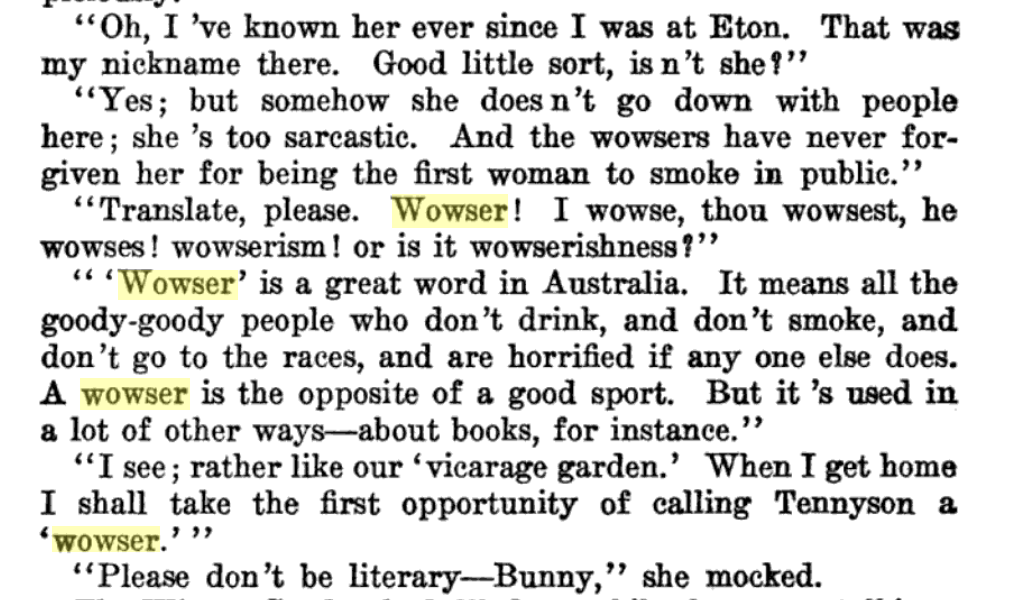
But first, as to the Miss Grundy-type “wowser,” Mencken was correct, though incomplete. The OED confirms Australian origin and has a citation from a Sydney newspaper in 1900: “That old Y.M.C.A. wowser, whose journalistic virtue is of such transparent Sir Galahad-like purity.”
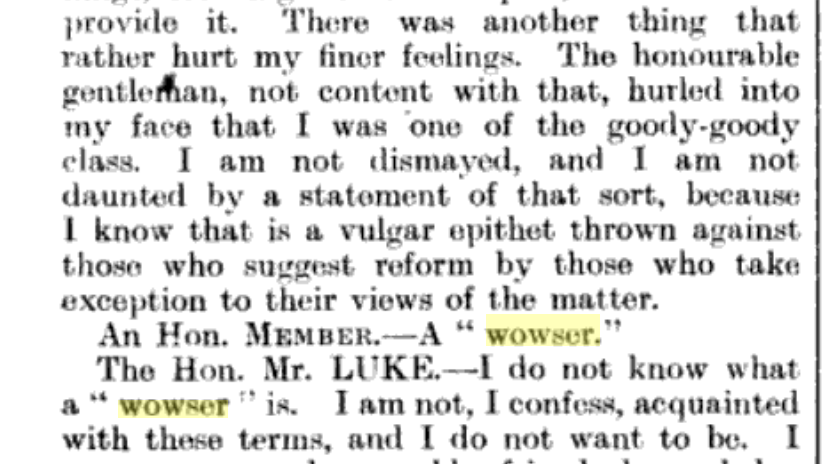
The word has traveled to New Zealand by 1910 as witness this parliamentary exchange:
It had spread to Britain by 1917, appearing in The Woman of the Horizon by Gilbert Frankau, the passage containing a helpful explanation of its meaning:
Mencken did not seem to be aware that the word had another, seemingly earlier, meaning, found strictly in Australia. In the OED‘s words, “A person, esp. a man, who behaves in an antisocial or disruptive way; a lout; a yob.” This appeared as early as 1898 but seems to have died out by the 1930s (even as the puritanical “wowser” persisted in Australia and Britain into the 21st century).
As for the American “wowser,” it derives from the exclamation “Wow!,” which originated in Scotland but flourished in America starting around the turn of the 20th century, as in this exchange from a book by George Ade, a virtuoso of slang: “‘The girls—wow!’ ‘Beauties, eh?’ ‘Lollypaloozers!’” Green’s Dictionary of Slang defines this “wowser” as “something, or somebody, impressive, sensational, successful.” The dictionary has citations from 1917 and 1924, which I’m a bit dubious about, and a solid one from a 1951 novel: “[She] Certainly was a wowser on that Gay Nineties stuff.”
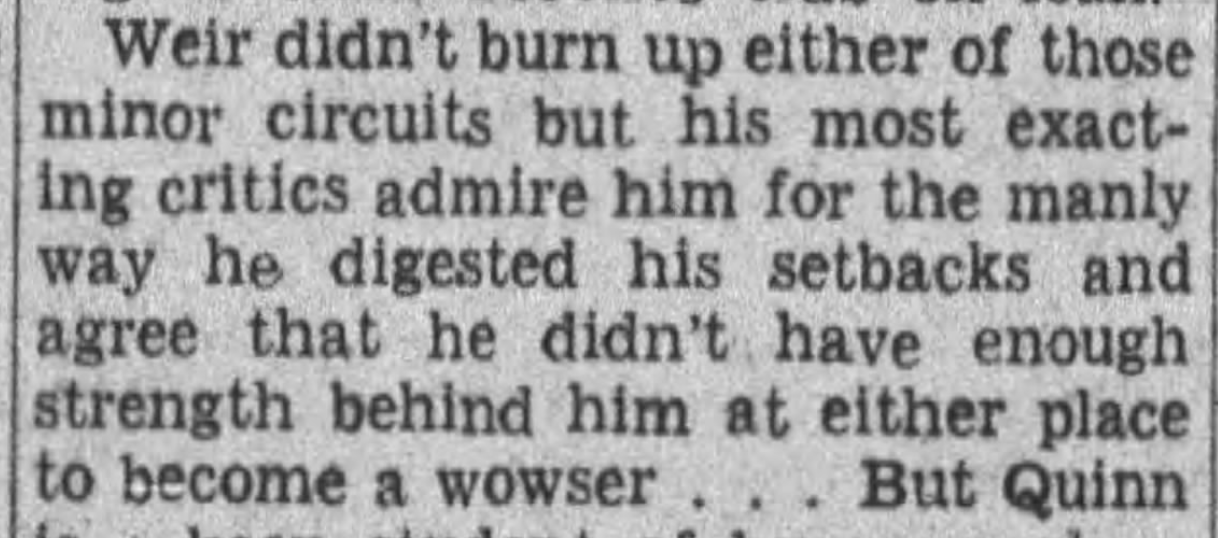
I found an earlier example, using newspapers.com, in a 1940 sports article in the North Adams [Massachusetts] Transcript. It’s about a baseball pitcher who had been playing in the minor leagues, or “circuits”:
An interesting thing about American “wowser” (sometimes spelled “wowzer”) is that even though it probably didn’t exist before the 1936 (else Mencken would have noted it), very soon it acquired an old-fashioned sound. Consider that 1951 quote, referring to the 1890s. And its second appearance in the New York Times (following a 1964 book review) was in a fanciful article that purported to be about the 1927 New York Yankees season and to be written in the style of the time. The owner of the team “had a wowser of a promotional idea, which he plastered on billboards all over the city: Babe Ruth promising to break his 1921 record of 59 homers ‘or apologize in person to each and every disappointed Yankee rooter!'”
I believe the sense of “wowser” as coming from the Jazz Age derives from its sounding like another word, which did. Green’s categorizes “yowza” as “US teen” argot and defines it as “a general excl., either of approval or of vaguely non-committal agreement.” The first citation, which seems to be either a definition or a repetition, is from the Philadelphia Daily Bulletin in 1933: “Yowza–Yes sir!”
The word, repeated three times, became associated with the bandleader Ben Bernie, who had a nationally syndicated radio show in the ’30s. It was adopted by the malevolent bandleader played by Gig Young in the 1969 film They Shoot Horses, Don’t They?, which is where I first encountered it. Wikipedia notes that the word was also picked up by “Richie Cunningham in a 1976 episode of Happy Days, ‘They Shoot Fonzies, Don’t They?’, by the band Chic with their 1977 hit ‘Dance, Dance, Dance (Yowsah, Yowsah, Yowsah),’ Frank Zappa in his 1979 single ‘Dancin’ Fool‘ and Ritch Brinkley as Cappy in 1994’s comedy Cabin Boy.”
Did American “wowser” spring from “yowza”? My guess would be yes, but more research is clearly called for.
A reader who goes by “Lurk” writes in: “Heard ‘pub crawl’ used in a U.S. TV programme today, “Law & Order”. Series 19 (2008-2009), episode 13 about half way through. Struck me as unusual.”
Lurk identifies himself or herself as British, but I already knew that, what with “programme” (instead of “program”), “series” (“season”), and the period outside quotation marks. In any case, “pub crawl” was actually on my mind, as I had recently come upon it in H.L. Mencken’s The American Language. In the 1945 edition, Mencken writes that most “Briticisms” in America are pretentious borrowings, such as “swank,” “swagger,” and “master bedroom.” However, he says, “Plenty of Briticisms, especially on the level of slang, deserve American adoption better than any of the shaky borrowings from the English upper classes, e.g., ‘pub crawl,’ (a tour of drinking spots).”
The OED defines the expression as “A visit to a succession of pubs with drinks at each one” and has three citations. They show a familiar progression:
Phrase in quotation marks: “We did a ‘pub-crawl’ in Commercial Road and East India Dock Road.”–T. Burke, Nights in Town, 1915
No quotation marks but hyphenated: “Simon Fleet had arranged a pub-crawl of the East End.”–Cecil. Beaton, Diary 9 February 1964, in Self Portrait with Friends (1979)
Unhyphenated: “A visit to London wouldn’t be complete without a stop at the famous Ceeps, a must-do on any pub crawl.”
That last one, from 1992, mentions “London” but it’s actually from a London, Ontario, newspaper and is about that city.
As for “pub crawl” in the U.S., I have a pretty strong feeling I heard it before 2008. There’s confirmation of that in two 1970s uses in the New York Times. In a 1975 column, the great Russell Baker wrote fancifully that in the pages of Esquire magazine, “Dante Gabriel Rossetti always seems to be jogging with Muhammad Ali while Norman Mailer is on a pub crawl with Vergil.”
And this is from a 1977 article about then-California Governor Jerry Brown:
[Voters] seem to accept the Governor’s desire to spend a few weekend hours at the Zen center in San Francisco, or his penchant, as a bachelor who will he 40 years old next April 7. for visiting such: sections as San Francisco’s topless bar area, North Beach, accompanied by Linda Ronstadt. the singer.
The North Beach date was no pub crawl; instead, Mr. Brown took Miss Ronstadt to the City Lights Bookstore, a relic of the beatnik years. where he bought a copy of “The Catholic Worker” and one of Henry Miller’s “My Life in New York.”
Nowadays, contra Lurk, American pub-crawls are a commonplace. Look at the results I got when I Googled the term. (Google is customizing it for me since I live outside Philadelphia.)
I’ve written several times about Americans using “trainers” to indicate what we normally call sneakers, tennis shoes, or running shoes, most recently here (that post has a link to the previous one, which should have a link to the one before that, etc.). The word is still a bit of an outlier here, which is why I’m still collecting examples.
The latest popped up on the Amazon page of a company called Fitville, a pair of whose shoes I bought (and am quite happy with, incidentally, as they fit my super-wide feet).
Now, this wouldn’t be worth writing about if Fitville were not an American company. So I dug into its website and came up with this:
Will “trainers” catch on here? I’m still betting no, but who knows? Look what happened to “kit.”
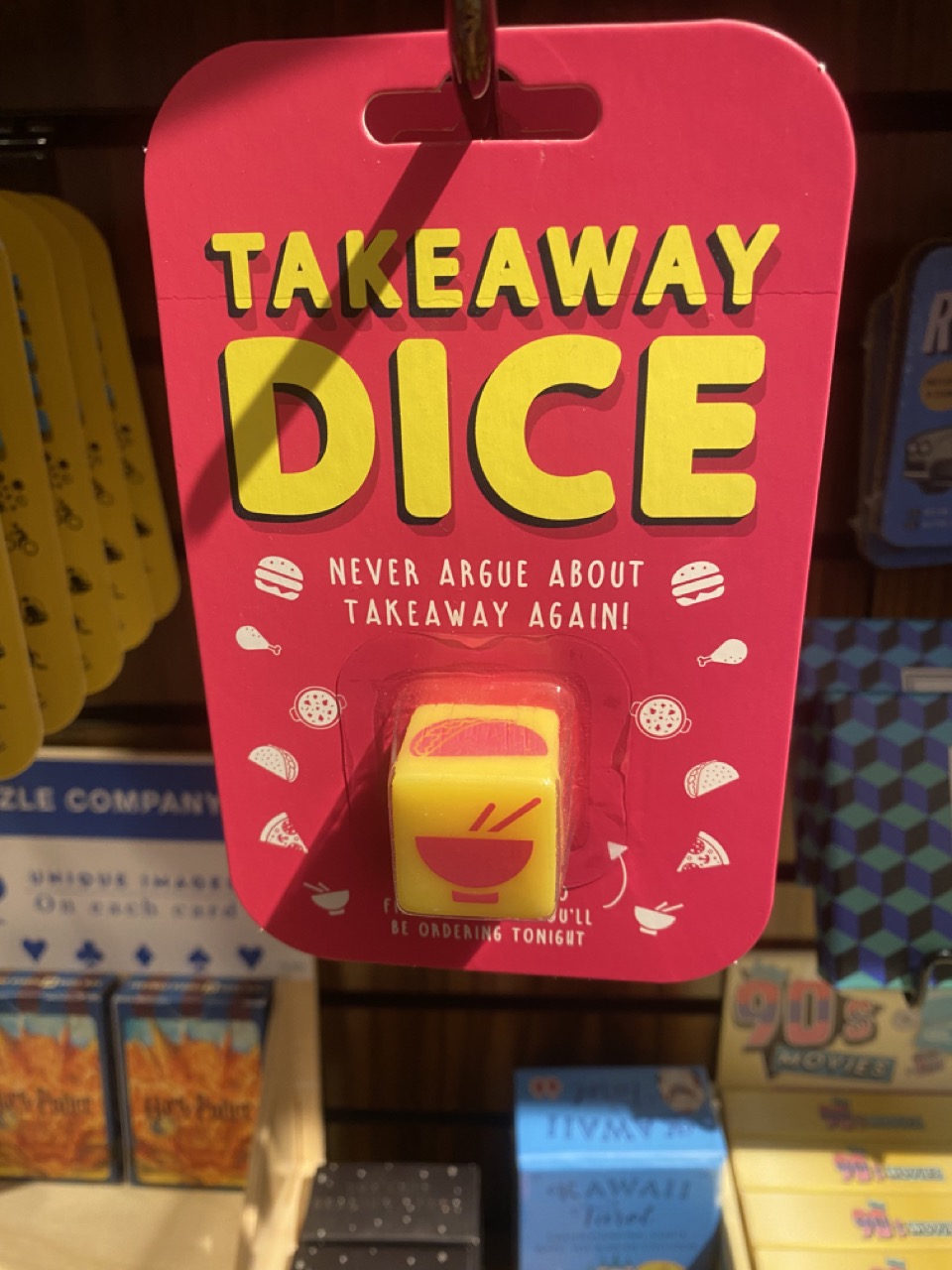
My pulse quickened when I saw this the other day at a local bookstore (which, true to the American custom, had more gifts and novelty items on offer than books).
The idea being that you roll the die to determine what sort of “takeaway” food you will order and eat. My pulse quickened because I knew that “takeaway” was British English for American “take-out” or “carry-out.” My pulse went back to normal when I looked at the back of the product and saw it came from an English company, Gift Republic.
The sighting prompted me to do a little research. The three phrases (hyphenation practice differs) are all terms that popped up in the mid-twentieth century and can be used either as a noun (“we had take-out”) or adjective (“we had carry-out chicken”) referring to food brought home from a restaurant; “carry-out”” and “takeaway” can also denote an establishment that specializes in such service. (“When they got home, Margery and Buddy had left and there were slimy paper cartons from a Chinese carry-out on the bed”–J. Marrtin, Gilbert, 1982.)
As I say, “takeaway” is predominantly British and the other two American–although Lynne Murphy’s blog post on the subject notes that “take-out” is used in parts of northern England and “carry-out” in Scotland. The OED feels that in Scotland, the term refers to “Alcohol bought from an off-licence, supermarket, etc., or bought in a pub for consumption off the premises.” (“Two of the world’s best footballers bought a carry-out and went to a party in Castlemilk.”–Sunday Herald (Glasgow) 19 November 2002.)
In America, I believe that the choice of “take-out” versus “carry-out” is mainly regional. Growing up in New York, I only knew from “take-out” and can actually pinpoint the first time “carry-out” crossed my radar. It was in the fall of 1973, and for a college sociology course, I was reading Elliot Liebow’s Tally’s Corner (1967), a study of African-American “streetcorner men” who hung out on a particular intersection in Washington, D.C. On the corner, Liebow writes, was a shop called Tally’s Carry-out (I quote not from memory but from a copy of the book I got from the library).
The Carry-out shop is open seven days a week. Two shifts of waitresses spend most of their time pouring coffee, opening bottles of soda, and fixing hamburgers, french fries, hot dogs, “half-smokes” and “submarines” for men, women and children. The food is taken out or eaten out standing up because there is no place to sit down.
The fact that most Black people in Washington at that time would have come from the South supports the idea that “carry-out” is a Southernism.
The question remains, is “takeaway” used in the United States to refer to food? It’s hard to give a good answer because “takeaway” as a noun meaning an idea or lesson you “take away” from an experience so popular. But I delved into the record to find at least one example, from the New York Times just a few weeks ago. An article about what do do in Durham, North Carolina, says of the Saltbox Seafood Joint, “What began as a tiny takeaway shack in the Old Five Points neighborhood is now a spacious, but still frill-free, sit-down locale on Durham-Chapel Hill Boulevard.”
Now, if I could just figure out the difference between “ordering out” and “ordering in.”
Further evidence that anything can be bespoke comes from Today’s New York Times, where David French has an op-ed column called “Welcome to Our New ‘Bespoke Realities.'” He argues that nowadays, “People don’t just have strange or quirky ideas on confined subjects. They have entire worldviews rooted in a comprehensive network of misunderstandings and false beliefs.” Those people, he says, live in a “bespoke reality.”
French attributes the phrase to Renée DiResta, technical research manager at the Stanford Internet Observatory, and who has written about “communities that operate with their own norms, media, trusted authorities and frameworks of facts.”
In her upcoming book, Invisible Rulers: The People Who Turn Lies Into Reality, DiResta writes that “Bespoke realities are made for — and by — the individual.” Americans experience a “choose-your-own-adventure epistemology: some news outlet somewhere has written the story you want to believe, some influencer is touting the diet you want to live by or demonizing the group you also hate.”
This headline, which appeared in the New York Times yesterday, reminded me of someone’s suggestion (please remind me if it was you!), months back, that I do a post based on the title of journalist Tracy Kidder’s most recent book, Rough Sleepers: Dr. Jim O’Connell’s Urgent Mission to Bring Healing to Homeless People. The Times’ review in January 2023 helpfully explains that the book “follows Dr. Jim O’Connell, a Camus-quoting, onetime philosophy graduate student turned Harvard-trained physician who, since 1985, has been treating Boston’s most vulnerable unhoused population: the city’s ‘rough sleepers’ (a 19th-century Britishism and Dr. Jim’s preferred term).”
The OED shows that variations of the expression goes all the way back to the seventeenth century. A New Dictionary of the Terms Ancient and Modern of the Canting Crew (1699) has a definition of a verb form: “To lie Rough, in one’s Clothes all Night.” An 1824 Walter Scott novel has “sleep rough,” and a 1996 issue of Big Issue (the magazine sold by unhoused people) contains the line, “After 18 months living rough I went to Hammersmith Hospital and asked a doctor to help me.”
A quote from a 1987 New York Times article by Francis X. Clines, datelined London, actually predates that:
Up from skid row, Freddie Hooper is living like a lord now – one of the ”dossers,” or welfare recipients, newly ensconced in a 14th-century manor house purchased by an iconoclastic millionaire with a name and attitude straight from Dickens: Philip Stubbs.
”I tend to drink and live rough in the streets,” said Mr. Hooper, claiming sobriety lately in homage to the stately hearth that is his incredible new place in life. ”Mr. Stubbs has given me a home. What more can you say? A terrific man, Mr. Stubbs.”
The OED‘s first cite for the noun phrase in the title of the Kidder book is from a 1925 British novel: “It’s quite true, sir, that he’s a rough sleeper. Hasn’t slept in a bed since I’ve known him.”
As for U.S. use, I’ll first note that Americans have long said “live rough” in the broader sense of a bare-bones, rough-and-tumble existence. (And if you weren’t familiar with the other meaning, the Anchorage headline could be read that way.) The more narrow sense of “sleep rough” and “live rough” to mean an unsheltered existence started cropping up in the Times about twenty years ago. Here’s are some quotes:
“In [director Michael] Levine’s vision of 21st-century disorder, Siegmund, Sieglinde and Hunding live rough on a construction site; overhead are spider webs of girders and catwalks.”–opera review of Die Walküre, 2004
“Mr. Brigham knows the names of other homeless men who died sleeping rough.”–2007 article about the homeless in New Jersey.
“Attitudes toward people living rough in the area — already curdling when the fires struck — hardened further.”–2022 article about the homeless in Chico, California.
“In New York City, there are many rules on the books that have been used to restrict sleeping rough.”–2023 article
As Thanksgiving approaches, you’ll forgive me if I close with an expression of gratitude for the roof over my head and a wish that in the coming years we’ll have less occasion to use this expression, in whatever form.
I’ve previously noted the use of “range”–a handy British term for what Americans would call “product line”–in U.S. promotional materials from the British company Dyson and the multi-national Unilever. I’ll add to the list this sign I saw the other day in the Joyce Kilmer rest stop on the New Jersey Turnpike.
It’s an asterisk-y NOOB because the sign is from the Applegreen shop at the rest stop, and Applegreen started in Ireland and conducts most of its operations there and in the U.K. My guess is that it wasn’t going for a British or exotic feel with “range”; rather, its advertising boffins simply didn’t realize the word is not used in America.
I stopped at Kilmer on my way to Brooklyn to visit my daughter, and coincidentally, saw another “range” there that I count as a proper NOOB. It was in the Blue Bottle coffee shop in Williamsburg, and it was promoting a line of coffee-related apparel.
For more on “range,” read Lynne Murphy’s 2007 post on the word, and don’t neglect the comments.
A much less common (in the U.S.) commercial term is “custom” as in “thank you for your custom.” Americans certainly use the related “customer,” but we would say “thank you for your business,” or “patronage.” Hence faithful reader Tim Orr’s excitement when, he reported it in an email, he “was in a thrift store the other day, and this rocks glass practically jumped off the shelf and into my hands.”
Just for clarification, Michigan Beans isn’t another coffee enterprise, but rather a consortium supporting Michiganders who grow navy beans, pinto beans, etc.
Finally, and speaking of Dyson, I recently splurged on one of their fancy vacuum cleaners when it was deeply discounted on an Amazon Prime Day. I was struck by the last page of the User Manual.
Not only would an American company say “Taking care of” or “Caring for” instead of “Looking after,” but it certainly wouldn’t use such an admonitory tone. “Look after your machine.” “Look after your battery.” Hey, you’re not the boss of me!