“Mum”

Several months ago, a friend posted on Facebook a photo of his wife and son, with the message, “This guy … turned 26 yesterday with his beautiful mum by his side.”

What caught my attention, of course, was “mum.” That’s the equivalent in Britain and Commonwealth countries for Americans’ “mom,” as seen in this headline from a Scottish newspaper:

Screen Shot 2018-07-20 at 11.04.13 AM

On Mothers’ Day, in May, I noticed a few more American “mums” on social media. Then, less than a week later, the Royal Wedding happened, and I believe I saw some references to Meghan Markle’s “mum,” though I can’t locate them now.

It was a little hard to research it further, in part because “mum” is also a common word for silent, as well as a short form of chrysanthemum. I eventually discovered that on Twitter platform Tweet Deck, I could create a column for tweets containing “mum” that were posted within a 100 kilometer radius of New York City. Who knew?

This has proved to be a gold mine, with an average of a dozen or so hits a day. For example:

Screen Shot 2018-07-20 at 11.19.28 AM

From what I can tell, the American “mum” users tend to be female and on the young side. And the usage doesn’t seem to have extended to published sources. I would appreciate any additional observations on the matter.

“Go wobbly”

In a commencement address last month, former U.S. Secretary of State Rex Tillerson said, “When we as people, a free people, go wobbly on the truth even on what may seem the most trivial matters, we go wobbly on America.”

That “go wobbly” caught the ear of friend-of-NOOBS Stuart Semmel, as an echo of a famous Margaret Thatcher quote. She described in her memoirs a conversation with Pres. George H.W. Bush during the first Gulf War: “We must use our powers to stop Iraqi shipping,” she recalled telling him. “This was no time to go wobbly.”

The relevant OED definition is “Wavering, uncertain, or insecure; unreliable, unstable.” And I hasten to say that the word “wobbly” is nothing new in the U.S., especially in the literal sense of wavering back and forth. In addition, “Wobbly” is a slang term for a member of the International Workers of the World (I.W.W.) labor union. (A 1923 article by a member of the union gave an account of how the term originated: “In Vancouver, in 1911, we had a number of Chinese members and one restaurant keeper would trust any member for meals. He could not pronounce the letter w, but called it wobble, and would ask: ‘You I. Wobble Wobble?’ [that is, I. W. W.] and when the card was shown, credit was unlimited. Thereafter the laughing term among us was I. Wobbly Wobbly.”)

But “go wobbly” definitely has a Thatcherian and very British feel. Searching for the phrase in the New York Times, I found it in a January 2018 article about a conservative group’s hoped-for turn of events after a government shutdown a few years back:

“The public would express outrage that the president was willing to hold America’s full faith and credit hostage over the much-disliked Obamacare. Democrats would go wobbly.”

And then, not long after hearing from Stuart, I read in The New Yorker an article about the hacked e-mails of Sony Pictures co-chair Amy Pascal. One of them, from producer Scott Rudin, remarked, “So you’re feeling wobbly in the job right now.”

It’s clear: “wobbly” has arrived.


“Pull”

In today’s Philadelphia Inquirer, fashion columnist Elizabeth Wellington gives advice on what to wear to summer festivals. She warns men to be aware of what’s on their t-shirts because

the wrong phrase or picture can turn a nice guy into a lout. Topics to stay away from: how good you are in bed, how many women you can pull, how much beer you can guzzle.

I’ve noted this particular “pull” quite a bit in the U.K., but not till now in America. The OED has this definition and citations:

 a. Brit. slang. To pick up (a partner), esp. for sexual intercourse; to seduce. Also intr.

1965   Sunday Express 25 July 17/2   As a young man I could never pull (pick up) any birds of my own class.
1973   E. Boyd & R. Parkes Dark Number vi. 69   Five years ago you did the big male-menopause bit, didn’t you? Skulking off to Paris to prove you could still pull the birds.
1985   J. Sullivan Only Fools & Horses (1999) I. 4th Ser. Episode 6. 246   Rodney, use your loaf, you’re never gonna pull a tart dressed up like Bertie Bassett.
1993   Bella 29 Sept. 40/1   ‘So you’re a barman,’ she said with a wicked glint in her eyes. ‘I bet you don’t have any trouble pulling.’
The first and most popular definition on Urban Dictionary was posted in 2003 by  an English contributor:
“Word used to describe the successful act of attracting a person to such an extent that you would be able to snog or perhaps bone them if you so desired.
With the help of my lucky Y-fronts I should pull tonight.”
I leave open the question of whether “Y-fronts” is a Britishism, and what in fact it is.
Update: After I tweeted about this post, Elizabeth Wellington, who is African-American, responded: “please ‘pulling chicks’ has been a part of hood vernacular for a minute. :)”
So there you go.

“Food hall”

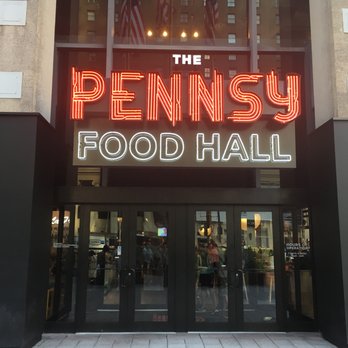
As noted, when my wife and I passed the Penny Food Hall in on Seventh Avenue in New York the other day, she remarked that she thought “food hall” was a Britishism, and it turns out she was right. The OED definition: “orig. Brit. a section of a department store or shopping complex where groceries, esp. speciality and luxury products, are sold.” The first citation is from an advert in The Times in 1925: “You are invited to taste..any of the delicious jams, tinned fruits and so forth in Harrods Food Halls.” (And it was the wonderful Harrods Food Hall that my wife was specifically thinking of.)

By contrast, the OED defines “food court” this way:orig. U.S., an area in a shopping mall, airport terminal, etc., containing a variety of fast-food outlets and a shared seating area for their customers.” So: food halls offer groceries, and food courts prepared foods. The first citation for the latter is from the LA Times in 1979, when malls were just starting to boom.

“Food hall” penetrated the U.S. no later than 1976, when a New York Times article about Cambridge, Mass., describes a retail emporium called the Garage:In the food hall section … is Formaggio, where you can buy 130 kinds of cheese as well as imported meats, pâtés, smoked fish and inventive sandwiches on home‐style breads.”

American cities, especially New York, have seen an incursion of upscale food halls in recent years, offering (in my experience) almost exclusively prepared food that you eat there. The Pennsy Food Hall, for example, has six such spots, and no fishmongers or greengrocers:

venu

A New York Times article in September 2017 addressed the trend:

Determined to provide experiences that will attract consumers and persuade them to open their wallets, developers are opening more food halls, the food court’s up-and-coming sibling, which are in the midst of a robust expansion.

Unlike food courts made up of fast food chains, food halls typically mix local artisan restaurants, butcher shops and other food-oriented boutiques under one roof. Many celebrate quirkiness versus uniformity, and their ability to draw crowds is particularly appealing to landlords battling the growth of e-commerce and changing shopping habits.

But it’s not just Americans who have changed the meaning of “food hall.” The last time I was at Harrods, I sat down and had a lovely afternoon tea.

Spotted in New York

I traveled up to New York City from my home near Philadelphia the other day to see the Broadway smash Hamilton. Great show! Unfortunately, what’s in my head now is the earwormy King George song, “You’ll Be Back.” Hopefully it will be out by the end of the decade.

Strolling the streets of New York I encountered a medical practice called Bespoke Surgical.

bespoke

Then, next to Madison Square Garden, I passed the Pennsy Food Hall.

hall

I thought nothing of it, but my wife (correctly) pointed out that “food hall” is of British origin. A post is to come.

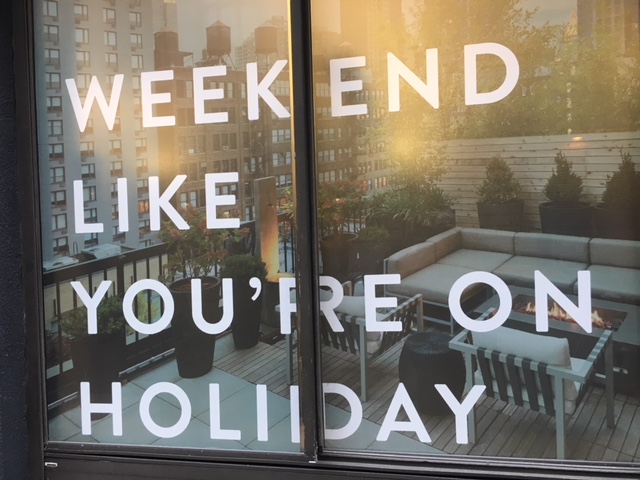
At that point I started taking my own pictures. Here’s an ad in an apartment house’s ground-floor window:

IMG_5946

(For more on “holiday” as British for “vacation” click here.)

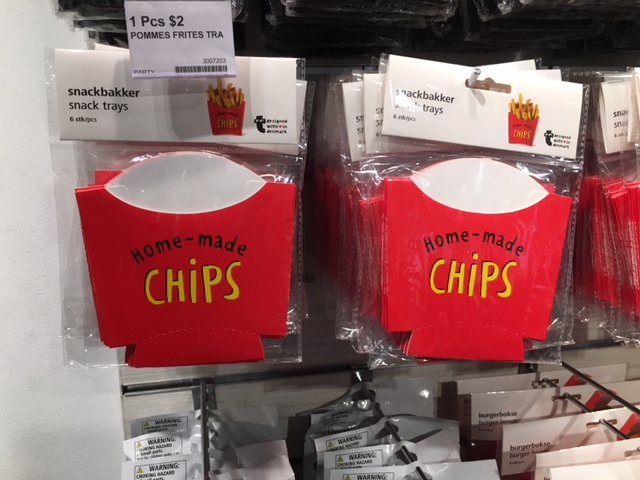
Finally, the Flying Tiger store on lower Broadway is selling these containers for what Americans call French fries or just “fries.”

IMG_5945

I realize Flying Tiger is Danish, but still.

“Chattering class/es”

I could have sworn I’ve done a post on this one, but apparently not, so here goes. The OED‘s definition and first three citations:

chattering classes  n. (occasionally also in sing. chattering class) freq. derogatory members of the educated metropolitan middle class, esp. those in academic, artistic, or media circles, considered as a social group freely given to the articulate, self-assured expression of (esp. liberal) opinions about society, culture, and current events.

1980   F. Johnson in Now! 21 Mar. 48/1   The peculiar need for something to be frightened about only seems to affect those of us who are part of the chattering classes.
1990   R. Crichfield Among British vii. 457   The old Britain of Eton, Oxbridge, the land, and the Guards, allied with a chattering class of literary intellectuals, so invaluable when it came to running an empire, is deadly when it comes to bringing the country into the 1990s.
1994   Daily Mail 18 July 8/2   A battle between Middle England—the sensible heart of the British middle classes—and Islington Person, the politically correct voice of the chattering classes.

Tooling around Google, I found a use that antedates the OED‘s first cite by more than a century, in an 1871 article in The Spectator called “The New Indian Danger”: “… and everything seemed to grow dear at once, to the immense disgust of the chattering classes who bought …” It’s clearly an outlier–nobody picked up on it–but it’s there.

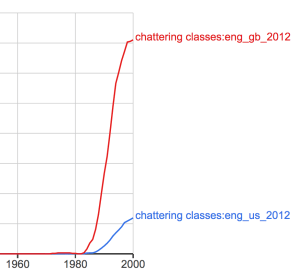
In any case, the phrase is definitely of British origin. This Google Ngram Viewer chart shows it picking up popularity in the US starting in the 1990s, though still lagging far behind Britain.

Screen Shot 2018-05-05 at 11.00.55 AM

Ngram Viewer only offers reliable data through 2000, but “chattering class/es” has definitely picked up steam in the U.S. since then. In the New York Times, one or the other variants phrase have been used 295 times post-2000, most recently in a review of a book on Hillary Clinton’s campaign that appeared April 24 of this year: “… while the chattering class may be intrigued by, for example, Clinton’s flirtation with ABC’s David Muir, ordinary readers may find themselves swimming in references to journalists and staffers who are far from household names.”


“Gastropub”

Here’s the third and final (after “bestie” and “flummox“) entry in a series of posts based on words I only realized were Britishisms after reading Lynne Murphy’s book The Prodigal Tongue. They represent a sort of blind spot, or koan, for your humble blogger: if a word or phrase is prevalent in the U.S., how is one to realize that it’s of British origin? Sometimes I encountered it in the U.K. years before hearing it here; sometimes it just has a telltale whiff. Other times, you just have to rely on Lynne Murphy.

And so with “gastropub,” meaning, basically, a bar that purports to serve good food. If I had thought about it, I probably would have realized it’s British, as it’s the British who have proper pubs. In any case, according to the OED, it popped up no later than April 1996, when the (London) Evening Standard wondered: “Will stale pork pies and reheated bangers ever be axed from pub menus? The rise of the gastro-pub suggests that, one day, they might.” The term fairly quickly lost its hyphen.

It crossed the Atlantic in 2003. I can pinpoint the date (as well as the person who brought it over) because in November of that year, the New York Times reported:

April Bloomfield …, a 28-year-old English chef and alumna of the River Cafe in Hammersmith, just outside London, spent the summer in the kitchen of Chez Panisse in Berkeley, Calif., preparing for her new job in New York. She will be cooking at The Spotted Pig, a gastropub at 314 West 11th Street, when it opens in a couple of weeks.

After Pig, the deluge. Gastropub has made 315 appearances in the Times since then, including in a 2015 article about a Long Island sports-gastropub called Brixx & Barley. Instead of fried chicken wings,

jumbo wings … are marinated in pineapple juice, beer, jalapeño, cinnamon and other spices for about 48 hours, baked in a brick oven to render off the fat and grilled to order. There are about 15 sauces available, including maple sriracha, Jamaican honey and garlic Parmesan.

“Flummox”

Lynne Murphy’s new book, The Prodigal Tongue, has plenty of blog-fodder, which I’m just starting to make my way through. As with “bestie,” I was surprised when she mentioned “flummox” as a Britishism, but once again, she’s right. For the most part.

It’s a word with a history, for sure. The OED categorizes is as “colloquial or vulgar” and gives as primary definition: “To bring to confusion; … to confound, bewilder, nonplus.” The first citation is a line of dialogue from Dickens’s Pickwick Papers, 1837: “He’ll be what the Italians call reg’larly flummoxed.” (There is no evidence that the word has any Italian derivation–it shows up in late nineteenth-century books described as provincial English slang.) Green’s Dictionary of Slang bests that by three years with this quote from the bawdy songbook Delicious Chanter: “Joe owned he was flummix’d and diddles at last.”

However, both Green’s and the OED note a roughly contemporaneous use of the word in the United States, with the meaning “give in, collapse.” The OED has this quote from the 1839 novel Green Mountain Boys, by the Vermont author Daniel P. Thompson: “Well, if he should flummux at such a chance, I know of a chap..who’ll agree to take his place.” The online version of Green’s Dictionary of Slang has a definition and citations (the first from Britain, the second from the U.S.) for another meaning of the word.

Screen Shot 2018-04-18 at 3.48.20 PM

I also found this “flummox” in a slightly later novel by Thompson, Locke Amsden, or The Schoolmaster: “‘Well, he was a mean scamp, for all that,’ replied the oldest boy; ‘and we should have shipped him, at one time, if some of the boys had not flummuxed from the agreement.”

In any case, the “confound” meaning and the “flummox” (rather than “flummux”) spelling got solidified in Britain and seem to have been taken up in the U.S. in the middle of the twentieth century. An early use in the New York Times came in a 1954 James Reston column: “The Democrats were frankly flummoxed tonight.”

As this Google Ngrams Viewer chart suggests, U.S. use began to really rise in the 1960s and caught up with and then surpassed British use just before the turn of the twenty-first century:

Screen Shot 2018-04-18 at 11.36.43 AM

“Bestie”

Lynne Murphy’s new book, The Prodigal Tongue: The Love-Hate Relationship Between British and American English, has a lot of insights and revelations, which I’ll have more to say about in a subsequent post. For today, I’ll just note Lynne’s inclusion of “bestie”–slang for best friend–in a list of British expressions. That surprised me, because it’s certainly all over the place in the U.S.

But she’s right. The OED says the word is “originally and chiefly British” and has as its first citation a 1991 quote from The Observer: “Diana’s friends often date from the days BC (Before Charles). Some are Besties—reliable pals from school.” That appears to be a bit of an outlier. The next cite is from a 2008 novel called Swingers, and that’s about when the word starts showing up in the Google Books database.

By that time, “bestie” was already out and about in the United States. The first use in the New York Times came in a 2007 Maureen Dowd column, complete with quotation marks and definition indicating it was new on the scene; Dowd referred to “Urbanista, an online Rolodex that dispenses advice for ‘hip’ girls in Manhattan, offering to be a ‘bestie’ (a best friend) and answer questions like ‘Where should I go to get my Marc Jacobs shoes reheeled?’”

The word appeared once in the Times in 2009 and 2010 and kept moving up: 2012, four times; 2013, five; 2014, seven; 2015, 13; 2016, 16; and 2017, 14. (The slight dropoff is probably explained by the novelty having worn off.) There’ve been three appearances this year, including a headline:

Kardashian Bestie Simon Huck Is Selling You Beer and Shampoo

I’d be interested if any readers–British or American–could recall a specific pre-2007 when you recall using, hearing, or reading “bestie.”

“Bits and Bobs”

As noted in the previous post, I was surprised to see Harvard historian Jill Lepore use “bits and bobs” in a New Yorker piece; the phrase seemed just too British to be used by an American. But to paraphrase John Lennon, Lepore is “not the only one.”

Backing up a bit, “bits and bobs” does not have its own entry in the Oxford English Dictionary, but is included in a larger entry for various expressions that include “bit.” It’s lumped with “bits and pieces” (very familiar to Americans) and “bits and bats” (not so) and defined as “fragments, oddments, odds and ends; small articles, personal belongings, bric-à-brac.” The first citation is an entry in A Warwickshire Word-book, 1896, which gave a sample sentence: “Gather up your bits-and-bobs, and let me lay the tea.”

However, I have found in the Google Books database a use that seems to precede that by two years. It’s in the novel Baptist Lake, by John Davidson (a Scottish writer):

For an hour and more, Mrs. Tiplady entertained Salerne with gossip — light, if a little muddy, like the froth of porter — with bits and bobs of music-hall songs and step- dances, and with caresses brief and birdlike — the wariest of landladies, deep in love with her viking as she was.

Google Books also suggests that “Bits and Bobs” was used as a chapter heading in a photography yearbook a year earlier, in 1893, but the date can’t be confirmed from what Google shows of the book.

On the matter of “bits and bobs” appearing in American sources, Google Ngram Viewer shows sporadic use in the twentieth century, with a gradual increase starting in the ’70s.

Screen Shot 2018-03-23 at 10.03.22 AM

The expression has been used 57 times in the New York Times, some but not all coming in quotes from British people. The first appearance is in a 1951 review of a children’s book about making puppets, using, for example, “the bits and bobs to be found in a young boy’s pocket.” And the most recent is in a December 2017 Vows column, which describes one of the two grooms: “He was always creative and enjoyed making crafts with bits and bobs of paper he had saved, ticket stubs and back-of-the-envelope doodles.”

In any case, it’s a useful expression, not quite the same as “bits and pieces”–which for me, anyway, always brings to mind the Dave Clark Five song. I imagine it’s here to stay.