“No worries”

In last week’s run-up to Thanksgiving, I wrote a post for the Chronicle of Higher Education’s Lingua Franca blog about the proliferating ways of saying you’re welcome. I focused on the eminently annoying Not a problem! and No worries!, the latter of which has periodically been suggested as an NOOB.

I have always resisted. Not because it isn’t popular in the U.S.; indeed, it is nearly inescapable. Rather, because it’s not a Britishism but an Australianism. According to Wikipedia: “‘No worries’ was referred to as ‘the national motto’ of Australia in 1978, and in their 2006 work, Diving the World, Beth and Shaun Tierney call ‘no worries, mate’ the national motto of the country.

But looking into the matter I see that the the phrase itself has deep British roots. The Times used it 463 times between 1785 and 1985–for example, in the 1970 headline NO WORRIES FOR CELTIC. The Aussie innovation–now picked up in the U.S., with a vengeance–may have been to isolate the two words as a response to thank you or I’m sorry.
On the radar: “xx”

My college-student daughter Maria informs me that in Facebook birthday greetings, the normal salutation is xoxo, meaning, “hugs and kisses.” But she says that every one of her friends who has studied in England–as well as all their English friends, and increasing number of people who seem to want to sound English–merely write xx, meaning, presumably, “kisses.”

This bears further study. I wonder if it relates to the hugging epidemic that reached American shores a decade and a half ago. Has it not gotten to the U.K–do acquaintances merely kiss there on greeting each other, and eschew body-on-body content?

In any case, I fancy–and note the writer’s use of the word fancy, suggesting English origin–the definition of xx on urbandictionary.com:

Something every girl says. If she says it to you, you’re not special, she doesn’t fancy you, shut up.
Tom : Hiiiiiiiii :D:D HI
Mel: hi do i know u…
Tom: HOW ARE U !
Mel: Im ok soz g2g bye xx
(Mel signs out, or blocks tom)
Tom (to other friend) HIIII MAN MEL JUST SAID “xx” TO ME!
friend: And?
Tom: SHE LIKES ME
friend: No she doesnt shut youre mouth.

“Massive”

I first became aware of massive as a Britishism about ten years ago, when I interviewed the English tennis player Tim Henman and he used the word roughly every third sentence. The Britishism, I should point out, is not the adjective in the traditional meaning of very big but its use, in the OED’s words, “in weakened senses: far-reaching, very intense, highly influential.” The OED cites the periodical “Sound” in 1984: “Personally, I’m convinced the Immaculate Fools are going to be massive.” Massive Attack (I quote from Wikipedia because I am not conversant with the terminology and because of plural verb for a collective noun makes me weak in the knees) are an English DJ and trip hop duo” that began operations in 1988.
Weakened-massive got on my radar as an NOOB when I read an October 2, 2011, article by David Hiltbrand in the Philadelphia Inquirer. Hiltbrand was interviewing the British actor Damian Lewis, who said of a character he played, “Brody is treated as a war hero but he’s carrying a massive secret.” Then, just two paragraphs later, Hiltbrand himself picks up the word, referring to a “massive cattle call for [the miniseries] Band of Brothers.”

Here’s a relatively early American use: The series [“Survivor: All Stars”] made its debut immediately after the game, and minutes after the first contestant was bounced from paradise, an anonymous gremlin posted a massive ”spoiler” on the entertainment Web site Ain’t It Cool News — a detailed list of upcoming plot twists. (Emily Nussbaum, New York Times, May 9, 2004)

“Larky,” “Larking”

It's a jolly holiday with Mary

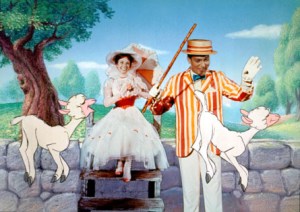
The OED definition of larky, adj.: “Inclined or ready for a lark; frolicsome, sportive.” The verb form is commonly used in the gerund and followed by about. As Julie Andrews’ Mary Poppins famously instructed Dick Van Dyke’s Bert in the Disney film (words and music by Richard M. and Robert B. Sherman): “None of your larking about!”

It is a portrait of the larky upper-class sleuth of King’s College, Cambridge, and his thunderous middle-class quarry at the red-brick University of Newcastle. (Richard Eder, New York Times, August 13, 2000)/…Robert Wagner, who enjoyed his biggest success on Hart To Hart and It Takes A Thief, this larky series about an urbane jewel thief recruited to steal for the government when they’re not free to act. (Huffington Post, November 17, 2011)

“Barmy”

The diction of mental instability is rich indeed. Already NOOBs has covered daft, nutter,  and mad; now comes barmy. The etymology is interesting. From the mid-nineteenth century through the early twentieth, the adjective balmy was commonly used to mean (in the OED’s words), “weak-minded, idiotic.” In due time, this combined in the public mind with barmy, an obscure term derived from barm, that is, “the froth that forms on the top of fermenting malt liquors,” which had been metaphorically, but sparingly, used to mean  “flighty” or “excited.”

By 1896, the confusion about the two words was such that a writer in the Westminster Gazette asked, “Should not ‘balmy’ be ‘barmy’? I have known a person of weak intellect called ‘Barmy Billy’.‥ The prisoner‥meant to simulate semi-idiocy, or ‘barminess’, not ‘balminess’.” As he suggested, barmy has since prevailed, no doubt in part to the felicitous barmy army, used to refer to political factions or supporters (a NOOB?) of particular teams.

The weak spot, whose center is off the coast of Brazil, is called the South Atlantic Anomaly, or S.A.A., and it has created a Bermuda triangle of space science. Under its influence, spacecraft can go barmy, losing data, having computer upsets and seeing ghostly images where none exist. (New York Times, June 5, 1990)/Our colleague Ron Charles checks in with Shakespeare scholars, who say Roland Emmerich’s “Anonymous” theory is half-snobby, half-barmy. (Washington Post, October 31, 2011)


“Whinge”

Complain, kvetch, whine, moan. Most often used in gerund form, i.e., whingeing. Interestingly, in U.S., spelling is frequently given as whing and whinging, which, sensibly (as the first g is soft, as in fringe), have not been common in U.K. in recent decades.

… money alone won’t do it [produce happiness]. Listen to the poor rich lottery winners whingeing away. (The word whinge, as used in my poker game, is a whine from a winner.) (Walter Goodman, New York Times, April 15, 1996)/And as much as I adore Sheldon’s persnickety nature, watching him devolve into a whingeing man-child, bitching about his mother not making him fried chicken or pecan pie, kept what had the potential to be a top-flight episode from ever taking off. (Entertainment Weekly, “Big Bang Theory Recap,” October 20, 2011)

NOOB Much?

“[Andrew] Stanton is ginger-haired, candid, and boyishly eager.”–Tad Friend, “Second Act Twist,” The New Yorker, October 17, 2011

“They settled in Los Angeles, where he’d got a glamorous, welcome-to-show-biz job…”–ibid.

“The task of adaptation was further complicated by [Edgar Rice] Burroughs’ racial bushwa, Mad Libs terminology … and general barminess.”–ibid.

(Note: in the above sentence, bushwa is 100 percent American slang.)

The “Bumbershoot” Conundrum

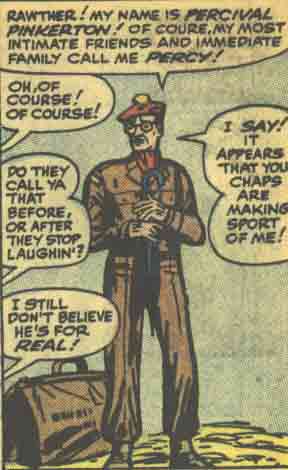
Percy Pinkerton, of Sgt. Fury's Howling Commandoes

(I wrote an essay for the online magazine Slate about whether bumbershoot is or is not a Britishism. The first two paragraphs are below.)

In my recent Slate article about Americans using more Britishisms, I wondered aloud, “Why have we adopted laddish while we didn’t adopt telly or bumbershoot?” More than one English person responded to this query with another: “Bumbershoot? What do you mean, bumbershoot?”

I told them I had always thought of this funny term for umbrella as one of those words, like cheerio and old man, that the stage Englishman is required to say. My wife had the same impression. But when I looked into the matter, I learned that we were apparently misinformed. The Oxford English Dictionary identifies the word as “originally and chiefly U.S. slang.” And the digital archive of the Times of London, comprising 7,696,959 articles published between 1785 and 1985, yields precisely zero hits for bumbershoot.

(To read the rest of the article, go to Slate.)