From an NPR report this morning, about a Washington State man who confronted and then was shot by a gunman in a shopping mall:
“The first word that went through my head was ‘Bugger!’ Clearly, too much British TV.”
I categorize this one as an outlier because, as the gentleman’s comment indicates, the word has not penetrated (pardon the expression) U.S. usage yet, either as an interjection, a verb or an adverb (“And the pain, the hellish pain, of spending all that money, and getting bugger all in return,” The Sunday Times, 2002).
The BBC provides this explanation and definition of the term:
The vast majority of parliamentarians do not hold ministerial or shadow ministerial office and are known as backbenchers. They are so-called because they sit on the back benches of the Commons or Lords – ministers and their opposition counterparts sit on the front benches.
The OED cites a first British use in 1910, and more than a century later it’s unavoidable in the U.K. and other countries with a Parliamentary system. But it took a long time for Americans to start to use the the term to refer to their own politicos. The moment finally arrived in in 1988 (at least in the archives of the New York Times), and the person who used it was none other than Representative Newt Gingrich, who had filed ethics charges against Speaker of the House Jim Wright. Gingrich (whose fondness for another Britishism has been covered on this blog) was quoted in the Times as saying: ”If Jim Wright were a backbench member, I probably wouldn’t have done anything…. But he’s the Speaker, and everything he could have done all his life as a backbencher becomes self-destructive when he becomes third in line to be President of the United States.”
The first time a Times reporter called an American a backbencher was four years later. Now it’s a commonplace. Four of the last six times the term’s been used in the Times have been in reference to Americans, most recently a January, 5, 2013, Ross Douthat column in which he noted that Speaker John Boehner’s “own backbenchers blew up his attempt at a fiscal cliff negotiating maneuver.”
It’s a useful term, but it bit less potent than in the U.K. since here, it’s not only metaphorical but untrue: since 1913, members of the U.S. House of Representatives have been allowed to sit anywhere they want.
I wrote this for the Lingua Franca, the blog I contribute to at the Chronicle of Higher Education. The post is below, followed by some subsequent reflections:
The expression po-faced has achieved, as expressions sometimes do, a vogue. The following quotations all appeared in print in the last 15 months:
“And it is satisfying to be allowed to hoot publicly at a man who is likely to remind you of every po-faced schoolteacher who told you to stop giggling.” (New York Times theater review.)
”To me, the scurrilousness has the pasty complexion of po-faced error. The worry, the criticism, feels tacky and fatuous.” (Darin Strauss, New York Times, on the supposed death of literary fiction.)
“Rather than coming off all po-faced and ‘I told you so,’ the 2012 edition of Muse is instead busy smirking, raiding the mini-bar and slurring ‘I told you so.’” (Buffalo News.)
“But 2011 has brought a crop of foreign-language films in which po-faced pedantry has taken a back seat to dynamic storytelling.” (Variety.)
” … a yearning Irish busker and a po-faced Czech pianist.” (New York Post, review of the musical play One.)
If you don’t know what po-faced means (as I did not the first couple of times I came across it), the examples won’t be very helpful in instructing you. TheOxford English Dictionary‘s definition is, “Characterized by or assuming an expressionless or impassive face; poker-faced; (hence) humourless, disapproving.” The first citation is from Music Ho!, a 1934 book by the British composer and critic Constant Lambert, and suggests an origin not long before that: “I do not wish, when faced with exoticism, to adopt an attitude which can best be described by the admirable expression ‘po-faced’.”
That the OED is far from certain on the expression’s origin can be gleaned from the fact that, in a two-line etymological note, it uses the word perhaps four times. Perhaps it derives from the interjection poh (or pooh), or perhaps from the noun po, meaning chamber pot. Or perhaps it’s a shortening of poker-faced. A comparison to pie-faced could be useful as well. Perhaps.
I don’t find any of these convincing, to tell you the truth. The first doesn’t jibe with the early uses. The interjection-derivation rings slightly truer (po-faced as one who says “poh”), but why would the h be dropped in the compound word? And those early uses are all British, while poker-faced and pie-faced are Americanisms. The OED defines the latter as, “Having a round, flat face or a blank expression; stupid”; all the early citations are in reference to babies or children.
Searching through Google Books, I found this in Who’s There Within?, a 1942 novel by the British author Louis Golding (1895-1958): “But how could she act like that, like an outraged Victorian matron, how could she? How could she be so po-faced! (She was using the favourite word of the Bohemians in the London of the early twenties, the Cave of Harmony, and Harold Scott, of Elsa Lanchester, and all that.)”
I mentioned all this to my daughter Elizabeth Yagoda, a teacher of history and a keen student of the Bright Young Things. She mentioned the post-Great War generation’s fondness for abbreviations and acronyms, and speculated that po-faced may have originally been p.o.-faced, though she didn’t have a thought on what p.o. may have stood for. I will go with that till proven otherwise, and, naturally, welcome opinions and speculation.
Not only Elizabeth but all the Americans to whom I’ve mentioned po-faced initially thought that the first word was a Southern rendition of poor (as in the New Orleans po’ boy sandwich) and that the term was related to the familiar American verb poor-mouth, meaning (the OED says), “The action of claiming to be poor, or of belittling or understating resources, abilities, etc.”
I initially had that sense, too. But that can’t be the case if the expression was created by London Bohemians in the 1920s. However, I believe recent American adopters have somewhere in the front or back of their minds a po-faced/poor-mouth relationship. That is, to them, po-faced is an attitude characterized by some sort of combination of impassiveness, disapproval, and feigning of poverty or humility.
Clearly, further research is called for. For the time being, I’ll merely note that the second use by a New York Times staff member (the first was in 1984 by the columnist Anthony Lewis, a well-known Anglophile) came in a 1988 piece, datelined London. Howell Raines—a Southerner who would later become the Times’ executive editor—wrote about a British performer who adopted the identity of an American named “Hank Langford”Wangford”–a “self-described ‘po-faced’ country singer.” Can anyone doubt that in his mind Raines connected po and po’?
Quintin Hogg in his later years
I’ll close with the observation that no matter how popular po-faced becomes on these shores, no one can use it like a Brit. A case in point is the Conservative leader Quintin Hogg (1907-2001), otherwise known as Baron Hailsham of St. Marylebone, KG, CH, PC, QC, FRS. In 1966 The Times of London reported:
Mr. Hogg said at Watford that he had been given five new walking sticks since he broke his at Chiswick on Mr. Wilson’s portrait. [Apparently a Labour supporter had waved a Harold Wilson placard in Hogg’s face, whereupon he struck it with one of the two canes he employed, owing to the many times his ankles had been injured while he was engaged in his favorite pastime, mountain-climbing.] “Politics should be fun,” he said. “Politicians have no right to be pompous or po-faced.”
Additional thoughts:
First, I found a use of po-faced nearly a quarter-century earlier than the OED’s 1934 cite. Surprisingly, it was in an American novel, The Annals of Ann (1910), by Kate Trimble Sharber. A character named Mammy Lou is speaking (“Mammy” being a term for an African-American female servant) about the suitability of a certain gentleman as a marital prospect”
“But, honey, he is tolerable po-faced, which ain’t no good sign in marryin’. If thar’s anybody better experienced in that business than me and King Solomon I’d like to see the whites o’ ther eyes; an’ I tell you every time, if you want to get a good-natured, wood cuttin’, baby-tendin husban’ choose one that’s fat in the face!”
So she’s using po-faced to mean more or less gaunt. Since this doesn’t show up anywhere else, and since the Bright Young Things most likely weren’t reading obscure American novels, I would take this as a rare, possibly unique, piece of regional dialect.
When the Lingua Franca piece appeared, the prolific and valuable language commentator Stan Carey posted a comment that the American HeritageDictionary was a bit more definitive than the OED about etymology, stating that the term comes from pot (pronounced “po”) de chambre, French for chamber pot, “a po-faced expression being likened to that of a person observing the contents of a chamber pot with disgust.”
On reflection, I am inclined to accept this hypothesis. The OED has an 1880 citation for po-as-chamber pot (in a dictionary of the Scottish Language, interestingly), and a use of it by Leonard Woolf in a letter written in 1905 (a time when Woolf, having graduated from Cambridge, was serving in the Ceylon Secret Service): “I have to help to see that King’s House is prepared for him, to reckon out how many fishknives & pillow cases & pos he wants.”
Faithful reader Wes Davis sends along a link to the outstanding American public radio show “This American Life.” He explained that the show’s staff “got a tip that hog rectums [known in the trade, collectively, as “bung”] were being sold as calamari and they set out to investigate the story.” Wes said that at roughly the 8:30 point in the segment, a NOOB erupted.
The reporter, Ben Calhoun, is talking to Ron Meek, an employee at a meat processing plant who confirms having been told that such a calamari bait-and-switch had indeed taken place. From the transcript available at the show’s website:
Ben Calhoun: And is there any possibility that you think that when they were explaining this to you, that they were kind of having you on a little bit?
Ron Meek: Having me on?
Ben Calhoun: Yeah, like–
Ron Meek: Bullshitting me?
Ben Calhoun: Yeah.
As Wes says, “It’s great because the exchange comes with a built-in reminder that American English already has a perfectly serviceable way of saying ‘having you on.'” (The OED has an 1867 first citation for the phrase and defines it as: “to puzzle or deceive intentionally; to chaff, tease; to hoax.”)
Indeed, AmE is especially rich in words denoting cheating and/or lying, which is one reason I am naming this one an Outlier. And Ben Calhoun doesn’t get any dispensation for using it by virtue of his heritage or education. Wikipedia says he was born in 1979 in Milwaukee, Wisconsin and now lives in Brooklyn, New York–which is, of course, the most enthusiastic U.S. outpost of NOOBs.
Incidentally, later in the episode–which is very funny and highly recommended–Calhoun has an exchange with his sister Lauren, a chef, in which they each use a NOOB. They are staring at bung in a butcher case:
The OED’s first citation for this adjective comes from the 1964 movie tie-in The Beatles in A Hard Day’s Night, by John Burke, and helpfully includes an etymology and partial definition: “‘I wouldn’t be seen dead in them. They’re dead grotty.’ Marshall stared. ‘Grotty?’ ‘Yeah—grotesque.’” The OED’s full definition: “Unpleasant, dirty, nasty, ugly, etc.: a general term of disapproval.”
A Google Ngram graph shows that grotty is a dead Britishism, with steadily increasing U.S. use. That appears to have picked up in recent years, including in a piece about the HBO series “Girls” in today’s Philadelphia Inquirer: “Hannah is still waiting hand in foot on Adam (Adam Driver) in his grotty apartment.”
An April 2012 New York Times theater review by Eric Grode says the play’s setting, in “a wood-paneled living room in Paterson, N.J., is more strip mall than Vegas Strip. (Mimi Lien contributed the suitably grotty set.)”
The reviewer’s name reminds me that there is more or less exact American equivalent, spelled, variously, grody, groaty, groady, and groddy, with all but the last rhyming with toady. The OED’s first cite for this is a 1965 Houston Chronicle but it gained immortality in the early ’80s, via Valley Girl Moon Unit Zappa and her immortal phrase “grody to the max.”
Is there any difference between grotty and grody? I leave a definite answer to wiser heads than mine, but I will note that all the OED definitions of grody refer to people and all but one of grotty refer to places.
A letter to the editor to my local weekly newspaper, The [Swarthmore, Pennsylvania] Swarthmorean, starts off this way:
Why is the college not using all the available space on the campus for a new car park?
If the present car park were expanded, it could accommodate many cars.
It was signed “Dorothy Moffett.”
I do not know if Ms. Moffett is British, but I suspect she is, because I have never encountered an American who uses car park instead of one of our two alternatives, parking lot and parking garage.
But I found that the term at one time has some currency in the U.S.–at least among headline writers, who are always looking for ways to trim words and phrases. A 1953 New York Times headline reads “City Set to Start Metered Car Park.”
The only recent U.S.-datelined use in the Times came in a 2011 style-section piece about the Art Basel Miami Beach festival: “The event was originally scheduled to take place at a mansion on Indian Creek Island but ended up, more conveniently and also more appropriately, at the Herzog & de Meuron car park at 1111 Lincoln Road.”
1111 Lincoln Road
And in that case, parking garage is hardly sufficient. Here is how Wikipedia’s description of the seven-story, $65 million Miami Beach facility begins:
The design has been characterized as resembling a house of cards. It is an open-air structure with no exterior walls constructed around buttresses and cantilevers that features floor heights varying from 8 to 34 feet.Some of the internal ramps are quite steep in order to accommodate the wider height intervals. Elevators and a central, winding staircase take drivers to and from their cars.A glassed-in high-fashion boutique sits on an edge of the fifth floor.The parking garage features retail space at the street level, with tenants such as Maxposure Media Group, and is joined to another structure at the same address that serves as an office for SunTrust Banks.[Developer Robert] Wennett has built a penthouse apartment for himself as part of a 18,000-square-foot (1,700 m2) space on the structure’s roof that also features a pool and gardens with hanging vines.
This word–meaning, basically, a really bad, pervasive cock-up–was invented in 2009 by the writers of the British TV series “The Thick of It.” Then it caught on. As the Financial Times has noted:
Tearing into the UK government’s budget, opposition Labour leader [Ed Miliband] detailed a list of fiscal shambles – an admittedly impressive array of gaffes from the taxes applied to hot pasties to caravans, from donations to charities and churches – before concluding that the end result was, you guessed it, an omnishambles.
The barb was well timed. The charge of omnishambles was quickly extended to pretty much all aspects of a government that had been granted the benefit of the doubt as it stuck with unpopular austerity policies but whose competence was now in question. The neologism even spawned neo-neologisms. A dispute about whether an independent Scotland could be an EU member became Scomnishambles; a row about badger culls became omnivoreshambles. A flip across the Atlantic to a series of gaffes by the Republican presidential contender gave us Romneyshambles.
In late 2012, omnishambles solidified its triumph by being chosen Word of the Year by the Oxford English Dictionary.
It has still not had much traction in the U.S., however. Other than reporting on the OED’s selection, the New York Times has used it only one time, in a December 24, 2012, blog post.
Shambolic, meanwhile, proceeds apace. Reader Peter Hirsch notes: “Two mentions by Jon Meacham on ‘Meet the Press’ this weekend had even the moderator puzzled.”
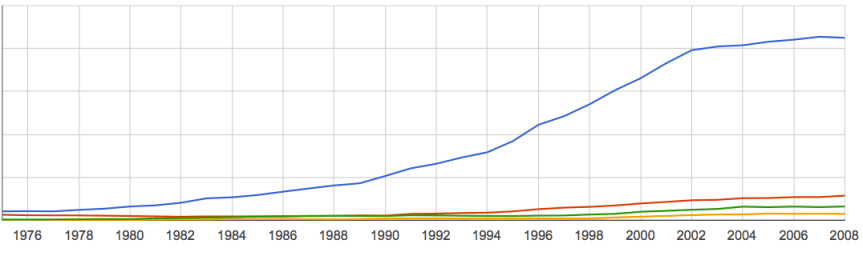
The expression is a compound adjective that, according to the OED, is “used with reference to a comparison of figures with corresponding ones for a date twelve months earlier.” The dictionary’s first citation is from a 1976 article in the Daily Telegraph: “It is hoped this will show a year on year rise in average earnings of between 14 and 15 per cent.”
The Google Ngram chart below showing use of year on year between 1975 and 2008 suggests it is both a Britishism (the blue line represents British use) and a NOOB (the red line, showing U.S. use, climbs steadily starting in the mid-1990s).
Certainly, it’s often been seen in U.S. financial pages in recent months, for example:
“Consumer spending suffered its sharpest year-on-year drop since World War II, according to Italy’s leading business association.” New York Times, December 12, 2012
“Home values in San Francisco have been growing on a year-on-year basis for four consecutive months.” San Francisco Chronicle, November 2012:
Interestingly, year on year has an (as far as I can tell) exact synonym: year over year. This one is an American speciality (to use a Britishism which has not yet appeared here). U.S. use of year over year is the green line in the chart, British use the yellow line. An example from the Associated Press, December 26, 2012: “October was the fifth straight month of year-over-year gains, after nearly two years of declines.” And the New York Times, December 28, 2012: “The pace of rental growth year over year has also slowed.”
The two expressions seem to be battling it out on these shores. I predict over will ultimately prevail. We like our literalisms even more than our Britishisms.
In a mere five paragraphs in yesterday’s New York Times, Neil Genzlinger writes that on January 21, the actor Kevin Bacon “turns up as the star of a new series on Fox, ‘The Following’”; that the villain of the series has “a knack for bewitching attractive women, who would later turn up dead, their eyes gouged out”; and that the series is similar to “Alcatraz,” a Fox series “in which investigators had to track down scores of inmates and guards who vanished from Alcatraz in 1963 and began turning up in the present.”
Genzlinger also writes that the bad guy “seems always to be one bloody step ahead,” but he’s probably being literal.
I have remarked on the fondness of young Americans–especially African-American rappers and/or people from the New York metropolitan area–for the glottal stop. Now it appears that another of Cockney characteristic, th-fronting, is ready for its U.S. closeup.
Th-fronting is a feature of Cockney–and now, apparently, of Estuary English–in which a th sound is pronounced like an f (as in I fink instead of I think) or v (as in the way the TV show “Big Brother” is commonly referred to in U.K. red-top tabloid headlines: “Big Bruvva”). Sacha Baron Cohen’s Ali G is a heavy user, and it’s been prominent recently in hip U.S. references to the Rolling Stones guitarist Keith Richards as “Keef.”
That same word actually represents the only indigenous U.S. use I’m aware of. It’s in the name of a teenage rapper from Chicago: Chief Keef. His website reports that he was born Keith Cozart but is silent on how Keith became Keef.
NOOB readers are a clever lot, and among them are probably one or two hip-hop fans. If so, I would be grateful for any enlightenment on the phenomenon of th-fronting among the rappers.



 notoneoffbritishisms.com