Much Ado About Not Much?

Geoffrey Pullum–the distinguished grammarian and my fellow contributor to the Chronicle of Higher Education’s “Lingua Franca” blog–has a post up there today asserting that the so-called differences between American English and British English are exaggerated. He writes:

… most trans-Atlantic differences either involve nothing more than pronunciation (most Americans pronounce the r of car and have the vowel of hat in words like glass, and the majority of British speakers don’t), or are merely differences in word choice, almost always choices among nouns (in Britain a truck is often called a lorry, though truck occurs as well).

He does acknowledge a couple of grammatical differences:

Americans like using the preterit rather than the perfect in clauses reporting past time with present relevance (I already did that), whereas British speakers clearly prefer the perfect (I’ve already done that). But speakers of both varieties can always understand both constructions. Closer to being absolute is the limitation to British English of the special use of the verb do in cases of omitted verb phrases, as in I don’t know if she understands French, but she may do. Americans would say she may, without that final do.

That’s admittedly not much, and he concludes, “the tiny differences between standard American and standard British English are trivial, barely even worth mentioning.”

Trivial, you say?  Well, I’ve got 800,000 page views (as of today) that say NOOBs are very much worth mentioning. Anyway, that’s my story and I’m sticking to it.  Will Pullum apologize? I’m not sure, but he should do.
“Stand” someone a drink

I recently encountered this Facebook post (by an American, about an American): “Anyway, I just wondered if any of my Facebook friends in NY feel like standing a good friend of a friend to a drink? Jeff’s a blast, and any friend of mine oughta be a friend of his…”

The verb stand, as used here is defined this way by the OED: “To bear the expense of, make a present of, pay for (a treat); to put up or make a present of (a sum of money), esp. as part of a larger amount sought.” The first citation is from Dickens, Sketches by Boz (1836): ” Mr. Augustus Cooper..‘stood’ considerable quantities of spirits and water.” The quotations marks indicate recent coinage. The dictionary also has this 1890 quote from Lippincott’s Monthly Magazine:  “I’ll stand you a dinner.”

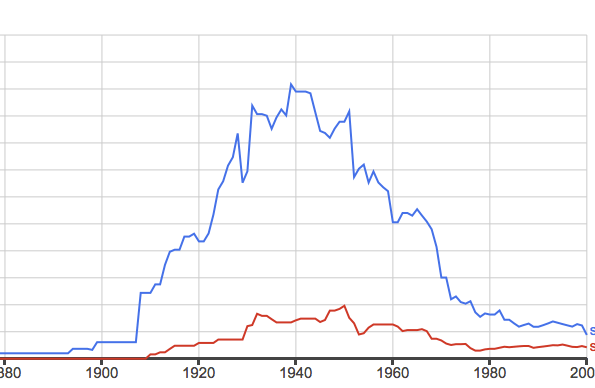
Google’s Ngram Viewer indicates the term is a Britishism, though one that started fading out around 1940. (The blue line indicates use of “stood me a drink” in British English, the red line in American English.)

Screen Shot 2014-03-10 at 3.36.03 PM

Some readers will have noted that my Facebook friend misused the expression,  talking of standing the gentlemen “to” a drink, when the proper expression is “stand him a drink.” That’s all the proof I need that this expression is a one-off.

“Worrying”

A syndicated columnist called The Word Guy (TWG) recently wrote the following:

A network-news correspondent recently described a medical issue that has led doctors and researchers to a “worrying conclusion.” Now, I’ve never seen a conclusion worry. I’m wondering whether it knits its brow, rubs its head, and grits its teeth.

 More and more people are using “worrying” not to mean “fretting” (“a worrying mom”) but “causing fretting” (“a worrying event”). “Worrying” joins other participles that have recently flipped in meaning, e.g., “these problems are very concerning.”… Frankly, I’m worrying about these worrying trends.

I have the same impression as TWG that concerning and worrying are on the rise as adjectives. And, indeed, Google News searches for each pull up examples on the first screen:

  • “The Mystery of Andros Townsend’s Slump Is Worrying for England and Spurs” (headline from Bleacher Report)
  • “In any of those situations, it’s very concerning. Up until we get all of the facts, we will let the process run its course.”—General Manager of the Baltimore Ravens Ozzie Newsome, on the arrest of the team’s player Ray Rice (ESPN.com)

To my mind, the conventionally “correct” alternative to both would be either troubling or worrisome. Google Ngram Viewer (showing the relative frequency of each term in printed English sources) gives some surprising results. (I put the word very in front of each word so as to get only adjectival uses.)

Screen Shot 2014-02-25 at 7.33.41 PM

I was struck by the relatively recent ascendance of troubling and worrisome, but the big surprise was the relatively long tail of worrying. When I told Ngram Viewer to search only in British books, here’s what I got:

Screen Shot 2014-02-25 at 7.45.07 PM

A NOOB, a palpable NOOB!

The OED shows, not surprisingly, that both words TWG found problematic have been used as adjectives for a long time. We find worrying (as well as figurative literally!) in Frederick Reynolds’s Life & Times (1826), “Your whole conduct is literally worrying and annoying in the extreme,” and concerning in Coleridge’s Literary Remains (1839): “To utter all my meditations on this most concerning point!”

Beyond historical precedent, TWG’s objections are specious. If he thought about it for a minute, he would realize that he had indeed seen a conclusion worry, e.g., “The researcher’s conclusion worried his collaborators.” Indeed, it is customary, when a person, situation, or thing emotionally verbs someone, to describe that person, situation, or thing as verbing. Think of perplexing, frightening, amusing, touching, exciting, etc. The only counter-examples that come immediately to mind are scary and awesome. The varied usefulness of worry is probably what led to the delayed arrival of worrying the adjective, just as the prominence of concerning in the sense of “having to do with” delayed that new meaning.

In any case, whether you find it concerning or not, it seems clear that these adjectives are here to stay

“American football”

ImageI meant to note a Britishism uttered on my favorite television show, The Simpsons, a few of weeks ago. I figure that two days after the Super Bowl is about the right time! In the words of the recap on Celebrity Cafe:

Lisa emerges in the kitchen with a book titled “Pretending to Like Football” by Mrs. John Madden. Lisa dishes out a fact about “American football” before Bart interrupts her saying that it’s not “American” football; it’s just football. Lisa rubs it in that Milhouse invited her to the “American” football game instead of Bart. And Bart tattles on Lisa to Marge.

Congrats to the Seattle Seahawks side and their supporters for a brilliant match.

Lisa emerges in the kitchen with a book titled “Pretending to Like Football” by Mrs. John Madden. Lisa dishes out a fact about American football before Bart interrupts her saying that it’s not “American” football; it’s just football.

Lisa rubs it in that Milhouse invited her to the “American” football game instead of Bart. And Bart tattles on Lisa to Marge.

Read more at http://thecelebritycafe.com/feature/2013/11/simpsons-recap-labor-pains#1w1VrtCrQvlwo4Lw.99

Lisa emerges in the kitchen with a book titled “Pretending to Like Football” by Mrs. John Madden. Lisa dishes out a fact about American football before Bart interrupts her saying that it’s not “American” football; it’s just football.

Lisa rubs it in that Milhouse invited her to the “American” football game instead of Bart.

Read more at http://thecelebritycafe.com/feature/2013/11/simpsons-recap-labor-pains#1w1VrtCrQvlwo4Lw.99

Lisa emerges in the kitchen with a book titled “Pretending to Like Football” by Mrs. John Madden. Lisa dishes out a fact about American football before Bart interrupts her saying that it’s not “American” football; it’s just football.

Lisa rubs it in that Milhouse invited her to the “American” football game instead of Bart.

Read more at http://thecelebritycafe.com/feature/2013/11/simpsons-recap-labor-pains#1w1VrtCrQvlwo4Lw.99

Lisa emerges in the kitchen with a book titled “Pretending to Like Football” by Mrs. John Madden. Lisa dishes out a fact about American football before Bart interrupts her saying that it’s not “American” football; it’s just football.

Lisa rubs it in that Milhouse invited her to the “American” football game instead of Bart.

Read more at http://thecelebritycafe.com/feature/2013/11/simpsons-recap-labor-pains#1w1VrtCrQvlwo4Lw.99

Lisa emerges in the kitchen with a book titled “Pretending to Like Football” by Mrs. John Madden. Lisa dishes out a fact about American football before Bart interrupts her saying that it’s not “American” football; it’s just football.

Lisa rubs it in that Milhouse invited her to the “American” football game instead of Bart.

Read more at http://thecelebritycafe.com/feature/2013/11/simpsons-recap-labor-pains#1w1VrtCrQvlwo4Lw.99

“Aeroplane”

I’ve been reading about the return tour of an American cult rock band from the 1990s, Neutral Milk Hotel. The reviews all mention the album that’s considered their best, “In the Aeroplane Over the Sea.”

Aeroplane was first used for a “heavier-than-air aircraft,” according to the Oxford English Dictionary, in 1868, that is, before the aeroplane before it was invented. The OED describes airplane as “chiefly North American”; its first citation is from a 1906 Scientific American article that notes: “Air-plane is a much better word than aeroplane. It is as good etymologically, and much better when it is spoken.” The OED comments: “Airplane became the standard U.S. term (replacing aeroplane) after it was adopted by the National Advisory Committee for Aeronautics in 1916. Although A. Lloyd Jones recommended its adoption by the BBC in 1928, it has until recently been no more than an occasional form in British English.”

Google Ngram Viewer confirms this analysis:

Screen Shot 2014-02-01 at 11.16.32 AMIf the chart is too small to make out, it shows that aeroplane is still (barely) the preferred spelling in the U.K., and is virtually never used in the U.S.–other than in Neutral Milk Hotel albums.

Of course, I’d bet that in both lingos, the far preferred term is plane.

Implied Offscreen NOOB

A few years back, a friend of mine was watching a horror movie with his precocious ten-year-old son. A couple of characters were out rowing on a lake, and then there was some sort of horrible sound. My friend’s son turned to him and whispered, “Hmmm. Implied off-screen suicide.”

That came to mind the other day when I read a Philadelphia Inquirer article in which Brett Brown, the coach of the 76ers basketball team, made some comments about a young player, Nerlens Noel:

brown

It was clear to me that Brown used the words tick and ticking, and the reporter supplied the American equivalent, check, in brackets. The backstory is that while Brown is a native American, he spent many years playing and coaching in Australia, which is presumably where he learned about ticking boxes.

Coincidentally, just a couple of days later, this appeared in the very same Inquirer:

kelcko

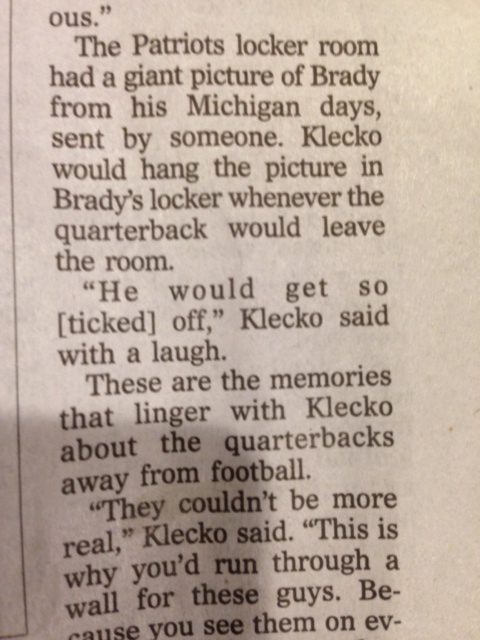
I would bet dollars to donuts that the word Dan Klecko used to refer to Tom Brady was pissed, which, of course, means something very different in the U.K.

“Naff”

The indefatigable Nancy Friedman sends along a sentence from a New Yorker blog post by Adam Gopnik: “Then Bob Dylan showed up from Minnesota—telling various tales about places he had never actually been, with his naff, made-up name—having nothing but genius.”

She sent it along, of course, because Gopnik (a native Canadian who has lived in the U.S. and written for American publications for numerous decades) used the word naff.

The OED defines the adjective as “Unfashionable, vulgar; lacking in style, inept; worthless, faulty.” The first citation is a 1966 quote from  B. Took & M. Feldman in B. Took, Best of ‘Round the Horne’ (1989): “I couldn’t be doing with a garden like this… I mean all them horrible little naff gnomes”

The OED has a lengthy etymological note, which I have slightly abridged:

Origin unknown . Probably unrelated to slightly earlier naff v.

Various theories have been proposed as to the origin of this word. It has been suggested that it is (in Polari slang: see polari n.) < naff in naff omi a dreary man (compare omee n.), in which naff may perhaps be < Italian gnaffa despicable person (16th cent.).

One of the most popular theories is the suggestion that the word is perhaps an acronym either < the initial letters of Normal As Fuck , or < the initial letters of Not Available For Fucking , but this seems to be a later rationalization. O.E.D. Suppl. (1976) compares the earlier English regional (northern) forms naffhead , naffin , naffy , all denoting a simpleton or idiot (see Eng. Dial. Dict. s.v. Naff v.), and also niff-naff n., niffy-naffy adj., and nyaff n., nyaff v.

The OED defines the “unrelated” verb naff, bluntly, as “fuck,” and notes it is often followed by off.

The etymology may be unknown, but it is unquestionably the case that naff is British to the core. I searched the entire run of The New Yorker (which has been publishing since 1925) and found seven previous naffs. Six either referred to a person named Naff or were spoken or written by British people. The seventh was from, yes, Adam Gopnik, who wrote in 2004: “Being an expert on wine and writing about it is what the English call ‘naff,’ embarrassing and uncool…” (“Uncool” is right, but I’m not sure about “embarrassing.”)

The New York Times has been publishing since 1851, so has printed naff more than the New Yorker, though not that much more. Twenty-one times in the Times’ pages, the word either been uttered or written by a British person, or presented as a British term. On three occasions, it has been used by the fashion writers Suzy Menkes and Cathy Horyn. That leaves this quote, from a 1999 review of Martin Gardner’s Annotated Alice: “An English author, one fears, would have found it ”naff,’ embarrassing, to point out what a hansom cab is…”

The writer of the review? Adam Gopnik.

“Crisps,” “Builder”

In the last couple of weeks, I came upon two examples of a not uncommon phenomenon: an American, writing for an American publication, using an obvious Britishism when writing about Britain or a Briton. You might call it protective coloration, or going native. The first one was in a New Yorker article by Elizabeth Kolbert in which she describes what she finds in a parking lot (which she does not call a car park) near her airport hotel at Heathrow: “empty water bottles, crumpled candy wrappers, crushed soda cans, half-eaten packages of crisps.”

Of course, crisps is the word British people use for what Americans call potato chips or chips (which is what British people call what Americans call french fries or fries). But, as a matter of fact, crisps has been worming its way into AmE of late, specifically for products that are more off-beat than your typical Wise or Lay’s potato chips. This one, for example:

010114_42903_BrownRiceCrispsGardenSalsa_D

So I will categorize crisps as “on the radar.”

The other example came in a New York Times obituary of “Micky Lay, a bibulous retired builder who helped Mark Rylance craft his performance in Jez Butterworth’s hit play about British outcasts, ‘Jerusalem.'” The relevant term is builder. In the U.S., that word is used pretty much exclusively by newspapers in describing people like Donald Trump–that is, real estate developers.

In Britain, the OED says, “As the name of a trade, builder now denotes the master artisan, who receives his instructions from the architect, and employs the masons, carpenters, etc., by whom the manual work is performed.” That is what Americans would call a “contractor.” But I believe that British builder also refers to a lower-level laborer, what we call “construction worker.” I await enlightenment on this point.

Builder has made some inroads into the youth of America via the animated children’s series “‘Bob the Builder,” which has aired here since 2001. Some of the kids who watched it back then have grown up by now. But I don’t see any evidence of builder being used here in the British sense. That may have to do, unfortunately, with our construction slump. It’s not a job with great prospects, so no one under thirty has much reason to talk about it.