“Negotiation” report

A couple of weeks ago, I posted two polls to try to determine whether pronouncing “negotiate” as “ne-go-see-ate” is, as I suspected, a Britishism. A commenter astutely noted that I had rather muddied the waters by remarking that I can’t stand that pronunciation. At that point it was too late to change the question, so I have to live with a somewhat poll that probably underreported the “see” pronunciation.

In any case, the results indicated that it is indeed more common in the U.K., with 11 percent of the respondents reporting favoring it, than in the U.S., with 3 percent.

A number of the comments shed some light on the subject. A couple of people remarked that “ne-go-see-ate” is the common BBC pronunciation. One Englishwoman said she used it herself, as a result of having gone to drama school. An Englishman said he used both pronunciations, favoring “ne-go-see-ate” “to press a point.”

An Irish woman who blogs as “Mollymooly” very helpfully provided a census of her own behavior on a variety of such words:

Definitely -s-
annunciation
emaciate
enunciation

Probably -s-
associate
excruciating
glaciate

Either -s- or -sh-
appreciate
negotiate

Probably -sh-
officiate
substantiate
licentiate
depreciate
differentiate

Definitely -sh-
ingratiate
cruciate
initiate
novitiate
transubstantiate

Now -sh- once -t-
expatiate
propitiate
satiate
vitiate

Finally, I e-mailed John Wells, editor of The Longman Pronunciation Dictionary. He replied that he had no statistics on the matter but, on the question of whether “ne-go-see-ate” is more common in the U.K. than the U.S., he had a one-word answer: “Certainly.”

I’ll take that as a yes.


“Negotiate,” for U.K. residents

I only have two linguistic pet peeves, both of them idiosyncratic. I don’t like it when people say “a couple things” (instead of “a couple of things”) and I don’t like it when the word “negotiate” is pronounces “ne-go-see-ate.” I had never thought of the latter as a Britishism until I  recently heard an interview where an English person used it.

I thought I’d find out from NOOB readers if the word is pronounced differently on either side of the Atlantic. I only seem to put in one poll per post, so depending on your nationality, please respond to the appropriate poll.

I’d love to hear about any other pronunciations, and the news from Canada, Australia, etc., in the comments


False alarm

My heart quickened when I saw this article on the website Bleacher Report: pace

The reason is that my friend David Friedman, an (American) West Ham supporter, periodically tells me about terms specific to English football, and one of them is pace, referring to the fleetness of a player. Americans, of course, use speed. The Bleacher Report story on the NBA (National Basketball Association) seemed like proof that the word had crossed over.

Was it Hamlet who said, “I know not ‘seems'”? In any case, it turned out the Americanization of pace was an illusion. The Bleacher report piece went on:

Screen Shot 2014-09-29 at 8.54.19 PM That is, the writer was talking about a team’s pace of play, not an individual’s foot speed. Never mind.

“Bits,” again

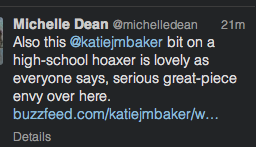
I have covered the use of BrE “bits” instead of the AmE “parts,” as in “the good bits,” “the naughty bits,” “lady bits,” “dangly bits,” etc. I’ve recently noticed another “bit” popular among journalists, as a synonym for a piece of work, traditionally and customarily shortened to a “piece.” David Carr of the New York Times is fond of it, and here it is from Michelle Dean on Twitter: Screen Shot 2014-09-19 at 12.01.48 PM The OED suggests that the use of bit by itself in this way derives from tit-bits or tidbits, referring to a number or series of small items. The dictionary gives these citations:

1896   Daily News 4 Nov. 2/7   This is a weekly journal called ‘Gems’. As its title suggests, the new paper will be of the ‘bits’ order.
1928   Granta 30 Nov. 172/1   If the editor of the Review were to ask me to write a little bit about Christmas I should laugh in his face.
The newfound popularity may stem from the fact that the flood of communications we are flooded with in this day and age, any one of them, no matter how long, starts to seem like a tidbit. Or, in fact a “bit”–in the sense of the tiny pieces of information by which computers operate. (The word, which dates from about 1947, was coined by J.W. Tukey as a combination of “binary digit.”)
But all that is a bit of a speculation. No pun intended.

“Bob’s Your Uncle”

English reader John Barrett reports that in an episode of “Marvel: Agents of Shield,” the (American) character Phil Coulson says, “Bob’s your uncle.” John elaborates:

It was the last episode and he was describing how his team were [I told you John is English] supposed to infiltrate HYDRA headquarters, but his plan ran out of steam rather quickly and he ended with “and..er.. Bob’s your uncle!”

I’ve heard it rather too often in project meetings down the years – it’s often an euphemism for the cloud on the board marked “And then a miracle happens.”

My favourite was about 20-odd years ago, a hardware engineer (ex-RAF, which probably explained a lot ) was showing me a piece of networking equipment which one “plugs into the old wossname, hit the tit and Bob’s your uncle.”

The OED defines the phrase as “everything’s all right,” and though (or maybe because) it’s a quintessential Britishism, it’s shown up rather frequently in American pop culture, at least according to the Wikipedia hive:

In Mission Impossible: Ghost Protocol (2011), Benji Dunn uses the expression to cap his quick summary of Ethan Hunt’s plan to intercept the nuclear code transaction….

In the NCIS episode entitled “Truth or Consequences,” Agent Anthony DiNozzo uses the phrase to explain the unspoken communication between Agent Gibbs and Director Vance.

In season 11, episode 15 of the animated cartoon TV show The Simpsons, titled “Missionary: Impossible,” Homer uses the phrase when talking with Reverend Lovejoy…

In Monk, season 8, episode 7, “Mr. Monk and the Voodoo Curse,” Lieutenant Randy Disher explains how a victim named Robert died: “He opens the box, sees the doll, Bob’s your uncle, his heart just stops.” After that, Captain Leland Stottlemeyer ribs him, asking if that is a real phrase, or if he made it up; Disher protests that it’s an Australian figure of speech.

The origins of the phrase are murky. The OED doesn’t give any etymology, and the ones I’ve seen on Wikipedia and elsewhere are unconvincing, partly because they cite 19th century happenings and the phrase didn’t pop up till the 1930s.

And in this regard I believe I have a contribution. The OED’s first citation for “bob’s your uncle”  is 1937, from Eric Partridge’s Dictionary of Slang. Subsequently, Stephen Goranson found a 1932 use and posted it to the American Dialect Society listserv. After poking around a bit, I found something even earlier: a song called “Follow your Uncle Bob, Bob’s your uncle.” The U.S. Library of Congress lists this as having been “written and composed by John P. Long, of Great Britain,” and copyrighted December 2, 1931.

#Micdrop.

Update: That’ll teach me to brag. Since posting this, I have learned that Gary Martin, who blogs as The Phrase Finder, has found an even earlier use. He writes: “The earliest known example of the phrase in print is in the bill for a performance of a musical revue in Dundee called Bob’s Your Uncle, which appeared in the Scottish newspaper The Angus Evening Telegraph in June 1924.”

I await an update of the OED entry. In the meantime, here’s a clip of Florrie Florde singing “Follow Your Uncle Bob”:

IWS

Incipient “Wanker” Spread, that is. An American friend (who works for a U.S. company) posted this photo on Facebook this morning, explaining that it’s a photo of the Post-It note that had been affixed to his keyboard overnight.

10407549_10203586897485765_912045831877120622_n

I asked for further details and he responded: “Still a mystery to me… though I suspect a British colleague who was displeased I left the TV volume on too loud.”

If more forensic information is unearthed, you will be the first to know.

“Hullo”

I got a business e-mail the other day (from an American) that started out with a one-word sentence: “Hullo.” The U.S. version, of course, is “hello.” I had always associated hullo with mum, except I sometimes encounter “mum” here, and I’d never seen an American “hullo.” Until now.

Poking around on the web for examples, I almost immediately encountered this quintessentially British quote from the quintessentially British P.G. Wodehouse (the narrator is the possibly even more quintessentially British Bertie Wooster):

“Hullo, Bobbie,” I said. “Hullo, Bertie,” she said. “Hullo, Upjohn,” I said. The correct response to this would have been “Hullo, Wooster”, but he blew up in his lines and merely made a noise like a wolf with its big toe caught in a trap.

Hello (first citation 1827) and hullo (1857) both have the same etymology as the verb holler, according to the OED, as do the older variants hallo (first seen in Dickens, in 1841) and hollo (Shakespeare, Titus Andronicus). Interestingly, an even earlier version is holla, which has recently come back in full force. The most popular definition on Urban Dictionary gives three meanings, the relevant one being, “A word used to acknowledge the presence of a fellow companion.” This example is offered: “Is that mah boy ova there? HOLLAAAAA!”

Generally, hello is indeed generally American and hullo generally British, through Google Ngram Viewer suggests some nuance:

Screen Shot 2014-08-29 at 10.49.53 AMThe decline in hullo use on both sides of the Atlantic suggests that my e-mail correspondent’s use of the word was a one-off–about as likely to catch on as the similarly Wodehousian abbreviation for the thing we used to talk on: ‘phone.


“Expiry date”

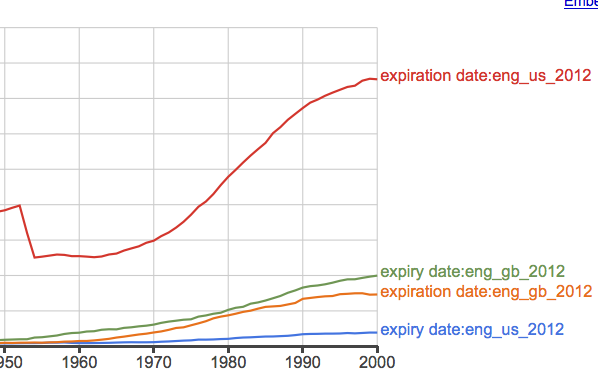
When the BBC did a piece a couple of years on British people’s most annoying Americanisms, “expiration date” instead of “expiry date” made the top 50. As Lynne Murphy observed, those people didn’t really have much cause for their annoyance, but the Google Ngram chart below indeed shows “expiration date” as preferred in the U.S. However,  the two versions have been pretty close in Britain for the last fifty years.

Screen Shot 2014-08-19 at 10.31.46 AM

Now, what of American “expiry date”? The graph shows it to be on the rise, and the ever-sharp-eyed Nancy Friedman reports a growing number of sightings, notably at the clothing and furnishings chain Anthropologie. I went to the company’s website and went far enough in the process of buying a $500 rug to come upon this:

Screen Shot 2014-08-19 at 10.27.28 AM

At that point, I x-ed out of that tab as quick as I could and hightailed it out of there.