

It’s always instructive to look at H.L. Mencken’s The American Language,, which was originally published in 1919 and went through many editions before Mencken released the second and final “Supplement” in 1948. In his chapter “Briticisms in the United States” (I have before me the 1936 edition), he writes, “It is most unusual for an English neologism to be taken up in this country, and when it is, it is only by a small class, mainly made up of conscious Anglomaniacs… To the average red-blooded he-American [the stage Englishman’s] tea-drinking is evidence of racial decay, and so are the cut of his clothes, his broad a, and his occasional use of such highly un-American locutions as jolly, awfully and ripping.”
He mention a number of words that have managed to “seep in” among certain classes, some of which I’ve considered in the past, including “mummy” and “smog“; on the other hand, he says, “wowser” and “wangle” “have never got a foothold.”
Wangle eventually did, though it took some time. Over thee next couple of weeks, I’m going to consider some of the other “Briticisms” mentioned by Mencken that took a while to catch on here, starting with one that will probably surprise you. Mencken writes,
When certain advertisers in New York sought to appeal to snobs by using such Briticisms as swagger and topping in their advertisements, the town wits, led by the watchful Franklin P. Adams …, fell upon them and quickly routed them.
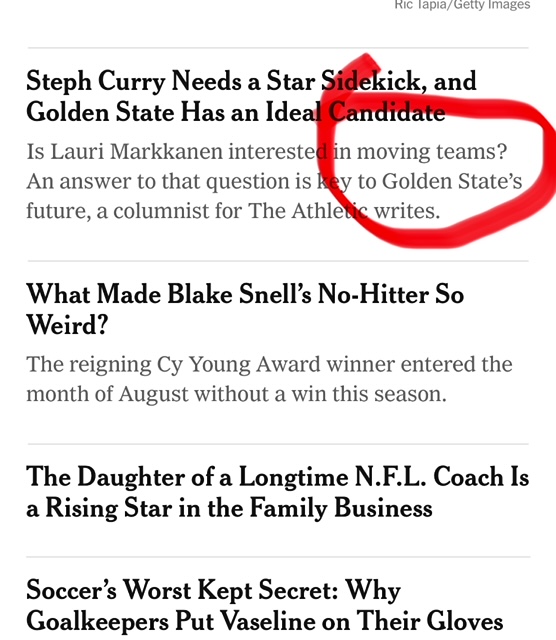
The surprising one, of course, is “swagger,” which is now common enough in the U.S. to have been used 272 times in the New York Times over the past year, including in these headlines:

These are all “swagger” as a noun, deriving from the OED‘s definition 1 a.: “The action of swaggering; external conduct or personal behaviour marked by an air of superiority or defiant or insolent disregard of others.” The dictionary’s citations, all British and all dating from the 18th and 19th centuries, include this from King Solomon’s Mines (1885): “He was an impudent fellow, and..his swagger was outrageous.”
The noun comes from the verb, defined by the OED as: “To behave with an air of superiority, in a blustering, insolent, or defiant manner; now esp. to walk or carry oneself as if among inferiors, with an obtrusively superior or insolent air.” The dictionary has some interesting quotes, starting with Shakespeare’s Midsummer Night’s Dream: “What hempen homespunnes haue we swaggring here, So neere the Cradle of the Fairy Queene?” Then this from Gulliver’s Travels in 1726: “He..became so insolent..that he would always affect to swagger and look big as he passed by me.” And, showing at least some adoption in America, from Washington Irving’s Tales of Traveller (1824): “He took complete possession of the house, swaggering all over it.”
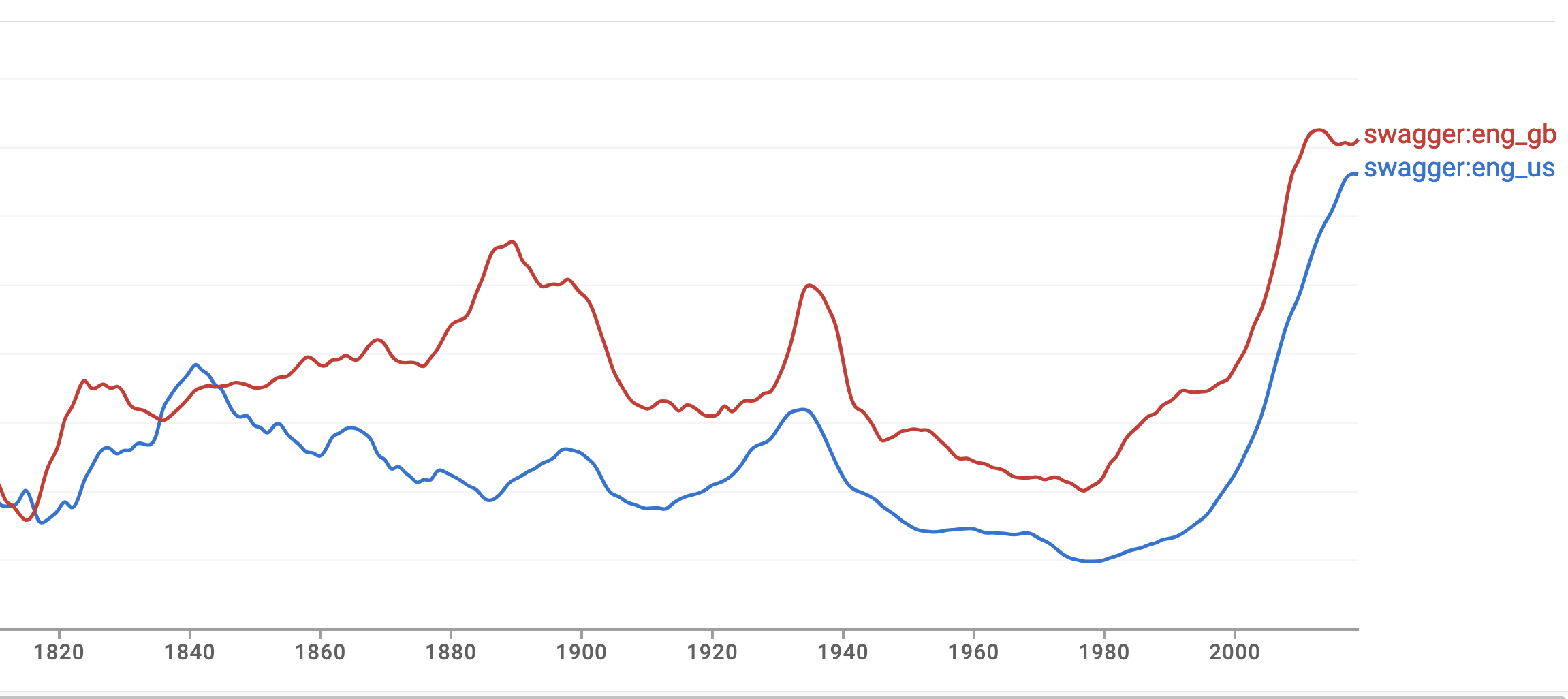
Google Ngram Viewer shows that except for a few years in the 1840s, “swagger” has always been more common in Britain than in the U.S.
The most common current form, I would say, is the shortened form “swag,” an incredibly rich word that has seven separate entries in Green’s Dictionary of Slang–four nouns (including the word for promotional freebies), two adjectives, and one verb. The one that comes from “swagger” has this OED definition: “Bold self-assurance in style or manner; an air of great self-confidence or superiority.” It came out of hip-hop where one of the first uses was in a 2003 Jay-Z song: “My self-esteem went through the roof, man. I got my swag.”
I wonder what Mencken would have made of that.





 notoneoffbritishisms.com