

Sometimes a NOOB just slips right by me. That was the case with the word at the top of his post. I had definitely encountered it as an adjective meaning characterized by shouting, but didn’t think of it as notably British, rather one of a group of relatively newfangled y-ending epithets that includes “flirty,” “melty” (as in cheese), and “stinky” (which has largely replaced “smelly”). But Lynne Murphy, in her latest Separated by a Common Language blog post, enlightens me.
As she points out, the word has been around for well over 100 years, but early uses tended to refer to a particular vocal quality, especially while singing. The OED quotes a 1914 book on choral technique: “There are a great majority of untrained voices, which may be roughly classified as follows:—weak and quavery, worn and tinny, harsh and shrill, strident, metallic, shouty, throaty, cavernous, hooty, scoopy, and nondescript.”
As Google Ngram Viewer shows, widespread use took off around the turn of the twenty-first century, first in the U.K.
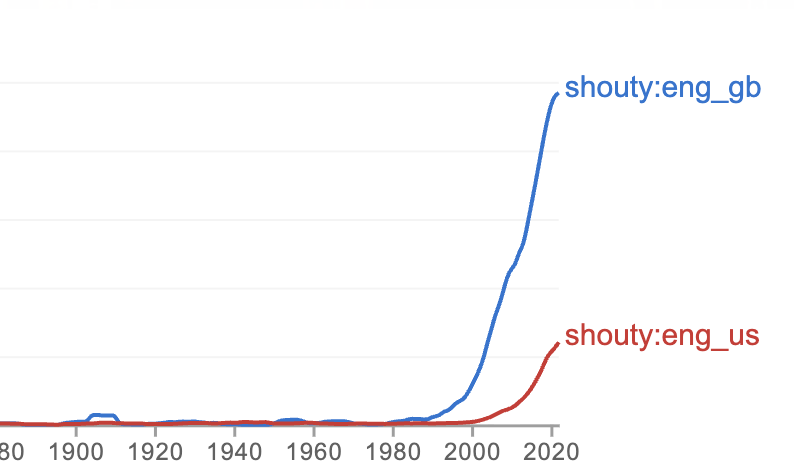
Lynne looked into the word because a reader sent in an example from an April 2026 article in the New York Times, referring to one of Donald Trump’s capital-letter-and-exclamation-point-laden social media posts as a “shouty missive.” That example, referring (as has become common) to metaphorical shouting in text rather than actual shouting, is just one of thirteen times the newspaper has used the word in the past year. Others include:
- In the TV show The Bear, an interviewer asks a chef “if a restaurant kitchen is as shouty as they depict it on TV,”
- Representative Chip Roy, Republican of Texas, is described as making “shouty floor speeches criticizing members of his own party.”
- A staging of Shakespeare’s Coriolanus is described as a “shouty, oddly arrhythmic production.”
- The common caricature of a sports agent is “a shouty, larger-than-life, money-and-power-focused suit.”
And finally this one, which shows that the singing use is still around: the Times review of part II of the film Wicked, mentions “routinely timed musical numbers … oscillate between shouty group set pieces and quieter, intimate interludes.”


is Hurty as in “Hurty words” similar?
I would say very.
Perfect time to remember Horrible Histories ‘Shouty Man’ parodying the Cillit Bang adverts which featured the equally fictitious (and shouty) Barry Scott.
New! Victorian Child!
Thanks for this John, I hadn’t come across it before. Horrible Histories team were very innovative with their satire. The Victorian shouty man was Jim Howick who would later portray Pat in ‘Ghosts’, UK (vastly superior) version.
Cillit Bang – Barry Scott
Horrible Histories – Shouty Man
https://www.youtube.com/watch?v=eUBPqCa-tiE
Thanks for mentioning this. Lynne Murphy gave it a shout-out (sorry) and I meant to. The character first appeared on “Horrible Histories” in 2009, which is right in the middle of “shouty”‘s rise to glory. Here’s a clip
In the late 90s or early 2000s, I developed a theory that a sitcom has reached the end of its comedic lifespan when it gets shouty. I first noticed it on Seinfeld, when George started shouting in almost every episode, and saw it happen again on Friends when suddenly Phoebe was shouting all the time. Have you seen this in other shows?
“Everybody Loves Raymond” and “Frasier” were shouty from the beginning, which might prove your theory.
Everybody Loves Raymond was horrible! Everyone was so nasty to each other; I didn’t even make it through one season.
So ‘shouty’ has taken off in both the UK and the US; but so too, according to Ngram Viewer, has ‘loudmouthed’. Is this a sign of the times?
And where did these y-ending abbreviations come from, flirty instead of flirtatious, grotty instead of grotesque? Did their popularity predate text-speak? Surely we can’t date the start of the trend?
Perhaps we can, and again I invoke the cheeky Scouse mop-tops. The musical comedy A Hard Day’s Night was seen by tens of millions in the summer of 1964, George Harrison introducing every last one of them to the word ‘grotty’, an invention of scriptwriter Alun Owen:
https://www.goldradio.com/artists/the-beatles/george-harrison-hard-days-night-grotty-influencer/#:~:text=The%20Beatles-,How%20The%20Beatles%27%20George%20Harrison%20coined%20the%20word%20“grotty”,deconstructed%20influencer%20culture%20in%201964&text=George%20Harrison%27s%20movie-stealing%20scene,also%20did%20so%20much%20more.
The Beatles have a lot to answer for, as they may also have kicked off the Pretentious Words Culture War, -esque being the suffixe prétentieux par excellence.
Oh for the lost innocence of the 1950s! That land of lost content where knowing more words simply meant you were a better person!
Interesting how an apparently ordinary word like “shouty” can reveal subtle differences between British and American English. Its long history and recent rise in everyday usage show how language keeps evolving in unexpected ways.
Shouty as an adjective is doing a lot of quiet work. American English absolutely has shouty now, we just pretend we invented it. I hear it constantly in rap commentary – a beat gets called shouty when the hi-hats will not sit down. The word crossed the pond on its own schedule.