

On Facebook, the writer Sonia Jaffe Robbins posted this quote from a New York Times article about the new mayor of New York, Zohran Mamdani.
With any new administration comes a roster of ascendant power players unaccustomed to high influence. Mr. Mamdani’s New York has elevated beanie-wearing socialists, aspiring rent-freezers, backbench lefty legislators who knew Mr. Mamdani, until quite recently, as a backbench lefty legislator.
Sonia wondered: “What exactly is a ‘beanie-wearing socialist’? What socialists wear beanies? What kind of beanie?” (A commenter had another question: “What is a backbench?”)
Someone replied, “Knit caps, I think,” and I responded to her: “Right, something like 10-15 years ago they started to be called beanies, who knows why.”
Not only was my timing off by a good decade, but, to my chagrin, I missed the British/Australian connection.
My first stop in looking into the usage was the OED, but my second, Green’s Dictionary of Slang, did a more comprehensive job with “beanie.” Its definition is: “(orig. US) orig. a small, tight-fitting cap, similar to a large skull-cap; thus propeller-beanie, such a cap with a small propeller affixed to its top; also used for any shape of hat.” The first quote is from the cartoonist and slang pioneer T.A. Dorgan (TAD) in 1904, the second is form the Mutt and Jeff comic strip six years later (“I’ll go right over and get a felt beanie”), and the third, from an Arizona newspaper in 1921, is, “Each year the freshmen wear their beanies until the first of April.”
Subsequently, a strong connection developed between beanies and U.S. colleges. Wikpedia reports that beanies “were worn by college freshmen and various fraternity initiates as a form of mild hazing. For example, Lehigh University required freshmen to wear beanies, or “dinks”, and other colleges including Franklin & Marshall, Gettysburg, Rutgers, Westminster College, and others may have had similar practices….At Cornell University, freshman beanies (known as “dinks”) were worn into the early 1960s.”
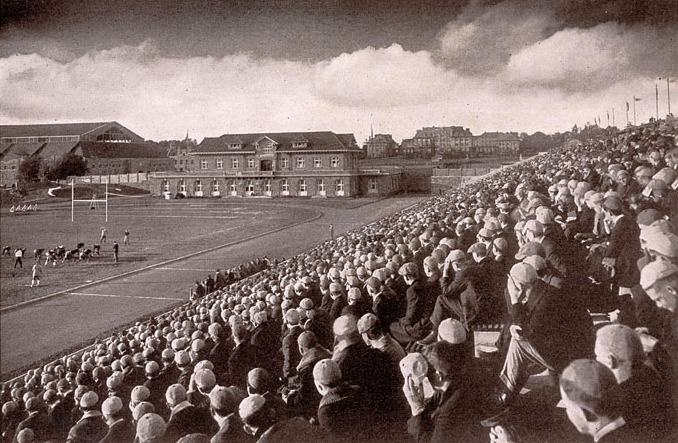
Meanwhile, the propeller thing happened. I direct anyone interested to the comprehensive history Ian Ellis published in the Today in Science website, but for now, here’s Ellis on the origin:
“It is generally accepted to have been first improvised in Cadillac, Michigan, using a beanie (a visorless cap) in 1947, made by Ray Faraday Nelson. It quickly became an icon for science fiction fans to identify themselves, and a national fad.
“In a published interview1, Nelson described how ‘In the summer of 1947, I was holding a regional science fiction convention in my front room and it culminated with myself and some Michigan fans dressing up in some improvised costumes to take joke photographs, simulating the covers of science fiction magazines. The headgear which I designed for the space hero was the first propeller beanie. It was made out of pieces of plastic, bit of coat-hanger wire, some beads, a propeller from a model airplane, and staples to hold it together.'”
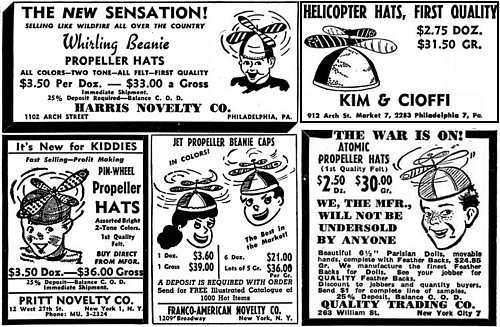
And for some unlikely reason, the propeller beanie became a fad, as witness these ads from Billboard magazine in 1948:
As for beanies as knit hats–also known as watch caps or toques–the terminology seems to have started in Australia, where they were worn by surf lifesavers. I’m guessing that’s the sort of beanie referred to in a 1986 Australian book quoted by Green’s: “He had on an old pair of overalls and a beanie.” But the connection is definite in this line from an Australian book published ten years later Peter Temple’s Bad Debts: “The beanie, for Christ’s sakes. It’s Collingwood beanie.” Collingwood is an Australian Rules Football club, and here are some of their beanies:
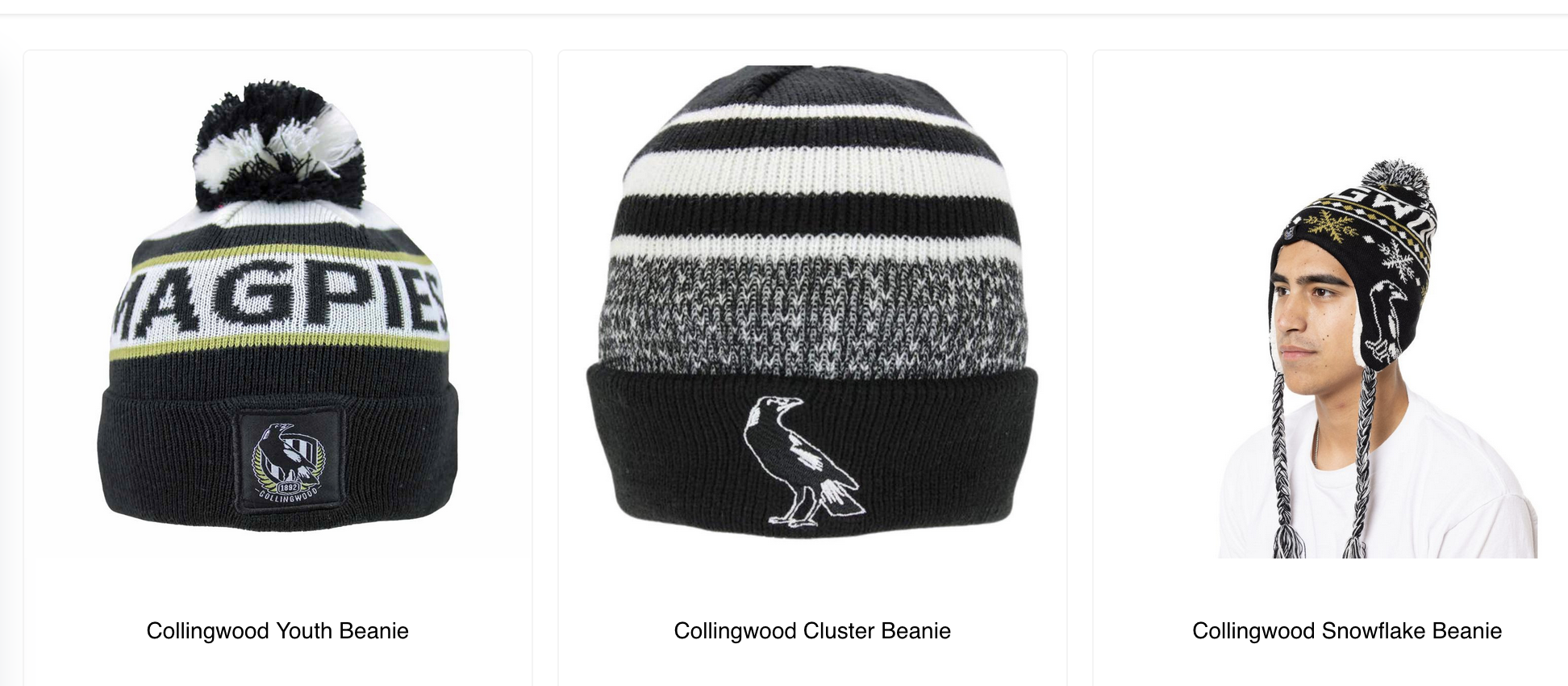
(I’ll add that I first became aware of this meaning for beanie when I was gifted one a few years ago by my study-abroad host at University College, Melbourne, Tim McBain.)
The sense had arrived in the U.K. by 2000, per this Green’s quote from The Independent on Sunday: “Roll the beanie over your head until it’s full stretch below your ears.”
U.S. adoption came no later than 2003, when this definition was posted on Urban Dictionary:
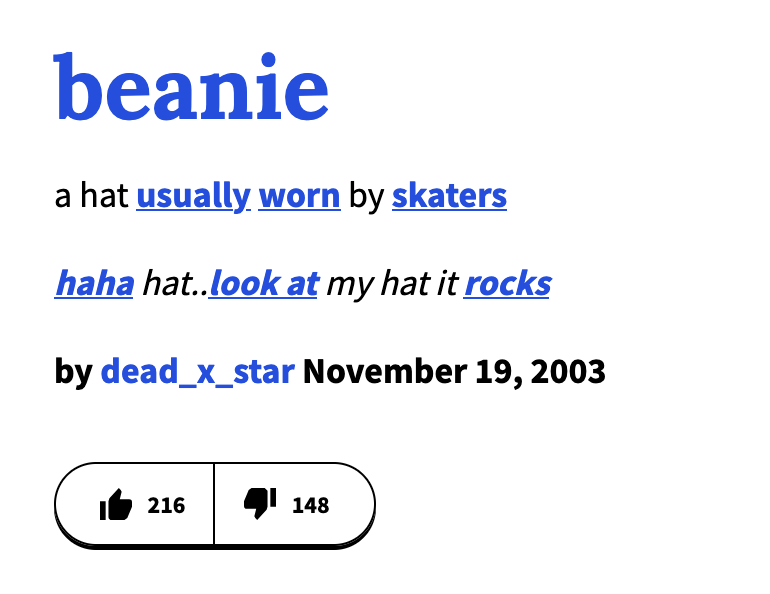
Since then, in addition to skaters, beanies have been associated with grunge rockers, slackers, hipsters, and now, apparently, socialists.
 notoneoffbritishisms.com
I have suddenly heard “beanie” being used frequently in this sense this winter when to my recollection I had never heard it that way before. Even if it does go back to 2003 (and Urban Dictionary is not a U.S.-only site), I wonder if there has been an uptick.
On backbencher – I noticed a reference to Mitch McConnell as once again a “backbencher” in a 60 Minutes interview last year. This was the first time I had ever heard the U.S. meaning expanded to include former leaders (as the original British meaning includes), not solely newcomers.
Correction on that – not the first time, as in your archives I found that I myself had mentioned that Nancy Pelosi had used the term to describe herself after she left leadership.
Some years ago, I attended a World Science Fiction convention in the US. At their merchandise stall they were selling what they called propellor beanies and I bought one. It was only later I found out that as it had a peak, it wasn’t a beanie.
A few years later, I wore it at a German convention and somebody asked what it was called. My German is near non-existent but German-speaking friend translated it as Hubschrauberhut.
I’m old enough that the first thing that comes to mind for “beanie” is the propeller hat. I don’t know that I’ve ever seen one, but they were common accessories for characters who populated the cartoons and comic books of my youth.
And I would have said that I’d never heard anyone use the word for a ski or knit cap, but, after reading your column, I think I must have. In fact, my guess is that my kids use that word.
This is acutely embarrassing, because I have given those warm winter hats I don’t call beanies to my wife and/or a kid or two as presents the last two Christmases. (I ran into interesting ones in my travels, bought lots, and had to do something with them…)
Google has several Beanie copters for folks to buy.
Of the three hats illustrated, I’d call the first a bobble hat. (It’s in Chambers.) The second I’d just call a woollen hat. Which reminds me that back in the sixties there was a Monkees strip in a comic my sisters got in which Mike Nesmith was called woolhat. Wikipedia tells me that name was dropped after the pilot.
Incidentally, I don’t know what magpies refers to but in England the Magpies is the name for Newcastle United, who my brother supports.
Collingwood are the Magpies for the same reason (Black and White shirts)
When I was a child I thought the word beanie came from the US television show “Beanie and Cecil” ( I now know that the character’s name came from the hat but I was in my 30’s before I realized that a beanie did not need to have a helicopter attached and could also apply to what I and everyone else in Canada called a toque.
To quote Lewis Carroll, “What I tell you three times is true.” 🙂