

I was watching the Ted Danson Netflix series Man on the Inside when an English professor (the subject, not the nationality) played by David Strathairn says this to Danson:

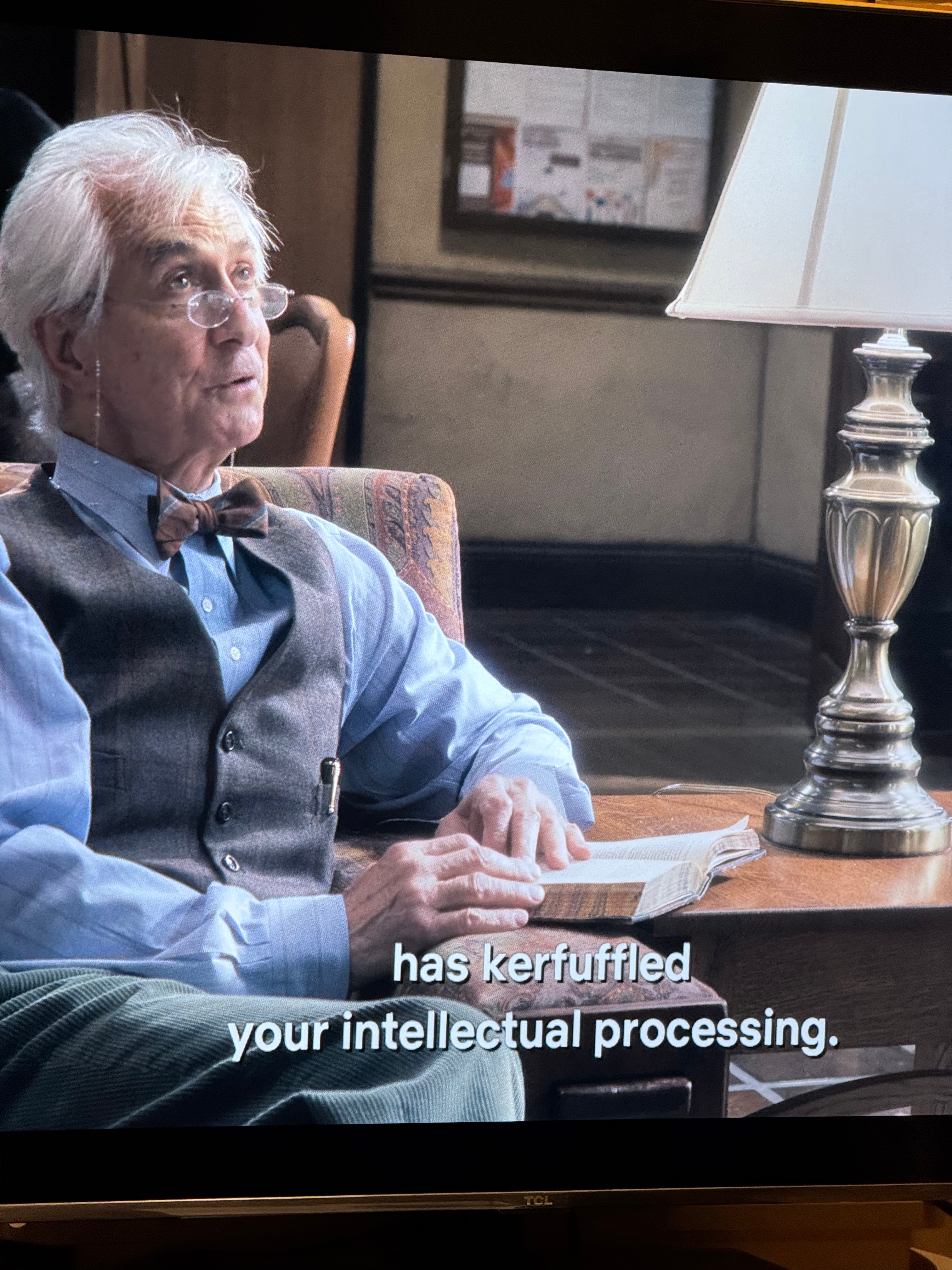
I (of course) have written about “kerfuffle” but only as a noun. When I heard the verb on TV, I initially thought it was an American invention, but it in fact, the first use I’ve been able to find (I’ve searched for the past tense, to avoid getting false positives) was from David Cunliffe Lister in the House of Lords in 1985: “The Earl of Swinton, My Lords, he could if the noble Earl would give him time: He is absolutely kerfuffled with figures here.”
And, talking of America, the great political columnist Molly Ivins used the word in Mother Jones in 1991, referring to George H.W. Bush:

The New York Times has used “kerfuffled” once, in 2014.
But one syntactical thing is different about the Man on the Inside example. The others are in the passive voice, talking about people who are kerfuffled. But in Man on the Inside, the riddle has kerfuffled Danson. I’ll be monitoring whether that’s a one-off.
 notoneoffbritishisms.com
Dear Ben YagodaHave you got one of your wonderful graphs for ‘kerfuffle’? I wouldn’t want to speak for everyone in Britain, but I’d say it was never a very common word here, and in decline these days – though, to be fair, a friend said it yesterday! It’s not a word that would be likely to occur to me – and if it did, I’d probably reject it, on the grounds that I wouldn’t know how to spell it. I doubt my friend could spell it, either – she was describing packing up her business of many years, which is costing her money instead of making some. As for ‘kerfuffled’ – never heard it. Just about possible if someone was showing off. Or (they claim) it was a word very well-used in the obscure school they once attended (they claim.) I think this is probably the case with the one British source you cite – David Yarburgh Cunliffe-Lister, 2nd Earl of Swinton (thanks for the help, Wikipedia!) He was referring to himself as kerfuffled. Probably just to get it into Hansard. (The official record of proceedings in the House of Commons and the House of Lords – but, of course, you knew that.) As for your recent reference … who talks about “eighteen-year-old children”? Is this some Netflix’s writer’s weird assumption about how people over sixty talk?So, anyway, I think this is an Americanism, or at least the product of some American script-writer who thinks he knows how British English works. He doesn’t. Yours, Eleanor Sutton. PS I work
Scot who lives in Canada now. I still use kerfuffle quite a bit and just last week a police officer told me about a kerfuffle outside a bar in which he took both participants into custody but released them later without a charge. But I have never used Kerfuffled.
Scot who lives in Canada now. I still use kerfuffle quite a bit and just last week a police officer told me about a kerfuffle outside a bar in which he took both participants into custody but released them later without a charge. But I have never used Kerfuffled.
I broadly agree, Panda, though paragraphs would be nice.
We use kerfuffle from time to time, but it’s one of those lazy words that drives out alternatives, so I try to avoid it. A bit of a kerfuffle; how much is ‘a bit’ of an already vague term?
A bit of a fuss is almost as bad, but there’s: commotion, brouhaha, fracas, stir, to-do, hoo-ha, ruckus… Most are more specific in British English, to my mind. The last alternative reminds me of ‘there was many a ruction meself had a hand in’. Ruction wasn’t listed in my quick search.
Oh, and palaver/palava. Should have known the search results would be for American English.
Who’s heard of Antarctic English, btw; just discovered it.