

It’s always instructive to look at H.L. Mencken’s The American Language,, which was originally published in 1919 and went through many editions before Mencken released the second and final “Supplement” in 1948. In his chapter “Briticisms in the United States” (I have before me the 1936 edition), he writes, “It is most unusual for an English neologism to be taken up in this country, and when it is, it is only by a small class, mainly made up of conscious Anglomaniacs… To the average red-blooded he-American [the stage Englishman’s] tea-drinking is evidence of racial decay, and so are the cut of his clothes, his broad a, and his occasional use of such highly un-American locutions as jolly, awfully and ripping.”
He mention a number of words that have managed to “seep in” among certain classes, some of which I’ve considered in the past, including “mummy” and “smog“; on the other hand, he says, “wowser” and “wangle” “have never got a foothold.”
Wangle eventually did, though it took some time. Over thee next couple of weeks, I’m going to consider some of the other “Briticisms” mentioned by Mencken that took a while to catch on here, starting with one that will probably surprise you. Mencken writes,
When certain advertisers in New York sought to appeal to snobs by using such Briticisms as swagger and topping in their advertisements, the town wits, led by the watchful Franklin P. Adams …, fell upon them and quickly routed them.
The surprising one, of course, is “swagger,” which is now common enough in the U.S. to have been used 272 times in the New York Times over the past year, including in these headlines:

These are all “swagger” as a noun, deriving from the OED‘s definition 1 a.: “The action of swaggering; external conduct or personal behaviour marked by an air of superiority or defiant or insolent disregard of others.” The dictionary’s citations, all British and all dating from the 18th and 19th centuries, include this from King Solomon’s Mines (1885): “He was an impudent fellow, and..his swagger was outrageous.”
The noun comes from the verb, defined by the OED as: “To behave with an air of superiority, in a blustering, insolent, or defiant manner; now esp. to walk or carry oneself as if among inferiors, with an obtrusively superior or insolent air.” The dictionary has some interesting quotes, starting with Shakespeare’s Midsummer Night’s Dream: “What hempen homespunnes haue we swaggring here, So neere the Cradle of the Fairy Queene?” Then this from Gulliver’s Travels in 1726: “He..became so insolent..that he would always affect to swagger and look big as he passed by me.” And, showing at least some adoption in America, from Washington Irving’s Tales of Traveller (1824): “He took complete possession of the house, swaggering all over it.”
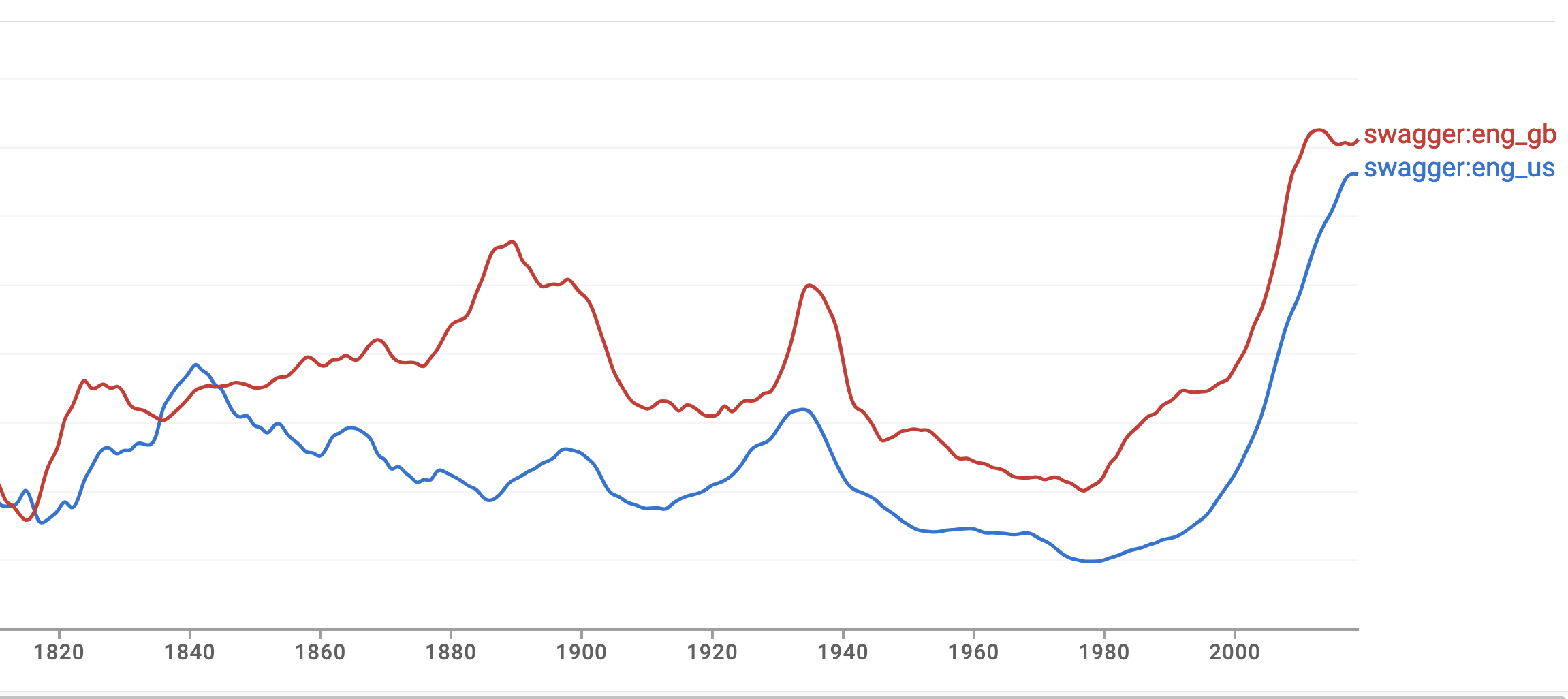
Google Ngram Viewer shows that except for a few years in the 1840s, “swagger” has always been more common in Britain than in the U.S.
The most common current form, I would say, is the shortened form “swag,” an incredibly rich word that has seven separate entries in Green’s Dictionary of Slang–four nouns (including the word for promotional freebies), two adjectives, and one verb. The one that comes from “swagger” has this OED definition: “Bold self-assurance in style or manner; an air of great self-confidence or superiority.” It came out of hip-hop where one of the first uses was in a 2003 Jay-Z song: “My self-esteem went through the roof, man. I got my swag.”
I wonder what Mencken would have made of that.
 notoneoffbritishisms.com
“Swag” for “swagger” (up here in the wilds of Canada and on CBC Radio no less) makes me as crazy as “collab” for “collaboration.”
What a way with words the Sage of Baltimore had! “For every problem, there is a solution that is simple, neat and wrong.” Or, “Democracy is the theory that the common people know what they want and deserve to get it, good and hard.”
I think the old pantomime shows used to have the Robin Hood-esque character dragging a huge cloth bag with “Swag” painted on it.
Best regards!
Tim Orr
I don’t recall Robin Hood, but when I was growing up in the late fifties, early sixties, burglars in comic strips usually carried a bag marked swag and probably wore a mask.
Really? That’s good evidence for NOOB status, then. I don’t believe American burglar cartoons had anything written on them. I remember they sometimes had a dollar sign, but not “swag.”
This is another example of a word that I would have guessed the opposite on as a gut feeling– more American than British. But Phoebus reminds us about Australian swagmen, which, of course, I knew about via Waltzing Matilda, so, in the end, what do I know? Very little about most things, including this word.
And then there’s: “No one in this world … has ever lost money by underestimating the intelligence of the great masses of the plain people.”
I have written before, and just opened the book Gobsmacked. Love it so far. Am chuffed at choosing it. I say this as we were watching Graham Norton’s Chat show with celebrities a day ago and Kieran Culkin mentioned being married to a Brit and how hard it was to learn to use such Britisims as ‘chuffed.” My husband and I lived in Boston and then New Jersey for years, and our words such as peckish they had never heard of, of chuffed. We Canadians grew up using all the words in the glossary at the back of the book and are quite amused by it all.
Aside from that is is a great scholarly read with proper citations noted. This from a former librarian who publishes and always has to change my British forms (neighbours, programme, etc when publishing articles in magazines. Or online.
Lovely book. When we lived in Yorkshire two words came up for us that were new ”’ the neighbour next door was feeling ‘poorly’ meaning ill or sick and then there was Mardy, a very Yorkshire word.
Cheers and good work.
Gail Benjafield, St. Catharines ON Canada
Thanks very much, Gail. If I’m not mistaken, the Yorkshire thing would be to just say, “She is poorly.” I think Americans would say, “She is feeling poorly.”
A swagger coat was a postwar fashion item of women’s wear. Elegant example:
https://maggiemaesvintage.co.uk/products/original-1940-s-beautiful-edge-to-edge-swagger-coat-navy-with-royal-navy-velvet
Here a modern recreation – described as a 1940s swing coat – worn by a model:
https://www.etsy.com/uk/listing/1824158669/43-swing-coat-in-green-by-the-seamstress?
I’ve not encountered the word “swag” having a similar meaning to “swagger” in BrE. Inevitably, it is used to describe stolen goods or items obtained in a dubious manner. The term evolved in Australia to mean the bedding pack carried over the shoulder by itinerant workers, who then became known as “swagmen”, the most famous of whom is the “jolly swagman” in the national song of Australia, “Waltzing Matilda”.
I’m too familiar with swag in the sense of promotional items. I was a medical reporter for 40 years and covered about six major medical conferences each year in the U.S. Many of us, and freelancers especially, would wander through the exhibit area filled with pharmaceutical companies displaying their wares, with freebie branded (of course) swag to entice doctors and, grudgingly, us. Pens, notebooks, tote bags, sometimes T-shirts. Pediatrics conferences ere the best – pens with a chamber for soap bubbles and a wand, measuring tapes whose housing was an elephant or giraffe. The paper I worked for was Canadian, but Canadian conferences had no such delights – pharmaceutical swag having been outlawed by the Canadian Medical Association.
Now I’m having fond memories of Toyota’s 2010 “Swagger Wagon” ad campaign, complete with white-hipster music video. [Earworm alert!]
Thanks Nancy, not seen that ad, enjoyed it. Well cast.
Somewhat akin to swank (noun) Do you have swank in America?
We do, but mainly as an adjective (“a swank restaurant”) and pretty old fashioned. It’s another one mentioned by Mencken and I plan to address it at some point.
Washington Irving lived in Birmingham in England for a considerable time. Is anyone aware of the swagger stick, carried by Army officers?