

My pulse quickened when I saw this the other day at a local bookstore (which, true to the American custom, had more gifts and novelty items on offer than books).
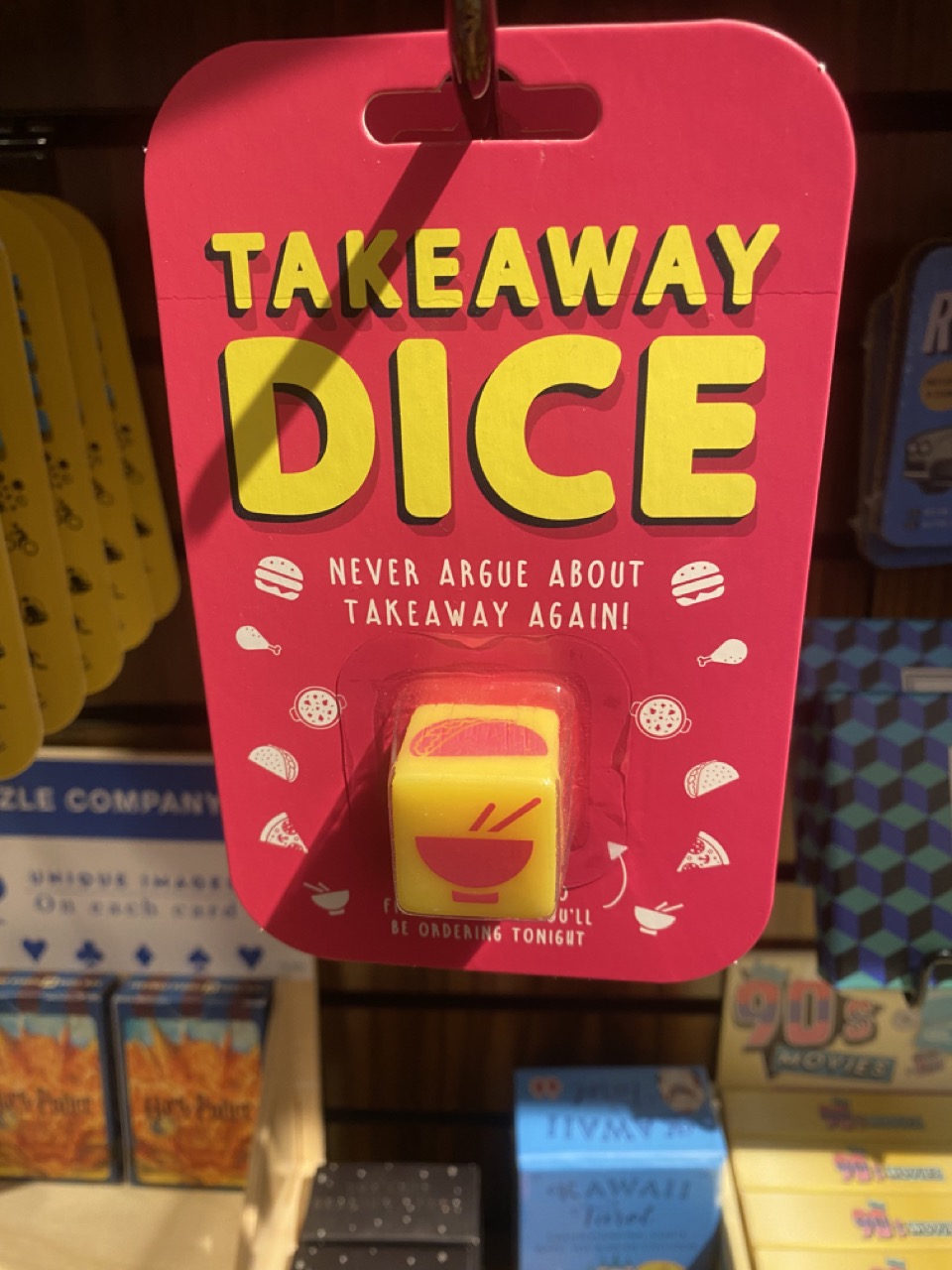
The idea being that you roll the die to determine what sort of “takeaway” food you will order and eat. My pulse quickened because I knew that “takeaway” was British English for American “take-out” or “carry-out.” My pulse went back to normal when I looked at the back of the product and saw it came from an English company, Gift Republic.
The sighting prompted me to do a little research. The three phrases (hyphenation practice differs) are all terms that popped up in the mid-twentieth century and can be used either as a noun (“we had take-out”) or adjective (“we had carry-out chicken”) referring to food brought home from a restaurant; “carry-out”” and “takeaway” can also denote an establishment that specializes in such service. (“When they got home, Margery and Buddy had left and there were slimy paper cartons from a Chinese carry-out on the bed”–J. Marrtin, Gilbert, 1982.)
As I say, “takeaway” is predominantly British and the other two American–although Lynne Murphy’s blog post on the subject notes that “take-out” is used in parts of northern England and “carry-out” in Scotland. The OED feels that in Scotland, the term refers to “Alcohol bought from an off-licence, supermarket, etc., or bought in a pub for consumption off the premises.” (“Two of the world’s best footballers bought a carry-out and went to a party in Castlemilk.”–Sunday Herald (Glasgow) 19 November 2002.)
In America, I believe that the choice of “take-out” versus “carry-out” is mainly regional. Growing up in New York, I only knew from “take-out” and can actually pinpoint the first time “carry-out” crossed my radar. It was in the fall of 1973, and for a college sociology course, I was reading Elliot Liebow’s Tally’s Corner (1967), a study of African-American “streetcorner men” who hung out on a particular intersection in Washington, D.C. On the corner, Liebow writes, was a shop called Tally’s Carry-out (I quote not from memory but from a copy of the book I got from the library).
The Carry-out shop is open seven days a week. Two shifts of waitresses spend most of their time pouring coffee, opening bottles of soda, and fixing hamburgers, french fries, hot dogs, “half-smokes” and “submarines” for men, women and children. The food is taken out or eaten out standing up because there is no place to sit down.
The fact that most Black people in Washington at that time would have come from the South supports the idea that “carry-out” is a Southernism.
The question remains, is “takeaway” used in the United States to refer to food? It’s hard to give a good answer because “takeaway” as a noun meaning an idea or lesson you “take away” from an experience so popular. But I delved into the record to find at least one example, from the New York Times just a few weeks ago. An article about what do do in Durham, North Carolina, says of the Saltbox Seafood Joint, “What began as a tiny takeaway shack in the Old Five Points neighborhood is now a spacious, but still frill-free, sit-down locale on Durham-Chapel Hill Boulevard.”
Now, if I could just figure out the difference between “ordering out” and “ordering in.”
 notoneoffbritishisms.com
Yesterday, a NYT writer used “whingeing,” which I’ve only seen in British writing. It’s hard to spell and pronounce.
You’ll see it in Australian writing – we use it to refer to English people (“Whingeing poms”)
It was discussed here in 2011. https://notoneoffbritishisms.com/?s=whinge
We use it in Canada and I once went to a meeting with the federal government – I worked for a trritorial government at the time – and all the federal public servants were wearing badges that said, “No Whingeing” signalling that they were tired of hearing us complain about the paternal hand of the federal government which often dictated what we did but also provided most of our revenue.
I’m assuming that the pot icon is for Indian food but the Mexican taco, while popular in the USA, would hardly ever be a possiblity for takeaway in most of the UK. Unless something dramatic has happened in the year I’ve been away. Seems like Gift Republic has its eye on the transatlantic market.
I thing the pot is actually a rice bowl – east Asian, not Indian. As to Mexican, a branch of Chipotle has just opened here in Guildford in southern England.
Or ramen noodles.
I’m not saying mexican food doesn’t exist, there are more than a few wahacas and chipotles around … it’s just not something that I’ve ever ordered to be delivered for dinner in the UK.
Actually, I rarely order food to be delivered.
Word reaches me via the excitable Daily Mail that something dramatic is happening here in England although it’s not Mexican but French taco. A Tik Tokers’ taco (!): “Not to be confused with the Mexican delicacy, the French taco is a gooey treat that is sending young influencers wild, rushing to pass on their recommendations from outlets in London and Manchester.” According to one purveyor: “The best way to explain it is it’s a mixture between a burger and a Shawarma.”
There was a New Yorker article a few years ago about this delicacy, which for some reason is always referred to in the plural, that is, “a tacos.” https://www.newyorker.com/magazine/2021/04/19/the-unlikely-rise-of-the-french-tacos
I’m thinking it could be a kebab rather than a taco.
A carry out in Scotland has always been alcohol. Food is a takeaway although these days I hear people referring to a Deliveroo, even if they have ordered via Uber Eats 🙂
I remember back in the seventies in the north of England a friend of my sister telling me a joke about the Last Supper. The punchline was that the disciples had been getting their food from Judas’s carryout, which in a Geordie accent sounds like Judas Iscariot. She went on to say that she tried translating the joke into French whilst on holiday, only to realise at the end that the pun doesn’t work.
For reasons that now escape me, I recall whilst chatting to 2 young French ladies in Boulogne in the 80’s trying to translate Fuzzie Wuzzie was a bear, Fuzzy Wuzzie had no hair, so he wusnae fuzzie, wuzzie? Which didn’t really work 🙂 Sadly, my French is no longer up to this task 😦
It’s interesting that you should mention that parts of Northern England say ‘take out’ instead of ‘take away’. I’m from the West Midlands and always say ‘take away’ but I have heard ‘take out’ said twice on the Yorkshire soap Emmerdale – I was unsure whether this was due to an American screenwriter but apparently not. On the other hand, I’ve only ever heard Scottish people say ‘carry out’ (or perhaps ‘carry oot’ or ‘Kerry oot’), I had no idea some Americans said that.
When I was a child in the North of England, my parents would refer to a Chinese ‘takeaway’ as as a ‘carry-out’. Then when I moved to London, I unconsciously assimilated ‘takeaway’, and did not have a clue why my parents used ‘carry-out’. I thought it must be their own made-up expression, because ‘takeaway’ seems to be the standard term.
Presumably “takeaway” is the term for ordering food and picking it up in at least parts of Wales, as indicated by Angela Hui’s book about growing up working and living in her parent’s Chinse take-out (AmE) restaurant: Takeaway: Stories from a childhood behind the counter
A term that’s also used in at least parts of Wales is ‘packed meals’ – there’s a takeaway called ‘Newton Packed Meals’ in Mumbles, near Swansea.
It looks like the author of that NYT article is based in Europe: https://twitter.com/ingridkwilliams