

I’ve previously noted the use of “range”–a handy British term for what Americans would call “product line”–in U.S. promotional materials from the British company Dyson and the multi-national Unilever. I’ll add to the list this sign I saw the other day in the Joyce Kilmer rest stop on the New Jersey Turnpike.
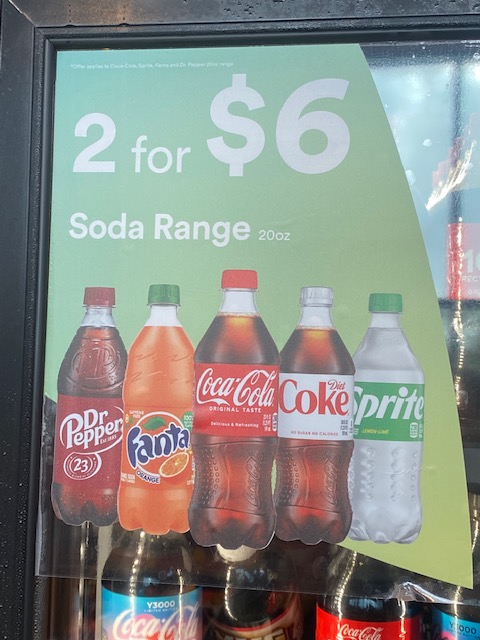
It’s an asterisk-y NOOB because the sign is from the Applegreen shop at the rest stop, and Applegreen started in Ireland and conducts most of its operations there and in the U.K. My guess is that it wasn’t going for a British or exotic feel with “range”; rather, its advertising boffins simply didn’t realize the word is not used in America.
I stopped at Kilmer on my way to Brooklyn to visit my daughter, and coincidentally, saw another “range” there that I count as a proper NOOB. It was in the Blue Bottle coffee shop in Williamsburg, and it was promoting a line of coffee-related apparel.

For more on “range,” read Lynne Murphy’s 2007 post on the word, and don’t neglect the comments.
A much less common (in the U.S.) commercial term is “custom” as in “thank you for your custom.” Americans certainly use the related “customer,” but we would say “thank you for your business,” or “patronage.” Hence faithful reader Tim Orr’s excitement when, he reported it in an email, he “was in a thrift store the other day, and this rocks glass practically jumped off the shelf and into my hands.”

Just for clarification, Michigan Beans isn’t another coffee enterprise, but rather a consortium supporting Michiganders who grow navy beans, pinto beans, etc.
Finally, and speaking of Dyson, I recently splurged on one of their fancy vacuum cleaners when it was deeply discounted on an Amazon Prime Day. I was struck by the last page of the User Manual.

Not only would an American company say “Taking care of” or “Caring for” instead of “Looking after,” but it certainly wouldn’t use such an admonitory tone. “Look after your machine.” “Look after your battery.” Hey, you’re not the boss of me!
 notoneoffbritishisms.com
Soda Range sounds wrong. Range of Sodas would sounds more natural, but even that sounds somewhat wrong. In the UK, something like Selection of Sodas would probably be used in that context, but of course, we don’t use the word, soda, except for soda water and bicarbonate of soda, we usually say fizzy drinks.
Or pop
Maybe “fizzy drinks” is used by younger people – it’s always been “pop” to me (British, aged 64, West Midlands). “Corporation pop” is available from the tap (faucet) when times are hard 🙂
I’d suggest that if the owners of the location at which you espied the
Applegreen advert ever decide to expand to the UK, they think twice
about their trading here under as “Blue Bottle. It’s a local name under
which the most unpleasant blow-flies are known!
And also, Bluebottle was a character voiced by Peter Sellers on The Goon Show.
It’s repeating the heading ‘Looking after your machine’ but in a truncated form and to me it does feel blunt. Instead, they could have made the individual headings the more familiar and natural ‘Care of your machine’ and ‘Care of your battery’, which don’t carry any taint of ordering you about.
I suppose that it depends on your geo-location.
Hereabouts (Wales), NaHCO3 is just ‘BiCarb’ and fizzy drinks are always called ‘Pop’
.
Somehow, the term ‘Range’ conjures up subconscious images of Gene Autry and Roy Rogers, though in a shopping context (meaning availability of an online product), it’s being eclipsed by the terms ‘offering’ and even ‘inventory’.
It is a living language, methinks.
Really interesting about the admonitory tone of “look after your machine”! As a BrE speaker, I don’t perceive it that way: I think I process it something like “[how to] look after your machine” or “[what to do in order to] look after your machine”.
It reminds me of the question of what’s grammatically happening when your computer shows you a button labelled “Save”, “Cancel” or whatever: is that an imperative, or an infinitive, or something else? https://www.reddit.com/r/linguistics/comments/llbkxr/are_computer_interfaces_semantically_imperative/
I like the ones that say “submit.” Seems like someone is into bondage.
I think Americans would say “selection,” rather than “range” in all those examples. Another comment on the instructions: I’d add “leave to dry” as British. Americans would say, “let it dry.” That’s also faithful to the significant British/American differences re the words “let” and “leave.”
I think “leave to dry” is a literal statement whereas “let it dry” is more of a directive meaning “allow it to dry”.
70-something American here, native to Texas. (Fled a couple of years ago.)
I had to think twice to see why the “range” of Samra products was a problem; I just read it as “adspeak” or something for “full range of products,” which is unremarkable to me.
Texans mostly call the fizzy stuff “coke,” as in, “Do you want a coke?”
“Sure; thanks.”
“What kind?”
“Got any Dr. Pepper?”
2 years in California has me flummoxed; I have no idea what to call the stuff here, but I’m pretty sure “fizzy drink” isn’t the right choice.
Also don’t Americans use the word “soda” for any kind of fizzy drink (i.e. not just for soda water)?
Well, yeah, we use “soda” in “soda water” or “soda pop” or just “soda,” all to mean “carbonated beverage.” But Texans use “coke” and others use “pop” alone.
Which means that when my daughter took me to Scotland and I wanted a [carbonated drink, preferably diet Coke or diet Pepsi], I walked up to a bar and stood there stumped for several seconds before I finally asked the bartender if they had soda water. You already know that what I got was what a friend of mine used to call “fizzy water,” but none of the syrup that would have made it Coke or Pepsi. I had to start all over again . . . .
Then again, I was in Cologne a few years ago and in a fast food place in the station I ordered currywurst. I wanted a cola to go with it so I said “mit ein Cola bitte.” And I got a beer. The local beer is called Kolsch so I guess he misheard me.
I agree with DJW, above, that the modified version “full range” would be totally normal in American usage.
That ‘look after’ wording strikes me as an example of ‘plain English’ which is all the rage – we are told to be direct and use active speech. I hate it, it comes off too colloquial, or in this case, pushy.
I don’t view “look after” as any more admonitory than “care for” in this context.
Your comments about the Dyson guide reminded me of the M16A1 Rifle: Operation and Preventive Maintenance guide, which was written by Will Eisner in 1968. That used, um, a different phraseology.
Outside this blog, I think I would interpret “value your custom” as a well-meaning attempt by someone who was not a native speaker. Glad to know if I ever encounter it in the wild, that is not the case.
‘Look after so and so…’ isn’t really meant in an admonitory tone, at least not to a Brit or an Ozzie. It’s simply a shortened form of ‘How to look after…’. Less time spend on words = more time at the pub! 😉