

Back when this blog began, in the very early days of 2011, the entries were short: a definition, a couple of citations from American sources, and a poll asking readers if they thought the term in question, in an American context, was “Perfectly Fine,” “Borderline,” or “Over the Top.”
Naturally, I started with the low-hanging fruit: British expressions that had firmly and unquestionably taken home in the U.S. And one of them was “gobsmacked,” a slangish term meaning (the OED says), “Flabbergasted, astounded; speechless or incoherent with amazement.” The etymology is “gob”=mouth and “smack”=smack, that is, something so surprising that you strike yourself in the mouth. And by the way, the poll results were 46 percent perfectly fine, 19 percent borderline, and 35 percent over the top.
Filling in the picture a little bit, the word comes from Yorkshire. The OED has a citation from 1935 but in 1980, politician Roy Hattersley, a native of Sheffield, wrote this sentence, which suggests it still hadn’t achieved wide currency: “It was his dazzling display of simultaneous social and intellectual sophistication that left me, in the patois of the place whence I came, ‘gob-smacked’.”
Neatly, Google Books Ngram Viewer shows sharply increasing popularity in Britain starting precisely in 1980.
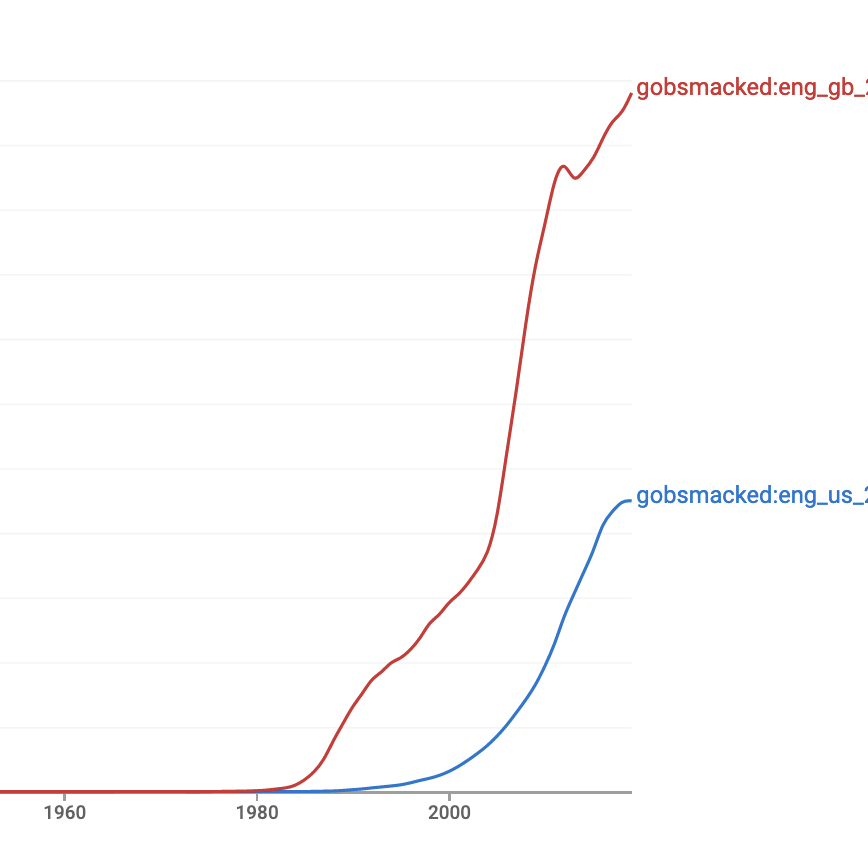
As the blue line shows, American use started going up in the 1990s and is still quite robust. The New York Times has used the term fourteen times in 2021, most recently in a review of a play about Henry James and Edith Wharton, where they are depicted “as giggling, snarking, gobsmacked adolescents.”
This all comes up because I recently got an email from a reader named John Hicks:
“In Rebecca Donner’s (excellent) book ‘All The Frequent Troubles Of Our Days’ — a factual historical account of German resistance groups in Nazi German — she tells us on page 278 that:
“[US Secretary to the Treasury] Henry Morgenthau had long ago concluded that the reports the diplomats and attaches in Berlin dispatched to Washington were nearly useless. He didn’t want summaries of newspaper articles or street gossip. He wanted numbers. He wanted facts. He wanted feet-on-the-ground intelligence, and he was gobsmacked that he couldn’t get it.”
“I was quite gobsmacked myself to learn that US government officials were getting gobsmacked in 1937. “
Indeed.
 notoneoffbritishisms.com
It is not clear from the example whether Henry Morgenthau personally used the term “gobsmacked”, or whether it is merely Rebecca Donner using it to describe the manner of Morgenthau’s reaction.
It seems clear enough to me that she is using it as a descriptor, not a quotation, but this is the sort of thing that can pull readers out of a historical narrative, and some historical editors discourage. It’s becoming more common – I saw an article written in the 19-teens described as “going viral” in a book a while back – but maybe that’s a subject for another blog: Not One-Off Anachronisms, maybe?
Yes, I expect that Henry Morgenthau reached out to the diplomats and attaches to explain what he wanted going forward.
Agree! Unless Rebecca Donner is herself a Yorkie (Yorkshire tyke?), she probably ought not to use “gobsmacked” in this way, leading to confusion.
I suppose that might’ve been true 35 years ago. Today it’s standard slang, more or less worldwide.
Is there a word for anachronistic language? If they are historical enough, I suppose all historical novels use it.
I remember reading a story set in an historical period – possibly eighteenth century – in which someone said, “Shall we cut to the chase?” a phrase associated with the movie industry.
Yes. In discussion of the books of Dorothy Dunnett (author of excellent historical novels) and the (very few) anachronisms therein, I came up with a classification system for anachronisms, and this would could as a Class III Anachronism. http://simonhedges.com/anachronisms.htm
In our family we say flabbersmacked.
What about other ‘gob’ words and phrases? Are these used in the US? For example:
– gobby
– gobstopper (often attributed to Roald Dahl but definitely around in the UK in the 1950s
– gobshite (said to be of US origin but popularised by the Irish)
– rentagob
Here’s my post on “gobstopping” https://notoneoffbritishisms.com/2012/03/31/gobstopping/. And “gobshite”: https://notoneoffbritishisms.com/2013/01/29/gobshite/ The others, not yet.
I honestly can’t make sense out of “giggling, snarking, gobsmacked adolescents”. Giggling and snarking, fine. But not gobsmacked.
Pascal Tréguer does a great deal of original research in local newspapers on the history of regional expressions at his blog wordhistories.net, and he’s found earlier written records of “gobsmacked” dating from 1925, 1926, and 1927 in Lincolnshire and Yorkshire, and additional examples from 1936 and 1937. These discoveries were posted in 2022 at gobsmacked on his blog, so they could have been acknowledged in your book published in 2024 — it’s too bad they weren’t. Ben, you really should be following that blog.
Another good earlier discussion should be acknowledged: Gobsmacked by Michael Quinion at World Wide Words. Quinion has an explanation of how it went national: “One reason why it starts to appear in print in the 1980s is that it was used by the writers of gritty television series set in northern cities, such as Alan Bleasdale’s Boys from the Blackstuff, about five Liverpudlian tarmac layers, and Coronation Street, set in a fictional suburb of Manchester (Jeffrey Miller included it in his glossary Street Talk — The Language of Coronation Street in 1986).”