“Tuck into”

Some friends and I were exchanging e-mails about two possible menus for a planned get-together. One of them wrote: “We, too, will happily tuck into either option.” (He was speaking for his wife, not using the royal “we.”)

That naturally made me think about the expression “tuck into”–meaning heartily eat–specifically that I’ve encountered it quite a bit recently. For example, a February 13 New York Times article about the American figure skater Adam Rippon notes that on the day of the interview, “he went to a restaurant and tucked into a lunch of leafy greens tossed in Caesar dressing and topped with pieces of seared ahi tuna.” A February 16 article from the (California) Mercury News about eating more healthily advises, “Tuck into a banana instead of a bag of pretzels.”

I suspected this was a Britishism, the rough American equivalent being “dig into.” My investigations confirmed my suspicions. A Google News search for “tuck into” yielded 18 hits, and the only American source was the Mercury News article. Most of the rest were British, with a few from Australia and one each from Israel and Malaysia.

I asked Anglo-American linguist Lynne Murphy her thoughts and she said she thought it sounded “Britishish.” Being a scientist, she tested the hypothesis with non-anecdotal evidence and searched the Corpus of Global Web-Based English (CoGWBE)–which contains 1.9 billion words, all from 2012–for the expression “tucked into a.” There are 46 hits from American sources, but none of them relate to food, instead to other things that can be tucked, such as shirts into pants or content into legislation; from PBS.org, “Even just a few lines tucked into a lengthy bill.” On the other hand, 17 of the 43 British hits referred to food, such as this caption to a Daily Mail photo showing then-Prime Minister David Cameron watching a basketball game with Barack Obama: “As befits a spectator at a U.S. sports event, the PM … tucked into a hot dog, with Mr Obama, washed down with a Coke.”

According to the OED, the verb “tuck” began to be used in reference to food in the late 1700s, to imply “put away” or “put out of sight.” It quotes an 1834 source: “Now that I’ve cured you, you’ll be tucking all that into your own little breadbasket.” Note that the food is tucked into a person. Eventually, “tucking in” became an intransitive verb and is still about; Green’s Dictionary of Slang quotes The Guardian, 2000: “The 500 faithful meet, greet, chat and tuck-in.” The first to use transitive “tucking into,” not surprisingly, was Charles Dickens, one of the great literary appreciators of food. In Nicholas Nickleby (1839), a character says, “If you’ll just let little Wackford tuck into something fat.” According to Green’s, “tuck” was first used as a noun to mean food in 1835. In Australia and New Zealand, this was lengthened to “tucker” as early as 1858 and is still used. In Trevor Noah’s wonderful memoir Born a Crime, he talks about the “tuck shop”–snack bar–at the school he attended in South Africa.

All the above citations are from British or Commonwealth sources. And so are the rest in the OED and Green’s. As recently as 2012, the CoGWBE suggests, the expression was still overwhelmingly British. But–at least as far as “tuck into” goes–things have changed.
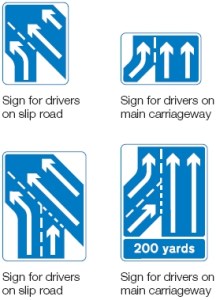
“Slip road/ramp”

13g
An image from ukmotorists.com

I need to come up with a term for the phenomenon where Americans adopt a British term but get it wrong. It has come up quite a bit on this blog, recently with “garden/ing leave,” and now with this term for what Americans call and “on [or entrance] ramp” or “off [or exit] ramp.”

The OED defines “slip road” as “a short (usually one-way) road giving access to or exit from a main highway, esp. a motorway; an approach road.” The first citation is from 1953; it and all the other ones are from British sources.

On January 25, Lynne Murphy, of the Separated by a Common Language blog, tweeted this as her “Difference of the Day.” @zekeys_mom responded, “‘Slip ramp’ is creeping into AmE. Used for toll road, minor exits to relieve congestion at major exits. Must have an auto-pay EZPass [the regional electronic toll collection system] to use it.”

Note: she said “slip ramp,” not “slip road.” When I checked Google Books for “slip road,” all the hits appeared to be from British sources, except a quote from a 2014 book by David Reynolds called Slow Road to Brownsville (Texas): “I took a slip road off 83, thinking it would lead into town—and found myself on a dark and crowded interstate heading west away from town.” But it turns out Reynolds is a Brit who wrote about his U.S. travels. I checked the New York Times archives and found “slip road” had been used exactly twice–once in a Reuters news article from London, and once in an article about Formula One car racing. Further research suggested that the term is used racing to mean a sort of escape path, for example: “That wing of his ended up 100 yards from where the car ended up down the Turn 1 slip road.”

That’s pretty much it for U.S. “slip road.” “Slip ramp” is another story. There is no definition for it in the OED, dictionary.com or merriam-webster.com. However, @zekeys_mom sent some links with uses of it, including a 2002 news release from the (U.S. state of) Pennsylvania, which helpfully defines the term: “The Pennsylvania Turnpike Commission today announced it will not advance preliminary plans to design and construct two ‘slip ramps’ — which are unmanned, E-ZPass only ramps built between existing interchanges.” The quotation marks indicate a newish usage, but as of 2015 it still hadn’t taken hold; a Pennsylvania newspaper article that year refers to “so-called slip ramps.”

Consulting Google Books, I found the earliest use of “slip ramp” in a 1959 issue of a state of California publication,  “California Highways and Public Works.” The caption to a map says, “The circled ‘A’ and arrow point out the new slip ramp on the Harbor Freeway.” This was long before the invention of E-ZPass and such systems and suggests the term was used more generally, for exit ramp.

But it’s been used in different ways as well, as shown by a 2011 discussion on the AARoads Forum. Someone asked, “Maybe I’m crazy, but I don’t know exactly what a slip ramp is? What is it, and how does it differ from a normal freeway exit ramp?”

The answers were somewhat all over the map. A San Diegan said he had always used it to mean “a ramp between parallel sets of carriageways – for example, freeway main lanes to the frontage road, or vice versa. Basically, you end up ‘slipping’ over a few feet, but going in the same direction as before.” A number of commenters agreed with this, but a New Jerseyan posted, “My understanding was that it was a connector between two freeways, that was full speed, at least that is what I think.”

Then a Bostonian said, “I’ve regularly heard and used the term to refer to a right turn at an intersection separated by an island of some sort from the intersection, like this example at Causeway and Washington Streets in Boston.” But then someone else said that what he was really talking about was a “slip lane,” not a “slip ramp.” (I’m not sure why I assume all these people are male, but I feel pretty confident about it.)

Someone from Virginia said, “I remember the old version of the AAA map of Northern Virginia from the mid-1980s used the term ‘slip ramps’ … in reference to the ramps connecting the Dulles Toll Road and the Dulles Access Road. For those unfamiliar, it’s a quad-carriageway with two carriageways in each direction; the inner (free) ones serve airport traffic and the outer (tolled) ones serve local traffic.”

No one could top (or possibly understand) that, and the discussion ended.