“Takeaway”

Sign for a San Francisco takeout joint

Takeout and takeaway (hyphenated versions are also commonly found) refer to food purchased in a restaurant or other shop and consumed at home. Both terms can be adjectives or nouns and can refer to the meal itself or the establishment that prepares it. OED describes take-out as “orig. U.S.” and finds it first in a line from James M. Cain’s 1940 Mildred Pierce: “Pies she hoped to sell to the ‘take-out’ trade.” Again according to the OED, take-out arrived in the U.K. no later than 1970, when The Times reported, “One of New York’s finest restaurants will provide gourmet ‘take-out’ lunches for the hard-pressed executive.”

By contrast, all of the OED’s citations for takeaway are from the U.K. or British Empire outposts, commencing with a 1964 quote from Punch: “Posh Nosh‥was serving take-away venisonburgers.”

Takeaway (in the food, rather than the golf-swing, football-interception-or-fumble, or business-jargon, sense) felt strange in the U.S. as recently as 1977, when the New York Times noted about Terence Conran’s new New York furniture store, “delivery is discouraged, and everything stocked carries a tag that says, ‘takeaway price.'” But it has made itself comfortable over here in recent years–for example, in this headline two days ago from the blog Culturemap Austin (Texas): “Fresa’s Chicken al Carbon brings a giant chicken mascot and fresh take-away food to Austin at a decent price.”

Or this from a New York Times review last year of a Brazilian restaurant in Queens: “For takeaway, banana and cassava cakes ($2.75 each) travel well.”

Thus, for my money, takeaway is a clear-cut NOOB. However, I have a nagging sense that I encountered it long ago (I’m talking a half-century) in the Washington, D.C., area, and at the time did a mental double-take to find it instead of the more familiar takeout.

Normally, when I want to look up a word in the Dictionary of American Regional English (DARE), I’m frustrated, because I only possess Vol. V., which covers Sl-Z. I got excited because both takeout and takeaway fall within its purview. However, DARE doesn’t have an entry for either one. Help?

Update, 4/21: The comment from Laura Payne, below, made me realize I was mistaken about remembering takeaway being used in Washington. The term I actually encountered was carry-out.
“Weds.”

“[Charles] Manson is scheduled to have a parole hearing at Corcoran State Prison in Central Calif., on Weds., April 11, 2012.” St. Louis Post-Dispatch

“Romney Coming to Delco on Weds.” Headline, PoliticsPA.com

“Smokers asked to ‘Kick Butt’ on Weds.” Headline, Wwlp.com (Chicopee, Mass.)

For some years, I have been noting an increasing tendency to abbreviate Wednesday as Weds. rather than the (U.S.) traditional Wed. This annoys me. Wed. is shorter (always a good thing in an abbreviation), and Weds. elides two letters (ne), never a good thing in an abbreviation. There is, in short, no reason for it.

I had a hunch that Weds. is of British origin, and a Google News search for “on Weds” (you can’t just search wed or weds for obvious reasons) returns more U.K. hits than U.S. ones, but that’s hardly scientific. I consulted my go-to expert, Lynne Murphy, who kindly conducted a survey of British informants. The results: 67 percent favored Weds. That sounds scientific. Unfortunately, the sample size was three.

Wherever it came from, I wish it would stop.

New York Times outliers: “maths,” “trainers” and “mate”

The New York Times publishes a lot of words, including some by me. So it’s not surprising that its contributors would occasionally let loose with some truly (presumably?) one-off Britishisms. Three recent examples:

“We keep reading that someone has done the maths and found the third Monday in January to be the most depressing day of the calendar year.” (Freakonomics blog, January 16, 2009)

“For the rest of us, the lesson might be that even if you’re not interested in going barefoot, you might want to invest in a slimmed-down trainer.” (Well blog, March 12, 2012. Note: trainers is British English for sneakers.)

“Jefferson Mays makes an effectively sweaty impression as a squirrelly former Army mate of Cantwell’s…” (Charles Isherwood, review of “The Best Man,” April 1, 2012.)

Note: the extremely common American phrase is Army buddy. I had always suspected that Isherwood is English, I imagine because of example of Christopher Isherwood. But apparently he is not:


European date format

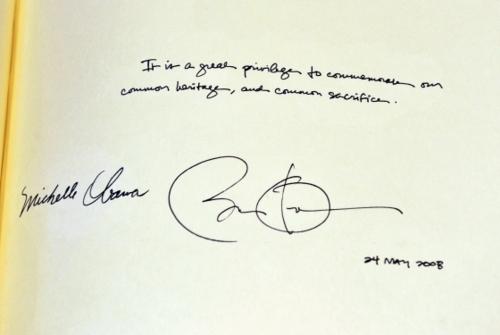
Perhaps thinking "When in Rome...," Barack Obama used European format when he signed the guestbook at Westminster Abbey. Unfortunately, he got the year wrong (it was 2011).

In the United Kingdom and, in fact, most of the rest of the world, today’s date would be indicated 9 April 2012 or 9/4/12. In the U.S., it would be April 9 (or 9th), 2012, or 4/9/12. We tend to think (as in most things) that we are doing it the “normal” way, but, Europe Blog notes, “The only countries that do not share the European date format in fact are the US, Philippines, Palau, the Federated States of Micronesia, Canada and Belize.”

(Interestingly, the blog goes on, the European Union and other international organizations do not use the European style but rather the “‘ISO 8601’ standard date format. Here the organisation is closer to the US dating but with the year placed at the start, for example ‘2010/12/20’.”)

In my opinion, the U.K./European way looks cooler than the U.S. style; it also avoids having to use commas and decide whether to write 9 or 9th. It is, in any case, getting more and more popular over here, as in this post from the web site Military.com:

Ah, another holiday weekend approaches and I’m getting tons of mail asking “When will we get paid?”   Folks, payday is Tuesday, 15 November 2011.  You’ll get paid on Tuesday, or on Monday if your bank releases direct deposit pay funds early.

On the radar: “Bollocks”

Lynne Murphy alerted me, via Twitter, to this photograph posted on the UK website The Poke:

It inspired various thoughts.

  1. Bloody good advert!
  2. The Poke includes no text with the photo, but the sign advertising “NY State Inspections” suggests that is was taken, in fact, in New York.
  3. The Poke (whose motto is “time well wasted”) appears to specialize in Photoshopped or otherwise altered photographs, so I am not sure if this is the real deal. I would be interested in hearing from anyone who has eyeballed it.

“Gobstopping”

My friend Andrew Feinberg e-mailed me as follows:
I just came upon the following in a new book called “The Escape Artists:  How Obama’s Team Fumbled the Recovery,” by Noam Scheiber.  On page 41 Scheiber writes:  “Simply put, Summers believed that a $1.2 trillion proposal, to say nothing of $1.8 trillion, would be dead on arrival in Congress because of the political resistance to such gob-stopping sums.”

Personally, I was gob-smacked by this locution and so startled that I gobbed on my carpet.  Where it all will end knows Gob.
 
For the record, Scheiber was a Rhodes scholar.  Have you come across “gob-stopping” before?

Well, no–and neither, I discovered, has the Oxford English Dictionary. The OED does, however, have an entry for gobstopper, to wit: “a large, hard, freq. spherical sweet for sucking.” Fans of Roald Dahl may recall the “Everlasting Gobstopper” featured in “Charley and the Chocolate Factory” and the subsequent film “Willie Wonka and the Chocolate Factory.”

Is Noam Scheiber alone in making a sweet into an adjective having nothing to do with sweets? Well, no again. It has been used a total of three times by The Times (of London), most recently this by A.A. Gill in October 2011: “…if you ask me, and I suppose you are, to recommend just one gobstopping, heart-racing dinner in all of London, it would be Hedone.”

Moving to the New York Times (of New York), it appears exactly once, in a 2007 quote from the blogger Sara Robinson: “Reading [Steven] Gilley on NYC was like reading Molly Ivins on Texas. You could only sit back, mute, at the gobstopping wonder of it all.”

Gobstopping and the phrase a gobstopper of a show up occasionally in various internet outposts, generally meaning something along the lines of astounding or amazing. (If you have tender sensibilities, I suggest you do not read the entries at Urban Dictionary, which are very different.)

My best guess is that gobstopping happened because gobsmacked doesn’t easily converty to an adjective meaning that which causes one to be or feel gobsmacked. But behold, gobstopper already existed, and the suffix -stopping did, too, in such words as heart-stopping and show-stopping. Hence, gobstopping.

Make sense, Andrew?

“Roundabout”

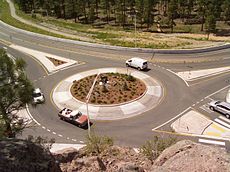
A proper roundabout

My NOOB ears perked up when I recently read in my local newspaper, The Swarthmorean, this line from an editorial supporting a local traffic project: “The proposed single-lane traffic-circle, or roundabout, with proper signs, would direct traffic to multiple destinations at slower rates of speed.”

What got my attention wasn’t a proper, which I’ve already covered, but roundabout, which struck me as a NOOB variant of the tried-and-true U.S. traffic circle or rotary. Sure enough, quite a few U.S. uses turned up, for example, this article posted today in the East Cobb (Georgia) Patch.com: “Dozens of East Cobb residents brought questions and concerns to Monday night’s information session about the roundabout being installed in their neighborhood this summer.”

Turning to the OED, the dictionary indeed says that roundabout, in a traffic sense, is “orig. and chiefly Brit.” The definition:

A junction of several roads consisting of a central (usually circular) island around which traffic moves in one direction. Vehicular roundabouts developed from large-scale circuses or rond-points in France and America … Typically smaller in size, British roundabouts are sometimes distinguished from similar junctions by the rule in which oncoming traffic must give way to traffic moving around the central island. Traffic circle and rotary are the more common terms in America …

The first citation comes from The Times in 1926:  “A protest should be made‥against the uncouth, Latinese word ‘gyratory’ to express the new traffic arrangements‥. Why not use the simple English word ‘round-about’?” The OED also quotes a 1966 U.S. source observing, “In my lifetime I have seen the traffic circle of the Middle Atlantic States become the rotary of New England.”
But the difficulty in labeling roundabout a NOOB lies in the difference among the three terms for circles into which traffic enters and from which it emerges. Wikipedia observes: “In the U.S., traffic engineers use the term roundabout for intersections in which entering traffic must yield to traffic already in the circle, reserving the term traffic circle for those in which entering traffic is controlled by stop signs, traffic signals, or is not formally controlled.” Or, in New England, rotary.
Complicating matters further, roundabouts are apparently on the way to supplanting rotaries and traffic circles in the U.S. A 2009 BBC piece focused on the town of Carmel, Indiana, which has built more than 80 roundabouts under the leadership of its mayor, a fervent proponent of the concept, and bids fair to become the Milton Keynes of the Midwest–that English city apparently being celebrated for its roundabouts.
So maybe my town isn’t building a rotary or a traffic circle but a roundabout and only a roundabout. And maybe roundabout isn’t a NOOB but rather a NOOBT–that is, a Not One-Off British Thing. I will let you know.

“Barman”

This is a pure play. By that I mean there is a precise (?) U.S. equivalent, bartender, so that the use of barman in the U.S. can be explained only by the  desire to use a Britishism, or the conscious or unconscious imitation of others who have done so. (I suppose another possibility is retrograde sexism.)

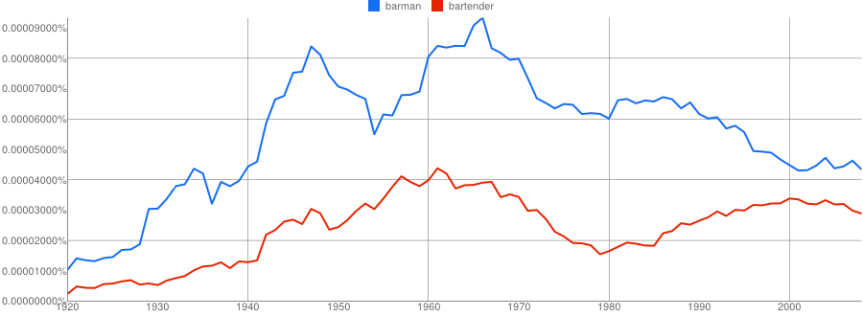
According to this Google Ngram, the use of barman increased about 20 percent in the U.S. between 2000 and 2008 (actually, between 2000 and 2005; it has held steady since then):

(It’s interesting to look at an Ngram, below, showing the use of barman [blue] and bartender [red] in British English between 1920 and 2008. At least since about 1960, it appears to be a case of an encroaching Americanism, with the two terms recently nearing equality. However, barman is still used about twice as often in Britain as in the U.S., and bartender is six or seven times more prevalent in the U.S.

)

The New Yorker has used barman 34 times from 1937 to the present, including in a 1939 poem called “Forsaken Barman,” a 1964 Talk of the Town piece called “Barman,” and this, from a January 30, 2012, Profile by Nick Paumgarten:

He cuts off the drinks, keeps spare umbrellas on hand for sudden squalls, shuffles customers around to make space for someone’s mom, and, like any barman with a following, dispenses a lot of free drinks.

But you can find the word in all sorts of other sources as well:

“Whiskey You’re the Devil”: The best version of this traditional song is the one you sing right before the barman kicks you out. (Rosie Schaap, New York Times, March 8, 2012)

I grabbed a spot at the bar and was immediately greeted by the friendly barman, Christopher. (HoustonPress.com, March 2, 2012)

Etc.