

 Noun or adjective corresponding, respectively, to the U.S. redhead and redheaded or red-haired. Also a nickname for a ginger person (equivalent to U.S. Red) as in drummer Ginger Baker or singer Geri “Ginger Spice” Halliwell (impressively, the second consecutive Spice Girls reference in NOOBs).
The term first appeared on my radar when, in London in 2004, I read this sentence in the Daily Telegraph: “The ginger asthmatic was always going to struggle in Coimbra’s oppressive heat.” I eventually figured out that this was a reference to footballer Paul Scholes–and “the ginger asthmatic” still ranks as my favorite all-time example of the class of misguided synonym that H.W. Fowler referred to as “elegant variation.”
Undoubtedly, the term gained traction in the U.S. with the popularity of the Harry Potter books. According to the Harry Potter Wiki, “Scabior, Fenrir Greyback, and a drunk man on Tottenham Court Road” all referred to Harry Potter’s famously ginger-haired mate Ron Weasely by this term.

The term has a long and sometimes unsettling history in Britain. According to Wikipedia (don’t judge me! there are footnotes!)
A UK woman recently won an award from a tribunal after being sexually harassed and receiving abuse because of her red hair;[55] a family in Newcastle upon Tyne, England, was forced to move twice after being targeted for abuse and hate crime on account of their red hair;[56] and in 2003, a 20 year old was stabbed in the back for “being ginger”.[57] In May 2009, a British schoolboy committed suicide after being bullied for having red hair.[58] The British singer Mick Hucknall, who believes that he has repeatedly faced prejudice or been described as ugly on account of his hair color, argues that Gingerism should be described as a form of racism.
Ginger prejudice arrived in the U.S. in 2005 with an episode of the animated comedy series “South Park” entitled “Ginger Kids.” In the episode, a satire on racial and other sorts of prejudice, “Cartman rallies all other ginger kids to rise up and assume their role as the master race” (in the words of the series website). As is often the case with satire, there were unintended consequences. A 14-year-old Vancouver boy started a Facebook group devoted to “National Kick a Ginger Day”; it attracted almost 5,000 members, and the founder was eventually investigated by the Royal Canadian Mounted Police for possible hate crimes
Marc Torsilieri, who looked like a ginger-bearded lumberjack and played the part in splendid fashion by annually felling the Christmas tree for Rockefeller Center, died on March 12 in Somerville, N.J. (Douglas Martin, New York Times, March 17, 2007)/Scarlett Johansson, who is now a ginger, and Donald Trump. Really, I would love to know what’s being said here. “Scarlett, I’d like to bring you back to the Trump Tower so I could tell you you’re fired while we make love on a bearskin rug.” “OH DONALD YOU’RE TOO MUCH! HAHAHAH, don’t you know I’m with Sean Penn now?!” (photo caption, BostonHerald.com, May 1, 2011)
 OED cites a 1914 use and defines it as “Smart, stylish, splendid, luxurious. Also (chiefly Brit.): typical of or belonging to the upper class; (affecting to be) superior or genteel; ‘snooty’, pretentious.” The closest American equivalent would be fancy, or maybe fancy-schmancy.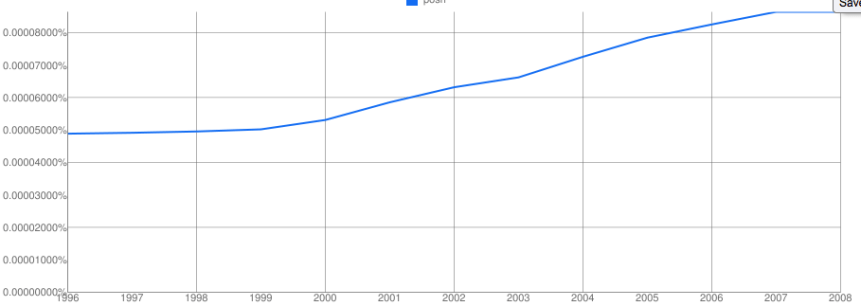




 Verb, transitive or intransitive. The OED’s definition:
 notoneoffbritishisms.com