Catching up on New Yorkers, I happened on a poem by John Koethe, which begins:

It’s a great poem, but, needless to say, what mainly interested me was Koethe’s use of covers band instead of cover band — to mean a musical combo whose repertoire consists of songs popularized by other performers. It was a new example, to me, of a phenomenon I’ve discussed before — the growing pluralization of attributive nouns, such as Yankees fan replacing Yankee fan. As with such phrases as jobs (instead of job) report, drinks (instead of drink) menu, and books (instead of book) editor, the covers band example is consistent with the trend of Americans (Koethe was born in San Diego) adopting British usage. Of course, plural forms have not been unheard of in the United States: for example, parks commissioner or Antiques Road Show. But more and more attributives have become plural; I actually have the sense that I had never before even confronted covers band.
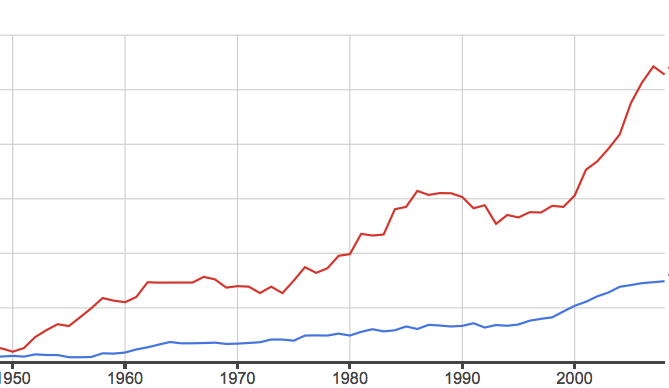
This Google Ngram Viewer chart confirms that it has been rare in the United States, while (interestingly) roughly equally common as cover band in Britain.

In a sort of Woody Allen-Marshall McLuhan moment, I tweeted at The New Yorker copy editor Mary Norris, wondering about the use of covers in the Koethe poem. She responded:

Oldies station — a radio station that plays old songs — is indeed a longstanding formulation here. Maybe it’s a music thing?
That doesn’t appear to be the case. In a 2002 paper, the linguist Elisa Sneed refines the work of Maria Alegre and Peter Gordon in determining the circumstances in which plural attributives tend to be used. There seem to be two important factors. The first is “abstractness.” Sneed writes: “Something not easily imagable, such as a process (admissions), an action (assists), a thing (benefits), or something that is otherwise complex (dissertations) is abstract; something easily imagable and simple conceptually, such as pencils or flowers, is concrete” (italics added).
So dissertations index sounds okay; *flowers pot does not.
The second factor is heterogeneity in the head (final) noun of the phrase. Sneed gives the example of analyst as a head noun that promotes “diversity among the entities denoted by the internal noun” and pile as one that highlights homogeneity. So we might say weapons analyst but weapon pile, as well as cookie jar and sock drawer.
She provides this nifty predictive chart, explaining, “Compounds that most closely meet the requirements for abstractness and heterogeneity will be perfectly acceptable, like admissions department. However, as we move away from the ideal in either dimension, the compound becomes less acceptable. This is illustrated by the difference between antiques dealer and antiques collector in the iso-acceptability diagram, where the latter is farther from the ideal.”

Three other wrinkles. First, irregular plurals tend to be more acceptable than regular plurals as attributives. We might say mice droppings but never *rats droppings. Second, as noted by David Crystal, the plural is often used in cases when meaning might otherwise be ambiguous or misleading. Thus, in baseball, a batter who doesn’t have enough power to produce doubles, triples, or home runs is a singles hitter. To call him a single hitter might mean that he’s just one hitter, or that he’s unmarried. Finally, the plural is used in cases when a possessive apostrophe is understood, such as farmers market or the street in Philadelphia where you go to buy a wedding ring, Jewelers Row.
I haven’t found a source that discusses, much less explains, the British preference for plurals even when Sneed’s criteria are not met, or the recent American tendency to adopt these expressions. Going back to the original example, there definitely is a sense of heterogeneity — it wouldn’t do to play the same song over and over again. But one has a concrete rather than abstract sense of the repertoire, be it “Proud Mary” or “Get Off of My Cloud.” Yet John Koethe chose and insisted on covers band. It is a puzzlement.
The one thing I’m fairly certain of is that the plural trend will continue, and that the tendency will be to call it the plurals trend.






 notoneoffbritishisms.com