“Cross”

I was perusing Twitter the other day when this turned up in my news feed (written by an American):

Luxembourg must be cross that the UK gets to provide the social services and they collect the taxes from amazon: shelf-awareness.com/theshelf/2013-…

The OED  defines cross in this sense as “Ill-tempered, peevish, petulant.” All the citations are British, including Austen’s Pride and Prejudice (1813): “I have never had a cross word from him in my life.”

This is certainly not an unknown word in the U.S. But it is an old-fashioned one, with a rather twee feel to it. Dawn Powell used it (along with a similarly antique verb form) in her 1944 novel My Home Is Far Away: “In the morning he was cross if they waked him.” I associate the word with bordering-on-precious children’s books, as in anthropomorphic bears and ducks who are cross if they don’t get their porridge on time.

As the tweet suggests, the word appears to be getting some broader currency, in part because of the current appeal of NOOBs and in part because it occupies a useful spot on the ever-wider spectrum of annoyance, along with irked, frustrated, and pissed off.

In June 2012, a writer for minnpost.com observed, “Trying to understand all this made me cross.” And health policy expert Uwe E, Reinhardt wrote in the New York Times in March 2013: “I wouldn’t be surprised if the New Jersey hospital industry was cross at me and the commission for our role in the passage of Assembly Bill.”

My favorite recent American use comes from blogger Everett J. Smith, who titled a recent post post, simply, “The Pope Makes Me Cross.”

“Fit”

There are two relevant senses of the adjective. The first, a commonplace in British sport commentary, is more frequently expressed in the U.S. in the phrase physically fit. But the shorter form is creeping through, thanks in some measure to tennis players, announcers, and reporters, who are partial to it. Thus the New York Times last year quoted Dominika Cibulkova of Slovakia, who had commented that Samantha Stosur “played like a man.” Asked to clarify, Cibulkova said, “As a player, she’s very fit. I’m not saying anything bad.”

A British reader of that quote may have had the impression that Cibulkova fancied Stosur, as the second British meaning of fit is “sexually attractive. The OED cites this 1985 exchange from The Observer: “Better ‘en that bird you blagged last night.’ ‘F—— off! She was fit.’”

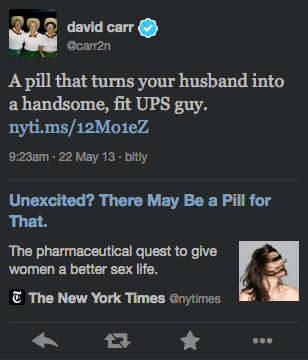
I had never encountered a U.S. use of the second fit till this morning, when New York Times media correspondent David Carr sent this out over Twitter:

Screen Shot 2013-05-22 at 9.24.09 AM

Now, it’s possible that Carr was merely imagining a United Parcel Service employee who regularly went to the gym. But where’s the fun in that?

“Nervy”

I was reading The New Yorker the other night (the March 25 edition–I’m always a few weeks behind) and came across this description of 1970s punk rock: it was “spare, nervy music created in reaction to the embarrassing excesses of arena rock.”

It reminded my that my friend David Friedman, a massive West Ham supporter, had for years been telling me about the British use of nervy, especially in a sporting context, to mean something similar to what Americans call nervous.  I found this example, which is British in every possible way, in a headline on a website called “This Is Staffordhire”: “It’s getting nervy for all as Stoke City enter relegation battle.”

We use nervy, too, but here it’s traditionally meant something between audacious and impudent. The OED cites a 1991 short story by Joyce Carol Oates: “I was nervy enough to ask Joan how she’d gotten the little scar beside her mouth.”

Is nervy=nervous happening as a NOOB? The difficulty in answering is that in many quotes you have to study context clues to figure out how the word is being used. In the New Yorker quote, based on my sense of punk as a pretty twitchy affair, I think the British sense is being used. Same with these from the New York Times:

  • “Ms. Rebeck has created a noisy roomful of sharp-tongued characters who are uncomfortable in their own skin — none more so than the self-conscious Lorna, who is preoccupied with dieting, and her nervy brother Jack, who is elusive about his sudden return from New York.” (November 2012)
  • “Federer earned game point a point later with a 1-2 punch of serve and forehand winner that he followed with a deep bark of ‘come on!’, only to send another forehand well wide on the next point. Federer closed out the nervy hold two points later, however…” (July 2012, and note the logical punctuation)

I found another Times quote, from September 2012, interesting: “Those who followed [Rory] McIlroy’s final round will say he won the tournament with three birdies on the closing nine and two nervy par putts, at Nos. 14 and 17.”

It seems to me that the writer, Karen Crouse, was using nervy to mean something else, sort of the opposite of the British usage. It’s basically the OED’s definition 2a, “courageous, bold,” which the dictionary says is “now rare.” Its most recent citation is a 1942 Stevie Smith poem:  “What man will spoil the brick walls of their yellow brim? Such a one as is nervy bold and grim.” U.S. sportswriters may be bringing it back.

“Omnishambles”

This word–meaning, basically, a really bad, pervasive cock-up–was invented in 2009 by the writers of the British TV series “The Thick of It.” Then it caught on. As the Financial Times has noted:

Tearing into the UK government’s budget, opposition Labour leader [Ed Miliband] detailed a list of fiscal shambles – an admittedly impressive array of gaffes from the taxes applied to hot pasties to caravans, from donations to charities and churches – before concluding that the end result was, you guessed it, an omnishambles.

The barb was well timed. The charge of omnishambles was quickly extended to pretty much all aspects of a government that had been granted the benefit of the doubt as it stuck with unpopular austerity policies but whose competence was now in question. The neologism even spawned neo-neologisms. A dispute about whether an independent Scotland could be an EU member became Scomnishambles; a row about badger culls became omnivoreshambles. A flip across the Atlantic to a series of gaffes by the Republican presidential contender gave us Romneyshambles.

In late 2012, omnishambles solidified its triumph by being chosen Word of the Year by the Oxford English Dictionary.

It has still not had much traction in the U.S., however. Other than reporting on the OED’s selection, the New York Times has used it only one time, in a December 24, 2012, blog post.

Shambolic, meanwhile, proceeds apace. Reader Peter Hirsch notes: “Two mentions by Jon Meacham on ‘Meet the Press’ this weekend had even the moderator puzzled.”

Th-fronting

Rapper Chief Keef
Rapper Chief Keef

I have remarked on the fondness of young Americans–especially African-American rappers and/or people from the New York metropolitan area–for the glottal stop. Now it appears that another of Cockney characteristic, th-fronting, is ready for its U.S. closeup.

Th-fronting is a feature of Cockney–and now, apparently, of Estuary English–in which a th sound is pronounced like an f (as in I fink instead of I think) or v (as in the way the TV show “Big Brother” is commonly referred to in U.K. red-top tabloid headlines: “Big Bruvva”). Sacha Baron Cohen’s Ali G is a heavy user, and it’s been prominent recently in hip U.S. references to the Rolling Stones guitarist Keith Richards as “Keef.”

That same word actually represents the only indigenous U.S. use I’m aware of. It’s in the name of a teenage rapper from Chicago: Chief Keef. His website reports that he was born Keith Cozart but is silent on how Keith became Keef.

NOOB readers are a clever lot, and among them are probably one or two hip-hop fans. If so, I would be grateful for any enlightenment on the phenomenon of th-fronting among the rappers.

“Trainers”

Mike Jensen, writing in today’s Philadelphia about a legendary high school runner: “Her left foot hurt her sometimes in the front ‘near the toes,’ but only when she walked, not running. (Could it have been her Adidas LA trainers?)”

In these parts, we would still normally say “running shoes,” or maybe “sneakers,” but I have the feeling we have not heard the last of trainers.

“Knock-on” (effects)

Over on Twitter, Neal Whitman notes that the adjectival phrase knock-on appears twice in the current issue of New Scientist (British) and wonders if it’s “a recent BrE innovation? Just BrE? Just recent? Neither?”

My answer: fairly recent and, until quite recently, almost exclusively British English. The “quite recently” means that for this blog’s purposes, it’s an on-the-radar NOOB. The OED calls the phrase “chiefly” British and defines it as “Being a secondary or indirect consequence of another action, occurrence, or event;  knock-on effect n. a secondary, indirect, or cumulative effect.” First citation is from The Times in 1972: “They would be more than willing to move towards a minimum wage of about £20 a week..if they could be assured..that there would be no ‘knock-on effect’ in the differentials demanded by the rest of the labour force.”

As to derivation, although the term (apparently) has a meaning in rugby football, it’s more likely that the adjectival phrase comes out of physics, where it means “Ejected, produced, or caused as a result of the collision of an atomic or sub-atomic particle with an atom.” (“Knock-on protons produced by 3MeV neutrons would not..produce visible flashes.” Nature, 1971.)

Joining in the Twitter conversation, Lynne Murphy reports finding twenty-nine instances of knock-on in the Corpus of Contemporary American English, which boasts of containing 450 million words used by Americans in writing and on the air since 1990. My own search of COCA yielded twenty-seven hits, but that’s close enough for jazz.

At least half of the uses, I would judge, were written in American publications or uttered on American broadcasts by British people. However, fifteen of the twenty-seven have occurred since 2008, and Americans are responsible for a increasing number of these. For example, in 2011, Steve Coll wrote in a New Yorker blog, “The probable knock-on effect of a second Taliban revolution in Afghanistan would be to increase the likelihood of irregular Islamist attacks from Pakistan against Indian targets.” Georgetown professor Charles Kupchan wrote in Foreign Policy this past January, “[Citizens of industrialized countries] also expect their representatives to deal with surging immigration, global warming, and other knock-on effects of a globalized world.” And Annie Lowrey wrote in the New York Times in August: “Mr. Obama’s address coincided with the release of a White House report quantifying education job losses and detailing the knock-on effects, like bigger classrooms and shorter school years.”

The slowness with which the phrase has been adopted here relates, I would say, to the longstanding presence of perfectly adequate alternatives, side effects and unintended consequences, or, more simply, results. But never underestimate the appeal of a NOOB. I predict that knock-on effects will continue and indeed accelerate its ascent.

“Do” (food)

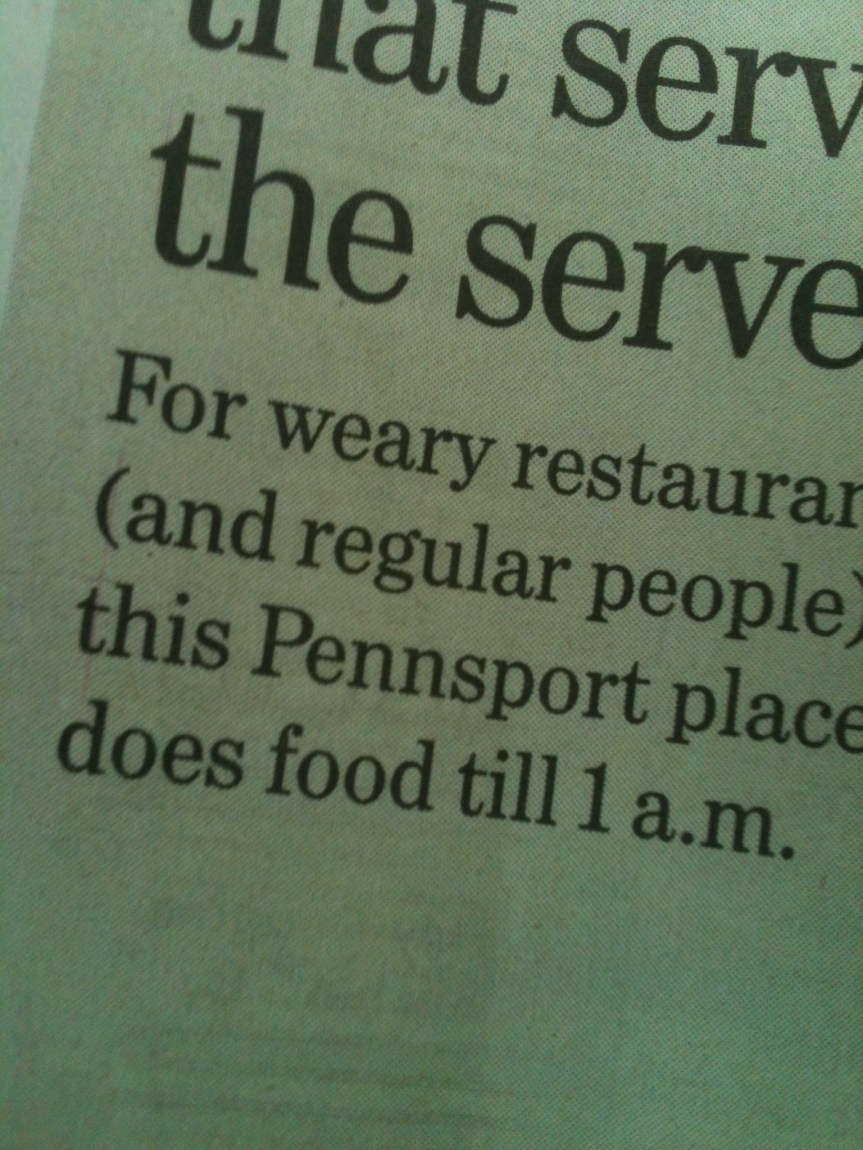
Among the no doubt hundreds of meanings of the verb to do is a particularly British one. It relates to food in general or a particular dish; the American equivalents are serve or offer. Thus an English tennis partner of mine once described a dinner part in which he “did pass-ta [the first syllable rhyming with class] and turkey.” Or one might inquire of a pub, “Do you do meals?”

I have been on the lookout for American uses of this do, with no luck until a couple of says ago, when I spotted this headline in the Philadelphia Inquirer:

So let’s see if do does America.

“Have a Quiet Word” with someone

Some time ago–never mind how long exactly–my colleague Dawn Fallik suggested I do a post on “have a quiet word with,” which, she explained, was  Britishism meaning to scream at remonstrate someone in private. I looked at her with elevated eyebrows, having never heard of such a thing. But over the months I have come to understand that it’s a solid Britishism.

I was roused into action a couple of nights ago watching Olympics soccer, when, after a miscue (British) announcer Arlo White commented, “Abby Wambach is going to have a quiet word with her about that.”

Also in the world of sport, the expression came up last year when (Australian) caddie Steve Williams apparently gave an interview that deflected too much attention from his employer, (Australian) golfer Adam Scott. The New York Times reported:

“The calmest reaction of the day belonged to the always-unruffled Scott, who laughed Tuesday when asked if he had had a  ‘quiet word’ with Williams about his televised interview and said: ”You know, having a quiet word with Steve is not very easy. He’s a big guy, you know.”

Quiet word shows up frequently in U.K. sources, way back to around the turn of the twentieth century. The other Times, the one in London, commented in 1908 that one of the duties of officers in the Metropolitan Police is to offer “a quiet word to one who suspected if complicity in some offence but who has not yet embarked in a life of crime.”

But is it a NOOB? Not quite yet. Only a couple of hits come up:

“At the funeral of Sen. Edward M. Kennedy in August 2009, Boston’s Cardinal Sean Patrick O’Malley pulled President Obama aside for a quiet word. It was a sign of things to come: the first failure of the president to understand the moral dimensions of his health-care proposal.” (Washington Post, June 30, 2012)

“[Penn State administrators had] thought about telling someone who could actually do something about evidence that [Jerry] Sandusky had raped a child in a locker-room shower, but, after Curley conveyed Paterno’s doubts, “humane” is what they told each other it would be if they had a quiet word with Sandusky instead.” (New Yorker, July 18, 2012)

Then there’s this comment on a CBS News blog, which is inadmissible because you can’t tell if the commenter is American:

Very interesting how CBS, last evening had the article headline: “Pregnant Pa. woman, baby killed by lightning” Today, the article was re-written, with a new more P.C. headline: “Pregnant Amish woman, fetus killed by lightning” The liberal editor had a quiet word with last night’s reporter.

In any case, quiet word is officially on the radar. Thanks, Dawnie.

“Knacker’s”/”Knackers”/”Knackered”/”Knacker”

I was recently e-mailed by reader Peter Hirsch as follows: “Today’s FT [The Financial Times] (arguably not a British paper except for their persistent use of the verb to ‘back foot’) carries a column by US financier Steven Rattner which uses the term ‘knacker’ without its conventional accompaniment ‘yard.”

I confessed that I wasn’t familiar with the term and he explained:

The phrase that I grew up with (I have now lived in the US for 30 years), is “knacker’s yard,” a place to which aged and worn out horses were once sent to be killed and turned into useful post-life products — lard, rope material, bone meal etc.  The knacker was the man responsible for this work and the phrase was most commonly used in sentences like “he’s only good for the knacker’s yard.”

I looked up Rattner’s article. He said that under Republican Congressman Paul Ryan’s draft budget, Medicare “would be turned over to cash-starved states, the fiscal equivalent of being sent to the knacker for execution.”

Peter’s dissing of Rattner’s command of U.K. vernacular is mostly correct, my investigations find. That is, it appears, first, that a large majority of knacker’s are followed by yard. The OED cites this poem by Thom Gunn: “The graveyard is the sea… They have all come who sought distinction hard /To this universal knacker’s yard.”

And even when there’s no yard, the preferred form is knacker’s or knackers, not Rattner’s knacker. For example, this comment to an article about protest over treatment of show horses in the Greater Dandenong Weekly. (Yes, that is what the publication is called. See for yourself–and by the way, can anyone help me out with “furphy”?) “Do not believe the furphy that they are saved from the knackers either — do we honestly think owners and trainers bleeding the last dollars from the jumpers will retire them gracefully?”

But, in any form, is this a NOOB? No, Steven Rattner stands alone.

However, another sense of the word is definitely a comer, in my opinion, as seen in this 2011 quote from the New York Times:

Last week the prophet Elijah made a personal appearance at every Passover Seder around the world, or so we are told: most people are unable actually to see him, although parents have traditionally found ways to convince their children that Elijah sipped from the wine cup left for him. Taking all that on faith, you have to think that Elijah is one knackered prophet just now…

The etymology is interesting. Knackers was once used to mean castanets, from which derived its sense as slang for testicles (pause for chortle). This was used by James Joyce in Ulysses (1922): “Eh, Harry, give him a kick in the knackers.” That meaning in turn led to verb to knacker, which originated in late nineteenth century as a synonym for castrate and not until about 1970 (according to the OED) took on its current familiar (in the U.K.) meaning, knackered=exhausted.

Knacker, as a noun, has a new meaning, most common in Ireland, undreamt of by the OED. It can be seen in this recent online comment: “sad man indeed, sitting in his sad cooncil [sic] house with his sad little life ….what a knacker.” A column in the Irish Independent explains:

Knackers, for those naive souls unfamiliar with the word, is a term of abuse for what the urban dictionary describes as an “Irish adolescent subspecies”… “originally a derogatory term of reference for Travellers but nowadays covering a whole spectrum of degenerates”. Members of the tribe can generally be found hanging around outside fast food outlets and off- licences, picking fights with random strangers. ‘Skanger’ would be another term.

That’s all for now. I’m knackered.