My friend Nanette Tobin and I are eagerly (though maybe quixotically) looking forward to the day when leaving do, meaning “going-away party” enters the American lexicon. In the meantime, we will have to content ourselves with this similar formulation, from the May 2, 2011, New Yorker:
Weddings are a big deal in Great Britain, where “hen parties” and “stag dos” often involve vomiting on the street corners of Magaluf.
In the future; “going forward.” One of several cases where the British delete the article favored by Americans, the most famous other one being in hospital. Also, the football teams Blackburn Rovers and (strangest of all, to American ears) Rangers.
Wes Davis alerted me to this passage from Charles Portis’s 1979 novel, The Dog of the South. Wes writes:
An American named Jack is helping some British soldiers load sandbags during a hurricane in Belize. When one of the Brit trucks gets stuck in the mud, Jack takes the wheel, claiming to know a special way to get a truck moving again. It doesn’t work. Here’s what comes next:
Jack said the gear ratios were too widely spaced in that truck. The young British officer, none too sure of himself before, pulled Jack bodily from the car and told him to stay away from his vehicles “in future”–rather than “in the future.”
But if the President now admitted a knowing falsehood, that admission would probably be admissible in evidence against him if in future he is prosecuted for perjury.(Anthony Lewis, New York Times, December 15, 1998)/If [Mickey] Hart should ever attempt to work with dancers again in future, he should consider consulting with [Jay] Cloidt. (The Bay Citizen, April 18, 2011)
In the UK, one disposes of unwanted stuff in the rubbish bin or merely the bin. The venerable U.S. equivalents are garbage can and trash can. In the April 18, 2011, edition of (yes) the New Yorker, one finds this in (American) Evan Osnos’s article about Chinese tourists in Europe:
He was a sanitation specialist by training, and he couldn’t help but notice Milan’s abundant graffiti and overstuffed trash bins.
In British football, and Britain in general (I infer this from the novel/film Nil By Mouth), nil is the equivalent of the Yank’s nothing. Referring to the local soccer team, the Union, Mike Jensen writes in today’s Philadelphia Inquirer:
Please don’t refer to the score of a Union game as “one-nil” or “a nil-nil draw.” England may have invented soccer, but it hasn’t won the World Cup in 4 1/2 decades and its national team coach is Italian. The rest of the world has moved on. “One-zip” is just fine, or if announcers want to go with soccer’s actual international language, try “uno-cero” or “cero-cero,” since Spain is now ground zero for the real innovation in the sport.
David Friedman will have to clarify this point, but my impression is that the most commonly heard form is this one (taken from the website of Central Michigan University Chippewas): “Despite a nil-nil draw, Stafford believes his team continued to improve.”
Is it possible that nil and other British football terms will migrate to American sport? Will supporters gathering to cheer their side as they battle on the pitch? At the end of the day, what will be will be.
There are no asterisks in the actual name of this U.K. band
You have spoken. Earlier this week, I asked for nominees for the next new NOOB, and you chose (narrowly) twee. So twee ’tis.
As for definition, I can do no better than the most popular entry at urbandictionary.com:
Something that is sweet, almost to the point of being sickeningly so. As a derogatory descriptive, it means something that is affectedly dainty or quaint, or is way too sentimental. In American English it often refers to a type of simple sweet pop music, but in British English it is used much more widely for things that are nauseatingly cute or precious. It comes from the way the word sweet sounds when said in baby talk.
“Belle and Sebastian are the Beatles of twee.”
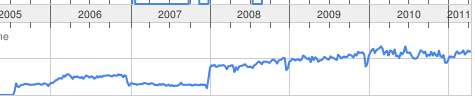
Here is a Google Trends chart showing incidence of twee in U.S. news stories. (If anyone can figure out what the vertical axis signifies, please let me know.)
The OED gives the etymology of twee as “infantile” pronunciation of sweet, dates it to 1905, and offers this definition: “Originally: ‘sweet’, dainty, chic. Now only in depreciatory use: affectedly dainty or quaint; over-nice, over-refined, precious, mawkish.”
Americans may find [choreographer Ronald] Hynd all too twee (look that one up in your Anglo-American dictionary). (Anna Kisselgoff, New York Times, April 18, 1982)/[Mari Eastman’s] paintings are pretty and a bit twee, and I never found them very interesting, until now. Culture Monster [Los Angeles Times blog], April 21. 2011)
A final set of nominees for a position, commission or award, from which the final selection is to be made. According the the Oxford English Dictionary, the now common verb form short-listed first appeared in 1961. The term is most associated with the Man Booker Prize, and appropriately so, since the prize (for best novel of the year “written by a citizen of the Commonwealth, the Republic of Ireland, or Zimbabwe”) also has a prestigious “longlist” of twelve or thirteen books, from which the short list of six is chosen. Otherwise, it’s (merely) a synonym for nominee or finalist.
Google Ngram for "short-listed" in American English from 1990 through 2008
The distinguished critic R.Z. Sheppard, for his part, is short-listed by People magazine as one of the “Most Intriguing People of 2001,” although, frankly, I can’t quite see it. (Lance Morrow, Time, December 27, 200)/A literary establishment that had never so much as short-listed one of [David Foster Wallace’s] books for a national prize now united to declare him a lost national treasure. (Jonathan Franzen, The New Yorker, April 18, 2011)
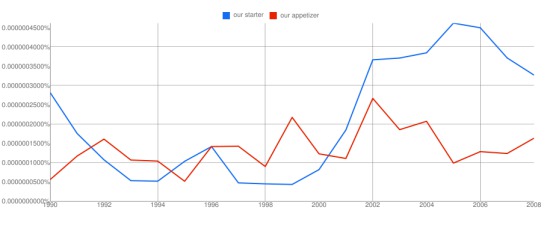
Google Ngram showing frequency of use of "our starter" (blue line) and "our appetizer" (red line) in American English between 1990 and 2008.
Several salads on the menu proved to be better appetite arousers than some of our starter choices. (New York Times, July 14, 1991. Note interesting use of the word arouser.)/While there’s a slew of appetizers and salads to try as starters, the small plates make for a nice way to try and share more dishes. (TheDay.com [New London, CT], April 21, 2011)
My friend Bruce Beans sent me a fun feature from the folks at Merriam-Webster Online–click on the above photo to link to it. They say, “Although Merriam-Webster is a dictionary of American English, it contains a range of words rarely heard outside Britain. Here are some of our favourites.” (Note the ou spelling of favourite in the text, but the Americanized favorite in the heading.)
I am on record as not totally agreeing with their statement, since I have already featured plonk as having entered the American lexicon. Of the other nine on the list, I can see some that have already established a foothold here, and a couple of others that may do in the future. What do you lot think?
The New Yorker is a veritable fount of Britishisms. I have already written about the magazine’s propensity for the participial had got (instead of gotten), which, if anything, has got more pronounced over the years. I still remember the thrill of seeing–in a 2003 Janet Malcolm piece about Gertrude Stein–a sentence that began, “She and Toklas were about to move house from Bilignin to a manor in Culoz, a few miles away…”: move house being a Britishism (equivalent to Americans’ move) I had not seen before that and have not encountered since.
Alas, Eustace Tilley has slipped. In an April 11, 2011, profile of Wall Street Journal editor Robert Thomson, Ken Auletta refers to a Journal piece about Goldman Sachs “which was intended to be a twenty-five-hundred-word front-page leader.” I am fairly confident it was intended to be nothing of the sort. What James Brander Mathews wrote in his book Americanisms & Briticisms in 1892 still holds today: “An American‥calls that an ‘editorial’ which the Englishman calls a ‘leader’.” It is derived from the older term leading article, which is still in currency in the U.K. The Goldman Sachs piece was surely not an editorial–that is, an unsigned expression of the newspaper or magazine’s collective opinion–but what Americans would call a lead article: the featured report on the front page.


 My friend Nanette Tobin and I are eagerly (though maybe quixotically) looking forward to the day when leaving do, meaning “going-away party” enters the American lexicon. In the meantime, we will have to content ourselves with this similar formulation, from the May 2, 2011, New Yorker:
 In the UK, one disposes of unwanted stuff in the rubbish bin or merely the bin. The venerable U.S. equivalents are garbage can and trash can. In the April 18, 2011, edition of (yes) the New Yorker, one finds this in (American) Evan Osnos’s

 A final set of nominees for a position, commission or award, from which the final selection is to be made. According the the Oxford English Dictionary, the now common verb form short-listed first appeared in 1961. The term is most associated with the