

This caught my eye in the New York Times the other day:
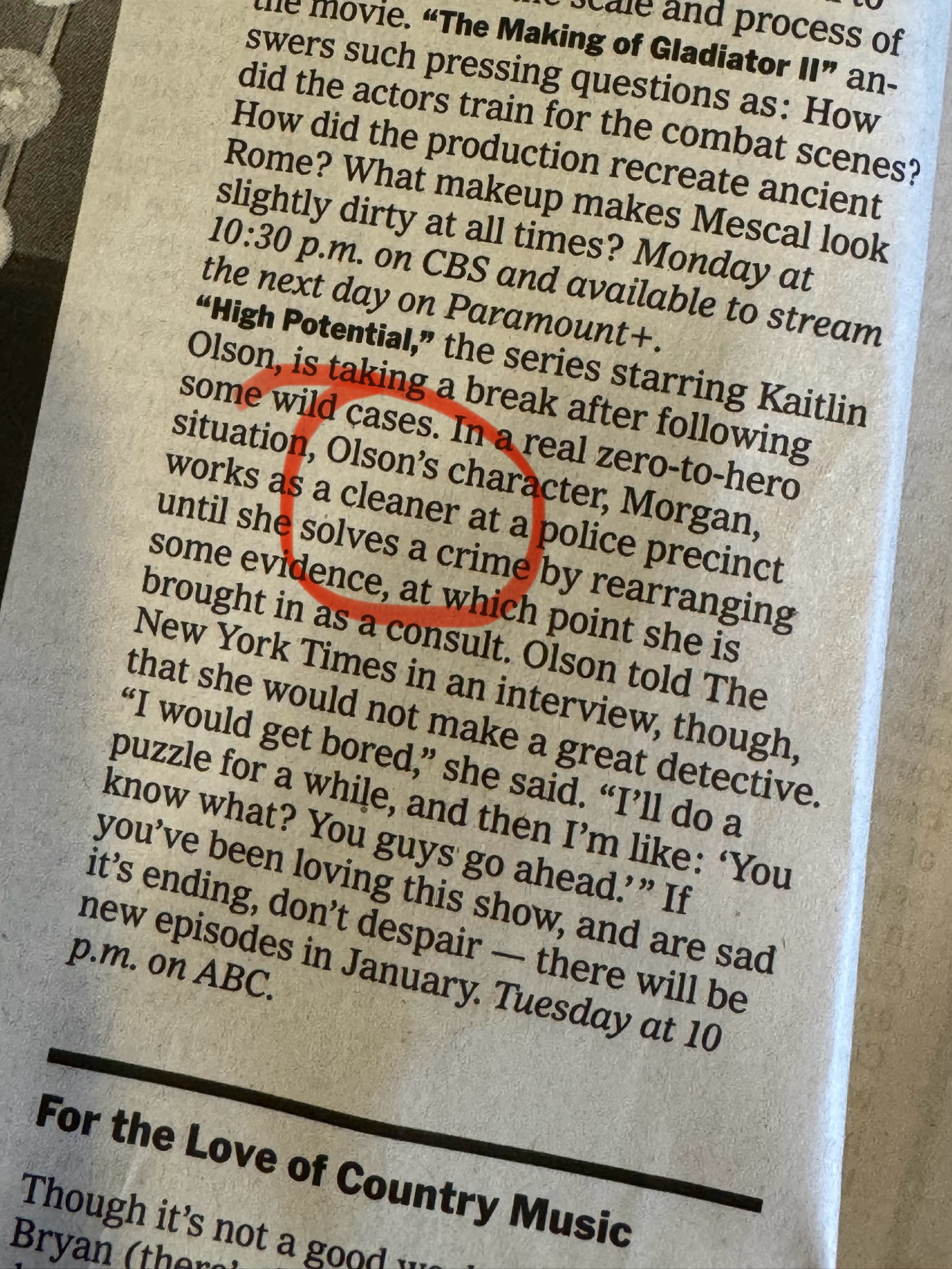
That word, “cleaner,” wasn’t familiar–I imagined it meant what Americans would call a cleaning lady, a cleaning person, a custodian, a janitor, basically, something that sounded a bit fancier than what the job really is. “Cleaner” felt British to me, along the lines of “carer,” also not found in the U.S. (We would say “companion,” “care-giver,” or, wordiest yet, “home health aide.”)
I asked Lynne Murphy about it and she confirmed that “cleaner” is widely used in the U.K.–as did the OED, with citations as early as 1816. (“A tribe of cleaners, keepers, and porters.’)
Lynne mentioned a British sitcom called “The Cleaner,” about a someone who tidies up crime scenes, but that’s a special case, similar to (but on the other side of the law from) Harvey Keitel’s character in Pulp Fiction, who as I recall was also referred to as a cleaner.
Incidentally, the IMDB description also calls the “High Potential” character a cleaner, but on Wikipedia she’s a “cleaning woman.”
I’ve seen one other U.S. use of the word, making it barely not a one-off. It was in a TV commercial for a company called Homeaglow, which advertised that for an absurdly low price, it would send a “cleaner” to my home.
I’ve got my ears open for more, but I’m not optimistic, as “cleaner” may be just too straightforward and plain to catch on in America.
 notoneoffbritishisms.com
Good afternoon, Ben!
Your last line caught my interest: “’cleaner’ may be just too straightforward and plain to catch on in America.’
I remember the very first time I saw a reference to the “Trades Union Council” in the UK as being equivalent to the “American Federation of Labor / Congress of Industrial Organizations” here in the USA. Seemed like the British way of saying it was much more, as you say, “straightforward.”
Best regards!
Tim Orr
Trades Union Congress, not Council.
Oops! Sorry! Look at me going all “non-U”!
I’m Canadian and we use cleaner and a lot Britishisms, so much of what interests Americans are not foreign to us. As well I have lived in both the U.S. and in the U.K. some time and own several books on the differences in words, phrases, and certainly spelling. Thus my interest in your site and your new book Gobsmacked.
Gail B , St. Catharine ON
Hmm. This is an interesting one. It’s almost unusual that Americans have not adopted “cleaner” as the name for that job, given the evolution to “chair” and “fisher” and “firefighter,” among others. It was always “cleaning woman” in American, but never “cleaning man,” possibly because men were usually given the catch-all “janitor” title and men were rarely domestic cleaning people.
David, I think “cleaning person” is pretty common in the U.S.
Yes, you’re right. “Cleaner” is, well, cleaner, but cleaning person is common.
What I find interesting in that article is “brought in as a consult”. To me, that should be consultant or to consult.
A slight tangent, but on the nominalisation of verbs theme, several times over the past few months I’ve seen American friends on social media use “understand” as a noun where you’d normally expect to see “understanding”, e.g. “My understand is that…”. I find this quite bizarre.
I find this quite incorrect.
I haven’t heard that yet, but it follows the insane use of “ask” as a noun, which is now pretty standard in American. I ban it from any workplace where I have to approve written product.
I’ve seen and heard younger Brits do that more than a dozen times, Rob; yes it’s bizarre.
I imagine it originates mainly from texting (twitter, etc.), though simplification must also appeal to speakers of English as a second language. Perhaps it’s part of a ‘Globish’.
I sometimes use cleaner and carer because they’re concise and more dignified. I did have a problem when I put “cleaner“ into my calendar and later couldn’t remember whether it referred to house cleaners or dry cleaners.
I believe making”Ask” a noun is an Australian invention. The usual usage is instead of another word that is both a verb and noun, “Favour.” The typical usage is “I know it’s a bit of an ask, but could you …”. I days of old it would have been “I know its a bit of a favour, but could you…”
THE OED confirms Australian origin, mostly in sport, with these early citations:
1975
I mean, Gulcher, I’m a top earn… A big ask, though. They wanted a grand.
Bulletin (Sydney) 26 April 44/2
1987
Four measly pounds is what the critics say. But according to his trainer..that four pounds is ‘a big ask’.
Sydney Morning Herald 7 May 40/2
I was just reading an article about a decision of a Judge in A Connecticut in relation to a case about Elone Musk’s pay deal with Tesla. Apparently, lawyers for the plaintiffs asked for fees of $5 Billion. The judge said:
“In a case about excessive compensation, that was a bold ask.”
It looks like this Australianism is catching on in the US.
Ben, do Americans exclusively say ‘knock on wood’ or is (the British) ‘touch wood’ also used? Just an idea for a Noob.
Prompted by a reference I just saw to Robert Graves in WW1, with two other officers commenting that none had been killed for months. The three of them looked around for wood to touch but were in an unrevetted trench. Graves gripped a pencil in his pocket. The other two were dead within 24 hours.
Which in turn prompts: I once played backgammon in the Hackney house of Rupert Graves, the actor. He wasn’t there. Nor is he a relation of Robert Graves, to the best of my knowledge.
Which in turn prompts: playing chess with Dave, the grandson of Ben Nicholson, the painter, in Hackney and Rome.
Which in turn prompts: fussing the Bedlington Terrier of Craigie Aitchison, the painter, in the park outside Dave Nicholson’s house. Craigie wasn’t there. Dave’s family favoured Manchester Terriers, incidentally.
None of this thought-association is name-dropping, you understand, as I met none of those artists. I’ll save my name-dropping for another time.
https://artuk.org/discover/stories/the-intensely-poetic-paintings-of-craigie-aitchison
I love it, David. In answer to your first question, in my experience, Americans never say “touch wood,” so it doesn’t yet qualify as a NOOB.
Yes, as a dog lover I find ‘Wayney Going to Heaven’ particularly moving (we’ve owned several Bedlingtons, the only breed I know of that smells pleasant).
https://artuk.org/discover/curations/the-scottish-colourists-13116/template/showcase/slide-page/17
I like colour more and more; as my eyesight gets worse, probably. Shades of Monet.
https://www.widewalls.ch/magazine/japonisme
https://alma-tadema.org
In Luc Besson’s film Leon the Professional the main character Leon, who is a professional hitman describes himself as a ‘cleaner’.
In Besson’s French language film La femme Nikita Victor the ‘cleaner’ arrives to sanitise a crime scene. On arrival the actor Jean Reno identifies himself with the memorable words ‘Victor, nettoyeur’ .
Both roles were played by Jean Reno.
In respect of the “nouning” of “ask”, it didn’t come from texting or Twitter. It’s been used in Canadian government circles for at least 35 years, originally in the context of what the “p/t s” (provinces/territories) were asking the federal government for in terms of financial support under any one of a myriad of programmes; s in, “Ontario’s ask would basically leave the programme bare for any small populationjurisdiction.” It may well have been used that long in other nation’s governments as well and I have no idea where it originated.